
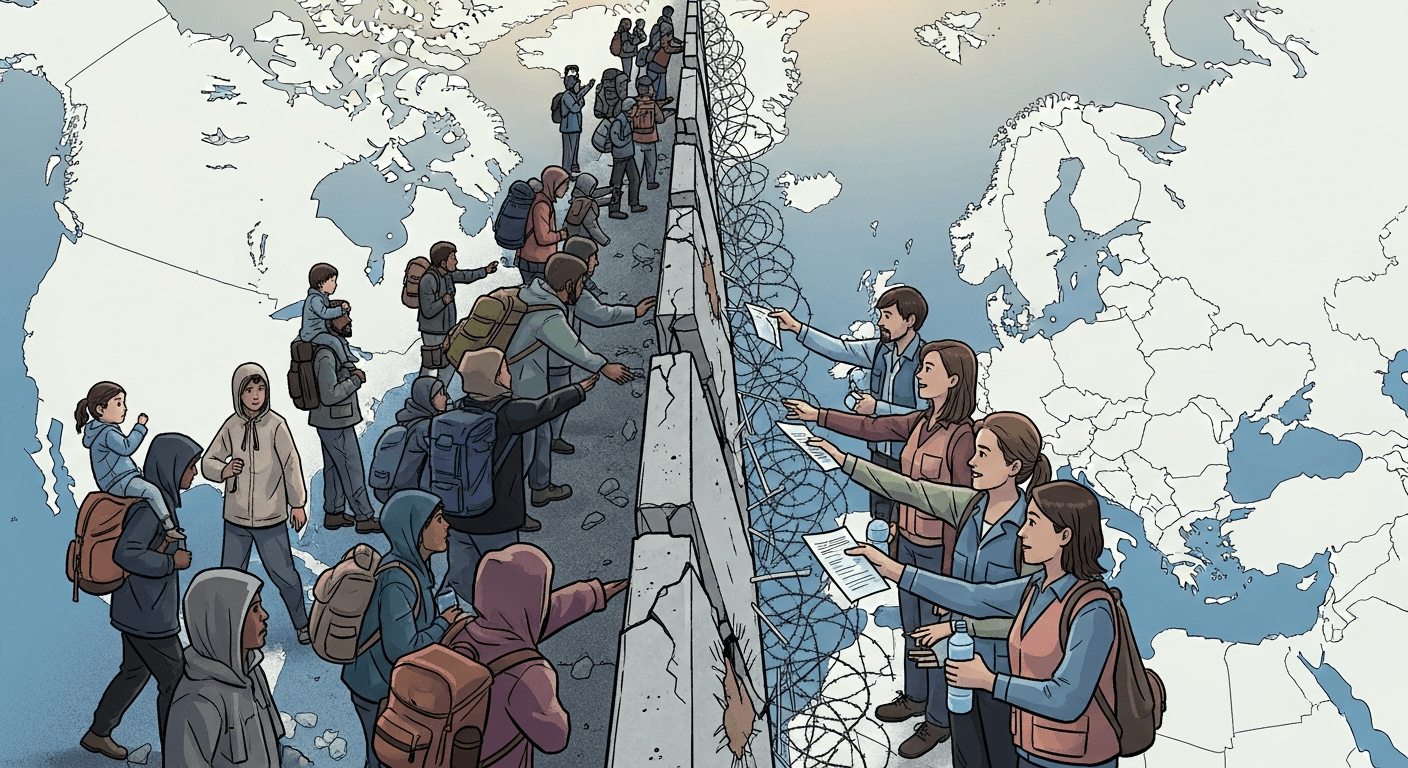
Context: Munich, Migration, and a Provocative Line
I watched the recent panel at the Munich Security Conference with close attention. A senior, well-known former U.S. secretary of state surprised parts of the audience by saying that migration "went too far," calling recent flows "disruptive and destabilizing" and urging that the problem be "fixed in a humane way with secure borders." The comments were widely reported, including in The Tribune and other outlets, and they reopened a debate that is now central to politics across Europe and North America (Tribune report, summary coverage available elsewhere).
I want to unpack what that short, sharp formulation means in practice, why it landed the way it did, and how we can turn alarm into policy rather than rhetoric.
What did she mean by "migration went too far"?
From the context of the panel, the phrase did not call for a return to closed societies or cruelty. It was a diagnosis: large, uncontrolled movements of people — whether from conflict, climate stress, or economic desperation — have outpaced many institutions' capacity to absorb them. That creates pressure on services, strains social cohesion where integration is weak, feeds political polarisation, and becomes fuel for populist movements that offer simple but often inhumane fixes.
Put simply: the claim is about scale and strain, not about denying the rights of refugees or dismantling legal pathways. And the prescription offered alongside the diagnosis—"fix it in a humane way with secure borders"—points to two simultaneous goals that are often seen as opposing: humane treatment and effective control.
Arguments and implications to consider
- Practical reality: Reception, housing, education, and health systems can be overwhelmed when arrivals spike unexpectedly. That produces real short-term problems, particularly at local levels.
- Political reality: Perceived policy failure on migration drives voters toward hardline parties and rhetoric that can erode democratic norms.
- Moral reality: Responses that prioritise deterrence alone risk grave human-rights violations and long-term damage to social trust.
The implication is that responsible governments must avoid both extremes—neither open, unmanaged borders nor policies that criminalise or brutalise people seeking safety.
Humane policy solutions I believe deserve center stage
- Invest in legal, predictable pathways: scaled refugee resettlement quotas, expanded family reunification channels, and work-permit programs tied to labor shortages. Predictability reduces irregular travel and smuggling.
- Rapid reception and triage capacity: increase short-term shelter, medical screening, and mental-health services so that arrivals are stabilised quickly and safely.
- Alternatives to detention: community-based case management, electronic monitoring only when strictly necessary, and legal aid to speed fair decisions.
- Targeted labour and training programs: connect newcomers to local labour markets while funding employers and municipalities to avoid local backlash.
These are humane because they preserve dignity and human rights, and practical because they reduce irregular arrivals over time.
International cooperation and border management
Migration is transnational; no single state can solve it alone. Effective responses require:
- Burden-sharing agreements across regions to distribute asylum processing and resettlement fairly.
- Common standards for reception, returns, and family reunification to prevent competitive pull-factors.
- Joint anti-smuggling operations that respect international law and dismantle criminal networks.
At border points, security and humanity are not mutually exclusive: trained border officers, independent monitoring, and clear referral mechanisms for protection needs can protect sovereignty while preventing abuse.
Refugee protection and integration strategies
Short-term protection must be paired with medium- and long-term integration: language training, recognition of qualifications, local housing strategies, and access to education. Successful integration reduces costs over time and builds social cohesion; it is an investment, not an indulgence.
Political reactions and the risk of simplification
The reaction to the conference line shows how quickly nuance gets flattened. Some commentators read it as a hard-right pivot; others saw overdue realism. The danger is twofold: politicians may weaponise the phrase to push cruel policies, or progressives may reflexively dismiss concerns about scale and local stress. Both are errors. Honest problem-framing should invite policy innovation, not partisan scoring.
Conclusion
Saying migration "went too far" is a provocation worth debating if it leads to constructive policy. The true test is whether leaders pair that diagnosis with concrete, humane, and cooperative solutions rather than with scapegoating or simple slogans. I hope we steer toward approaches that protect people on the move, strengthen communities receiving them, and preserve the rule of law — simultaneously.
Regards,
Hemen Parekh
Any questions / doubts / clarifications regarding this blog? Just ask (by typing or talking) my Virtual Avatar on the website embedded below. Then "Share" that to your friend on WhatsApp.
Get correct answer to any question asked by Shri Amitabh Bachchan on Kaun Banega Crorepati, faster than any contestant
Hello Candidates :
- For UPSC – IAS – IPS – IFS etc., exams, you must prepare to answer, essay type questions which test your General Knowledge / Sensitivity of current events
- If you have read this blog carefully , you should be able to answer the following question:
- Need help ? No problem . Following are two AI AGENTS where we have PRE-LOADED this question in their respective Question Boxes . All that you have to do is just click SUBMIT
- www.HemenParekh.ai { a SLM , powered by my own Digital Content of more than 50,000 + documents, written by me over past 60 years of my professional career }
- www.IndiaAGI.ai { a consortium of 3 LLMs which debate and deliver a CONSENSUS answer – and each gives its own answer as well ! }
- It is up to you to decide which answer is more comprehensive / nuanced ( For sheer amazement, click both SUBMIT buttons quickly, one after another ) Then share any answer with yourself / your friends ( using WhatsApp / Email ). Nothing stops you from submitting ( just copy / paste from your resource ), all those questions from last year’s UPSC exam paper as well !
- May be there are other online resources which too provide you answers to UPSC “ General Knowledge “ questions but only I provide you in 26 languages !




No comments:
Post a Comment