
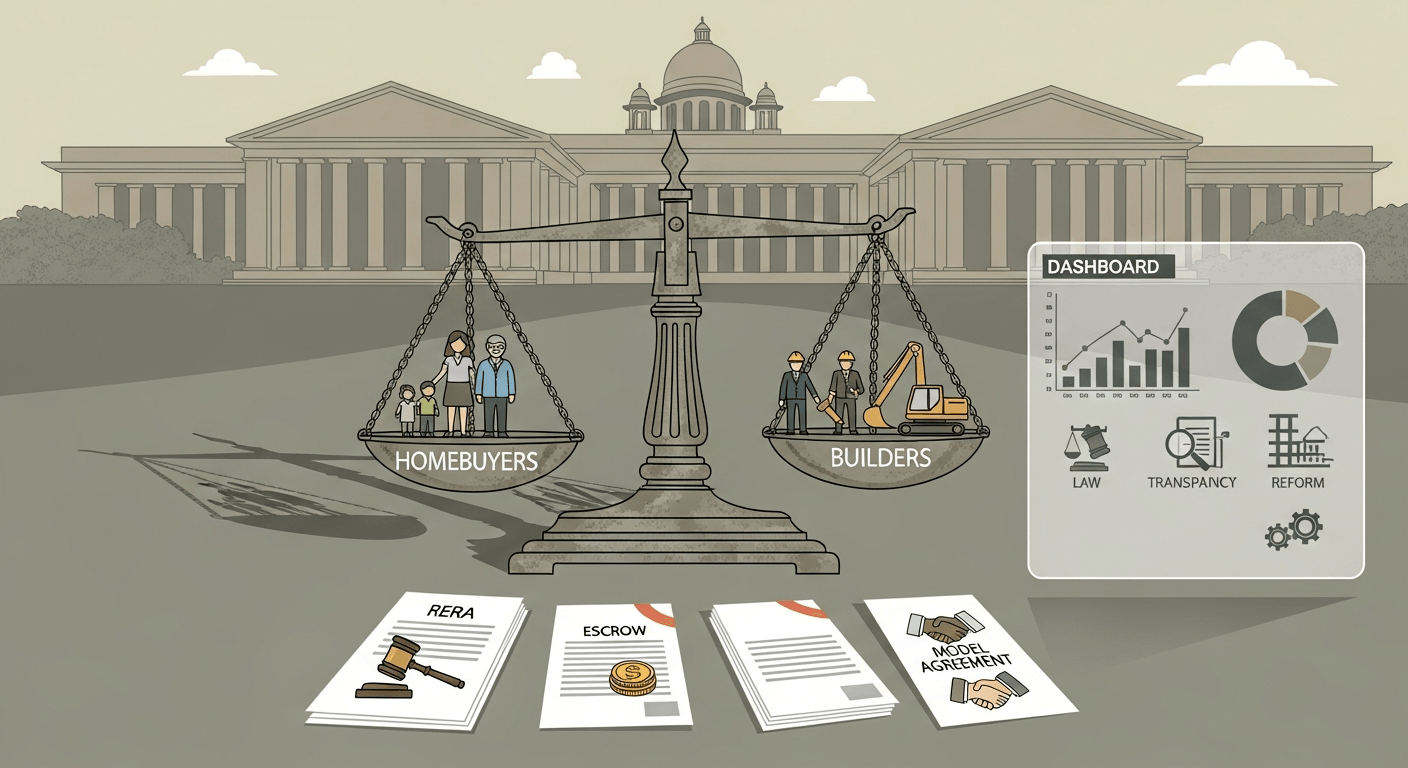
The Supreme Court’s recent, sharp observation that the Real Estate Regulatory Authority (RERA) “should be abolished if it helps only builders” has reopened a long‑running debate about whether India’s flagship consumer protection law for housing is failing those it was meant to protect.[^1]
In this post I unpack that observation, put it in context, and offer practical reform ideas that keep homebuyers—rather than procedural inertia or captured institutions—at the centre.
The Supreme Court observation — what happened
A bench of the Supreme Court, while hearing a petition about shifting a state RERA office, expressed deep frustration about how many real‑world RERA bodies operate. The court said these authorities sometimes appear to serve builders in default rather than provide timely relief to aggrieved homebuyers; the remark that abolition should be considered was an emphatic prompt for states and policymakers to reflect on RERA’s purpose and performance.[^1]
I cite the reporting of the hearing and the court’s remarks here for readers who want the original coverage: Economic Times and Hindustan Times both carried full reports of the court’s comments.[^1][^2]
RERA — a quick background
The Real Estate (Regulation and Development) Act, 2016 was enacted to:
- bring transparency to project registration and sales;
- mandate escrow rules and progress reporting so funds aren’t diverted;
- give homebuyers an accessible statutory forum for complaints and timely adjudication.
In many states, RERA did improve disclosure—project registration portals, mandated disclosures of approvals and project timelines, and penalties for non‑compliance were important steps. But implementation has been uneven across states and over time.
Why the court’s concern matters for homebuyers
The court’s frustration reflects several recurring problems I’ve seen and written about previously: delays in case disposal, poor enforcement of orders, inadequate monitoring of escrow compliance, and opacity over mortgages/encumbrances on projects. These weaknesses leave buyers in long limbo when projects stall or developers default.[^3]
For a typical homebuyer, poorly functioning RERAs mean:
- long delays to get redress or refunds;
- continuing liability (EMIs, interest) without possession;
- uncertainty about whether funds paid are actually held for the project.
When institutions designed to protect consumers gradually lose credibility, public trust and private investment both suffer.
Implications for builders and the market
Not all builders benefit from weak enforcement. Reputable developers rely on predictable rules and timely dispute resolution. But when enforcement is lax or appeals procedure is slow, dishonest or financially stressed promoters can game the system—delaying completion while litigation drags on.
Abolishing RERA in the abstract would not automatically fix these market failures. Removing statutory consumer protection without immediate, credible alternatives would likely worsen outcomes for honest buyers and builders alike.
Legal and policy considerations
Before anyone contemplates abolishing RERA, policymakers must weigh:
- Rule of law: RERA is statute—abolition requires legislation and a clear transitional framework for pending disputes.
- Enforcement capacity: Many failings are not in the law’s text but in enforcement, staffing, technical systems, and political will.
- Access to justice: RERA offers a specialised mechanism; repealing it without an effective replacement risks channeling disputes back to overburdened courts.
The Supreme Court’s remarks are a wake‑up call: either strengthen RERA’s teeth and independence, or redesign dispute resolution so buyers get faster remedies.
Alternatives and constructive reforms I support
I have long argued for practical fixes that keep the original consumer protection goals intact while fixing predictable implementation weaknesses.[^3] Concrete reforms include:
- Uniform, enforceable model agreements: make standard clauses (liquidated damages, escrow rules, bank guarantees) mandatory at registration.
- Stronger enforcement: time‑bound disposal of complaints, audited escrow compliance, and automatic triggers that protect buyer funds when projects slip.
- Improved transparency: mandatory, machine‑readable publication of mortgages/encumbrances (CERSAI integration) and real‑time project status on a unified portal.
- Professionalised leadership: recruit specialists (project managers, architects, forensic accountants) rather than relying mainly on retired administrators.
- Fast interim relief: statutory fast‑track orders (refunds/possession compensation) while substantive adjudication continues.
- Independent audit and public performance metrics: publish RERA timelines, case‑disposal rates, and outcomes by state.
These are practical, legislatively achievable reforms that reduce the chance RERA becomes a mere rehabilitation post for retired officials and a refuge for defaulting promoters.
Conclusion — abolition is a blunt instrument
The Supreme Court’s criticism is both justified and salutary: institutions that fail their core purpose should be reformed or, in extreme cases, wound down. But abolition is a blunt instrument. I prefer targeted, credible reform that restores RERA’s consumer protection promise.
If states and the Centre act decisively—standard contracts, better enforcement, technical leadership, and transparent data—RERA can still deliver on its promise of protecting homebuyers while keeping the real estate market functional for honest builders.
I’ve written on many of these practical ideas in earlier posts advocating transparency, escrow discipline, and model agreements—ideas that remain relevant today.[^3]
Regards,
Hemen Parekh
Any questions / doubts / clarifications regarding this blog? Just ask (by typing or talking) my Virtual Avatar on the website embedded below. Then "Share" that to your friend on WhatsApp.
[^1]: "RERA should be abolished if it helps only builders, says Supreme Court," Economic Times. https://economictimes.com/small-biz/legal/rera-should-be-abolished-if-it-helps-only-builders-says-supreme-court/articleshow/128260236.cms
[^2]: "Supreme Court says it's 'better to abolish' RERA as it benefits only defaulting builders," Hindustan Times. https://www.hindustantimes.com/real-estate/supreme-court-says-its-better-to-abolish-rera-as-it-benefits-only-defaulting-builders-101770892389348.html
[^3]: My earlier posts on RERA, transparency and self‑certification proposals (examples): https://myblogepage.blogspot.com/2021/11/fw-shri-hardeep-singh-puriji-request.html and https://myblogepage.blogspot.com/2015/11/self-certification-for-builders.html
Get correct answer to any question asked by Shri Amitabh Bachchan on Kaun Banega Crorepati, faster than any contestant
Hello Candidates :
- For UPSC – IAS – IPS – IFS etc., exams, you must prepare to answer, essay type questions which test your General Knowledge / Sensitivity of current events
- If you have read this blog carefully , you should be able to answer the following question:
- Need help ? No problem . Following are two AI AGENTS where we have PRE-LOADED this question in their respective Question Boxes . All that you have to do is just click SUBMIT
- www.HemenParekh.ai { a SLM , powered by my own Digital Content of more than 50,000 + documents, written by me over past 60 years of my professional career }
- www.IndiaAGI.ai { a consortium of 3 LLMs which debate and deliver a CONSENSUS answer – and each gives its own answer as well ! }
- It is up to you to decide which answer is more comprehensive / nuanced ( For sheer amazement, click both SUBMIT buttons quickly, one after another ) Then share any answer with yourself / your friends ( using WhatsApp / Email ). Nothing stops you from submitting ( just copy / paste from your resource ), all those questions from last year’s UPSC exam paper as well !
- May be there are other online resources which too provide you answers to UPSC “ General Knowledge “ questions but only I provide you in 26 languages !




No comments:
Post a Comment