
Why I’m writing about this
Over the last few weeks I’ve watched — as a citizen and as someone who studies how symbols shape public life — a debate revive around Vande Mataram. The government’s recent guidance for commemorations and school programmes has been read in different ways: as a cultural celebration by some, as a policy push by others, and as a legal and constitutional question by many. I want to explain, plainly and neutrally, what the new central guidance says, the legal and historical background, the range of reactions, and what this means for schools and government bodies on the ground.
What the Centre’s guidance and national bodies are asking for
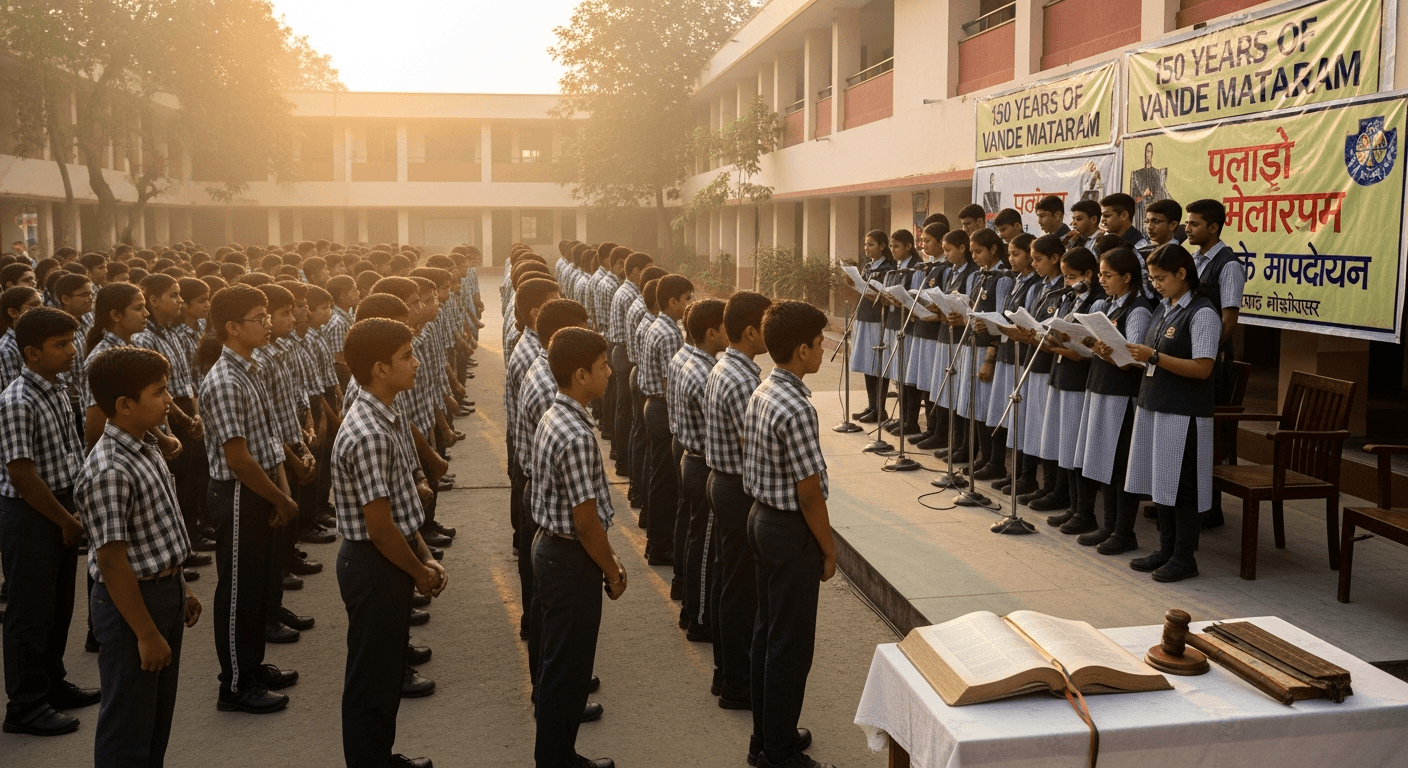
The Central Board of Secondary Education (CBSE) issued a circular asking affiliated schools to take part in a year-long programme marking 150 years of the national song, including a request for mass singing and “Vande Mataram Concerts” on designated dates and phase-wise activities through the year [CBSE circular].[https://cbseacademic.nic.in/webmaterial/Circulars/2025/85Circular_2025.pdf]
Several central and state-level education and cultural offices have asked schools and higher-education institutions to organize events where the full composition (the complete verses as found in the original publication) may be rendered as part of commemorative activities. Some state orders — issued for a limited week or week-long campaigns — explicitly asked schools to sing the complete text during that period (for example, a state circular asking schools to render the full song during the 150-year commemorative week).[https://www.indiatoday.in/education-today/news/story/maharashtra-schools-asked-to-sing-full-version-of-vande-mataram-from-oct-31-to-nov-7-2810653-2025-10-30]
National cultural events organised by the Ministry of Culture and university authorities have included the full hymn in official programmes to mark the anniversary; central agencies have framed these as commemorative, not as a change to permanent statutory rules.
Historical and legal background (short primer)
Origin: Vande Mataram was written in the late 19th century and published within the novel Anandamath. The poem as published later includes multiple stanzas; traditionally only the opening stanzas became widely used in public gatherings.[https://en.wikipedia.org/wiki/Vande_matram]
Status: The Constituent Assembly in 1950 accorded Vande Mataram the status of the national song and said it should be honoured alongside the national anthem. That same historical record explains why, from the 1930s onward, public practice focused on the opening stanzas to avoid language that later stanzas deploy (religious or goddess imagery) which some communities found exclusionary.[https://en.wikipedia.org/wiki/Vande_matram]
Legal precedent on compulsion: The Supreme Court has ruled that citizens cannot be compelled to sing a national song or anthem where doing so conflicts with conscientious religious beliefs — while respectful silence or standing is accepted as due respect. The leading case is the 1986 judgment often cited in debates about compulsion and religious freedom.[Bijoe Emmanuel v. State of Kerala].[https://globalfreedomofexpression.columbia.edu/wp-content/uploads/2015/12/Emmanuel-v.-State-of-Kerala.pdf]
Administrative vs statutory power: Many central circulars and departmental instructions invite participation, set commemorative timelines and request documentation. But circulars rarely create new criminal or statutory obligations; courts examine whether any compulsion flows from such instructions before finding a violation of fundamental rights.
What the guidance actually requires (practical reading)
Framing: The central guidance circulated to schools and institutions frames the activities as commemorative (year-long programmes, concerts, exhibitions, uploads of performances), and asks for mass singing and documentation on the campaign portals.
Scope: For most central documents the ask is to participate in the commemorative programme; select state orders for short windows have asked schools to sing the full composition during that period. There is not, as yet, a consolidated central statute that permanently makes singing the full original composition compulsory in all daily assemblies nationwide.
Exemptions: Most instructions and the legal landscape leave room for accommodations based on conscience or religious belief; courts have historically protected sincere religious objections so long as participants show respectful conduct (for example, standing respectfully) rather than disruption.
Reactions: politics, educators, minority groups, legal experts
Political parties have used the issue to press narratives about cultural heritage and past decisions: some have welcomed the revival of the full text as restorative of historical completeness; others have argued the selective earlier practice preserved inclusivity.
Educationists and school administrators have expressed mixed practical concerns: time in assemblies, preparing accurate musical notation and translations for multilingual schools, and managing students whose families or faiths have objections.
Minority and religious organizations have reminded authorities of constitutional protections for freedom of conscience and the Bijoe Emmanuel precedent; several groups have called for sensitivity and voluntary participation for students and staff.[https://jamiat.org.in/newsapp/jamiatpressreleasedetail/274]
Legal experts note that administrative circulars can encourage practice but cannot override fundamental rights; any attempt to criminalize non-participation would face constitutional scrutiny. Courts will continue to assess whether instructions create coercive consequences or unlawful penalties.
Possible implications for schools and government bodies
Practical burdens: preparing translations, rehearsals, audio-visual materials, and safe documentation systems for uploads.
Record-keeping demands: many circulars request photographic/video records — schools need clear consent systems for student recordings.
Accommodation policies: schools will have to adopt written policies explaining options for students/staff who decline to sing on grounds of conscience, while ensuring the event proceeds respectfully for others.
Practical tips for implementation (for principals and administrators)
- Communicate early with parents: share the event calendar, lyrics/translations and the voluntary accommodation policy.
- Provide alternate respectful options: standing quietly, observing, or participating in non-singing roles (flag, reading, exhibitions). Document accommodations transparently.
- Use accurate sources for lyrics and musical notation; avoid ad-hoc translations without review.
- Treat the commemorative window as educational: pair any singing with history lessons so children understand context and sensitivity.
Balanced conclusion
The recent central and state-level guidance marks a national commemoration that asks institutions to remember a historic song in its fuller form for a defined period. The documents I’ve read frame the activities as commemorative and educational, not as a permanent new criminal obligation. Still, the legal and constitutional landscape requires that administrators respect genuine religious and conscience objections. That means one practical, constitutional synthesis: governments can encourage collective remembrance and request broad participation, but they cannot constitutionally compel individuals to act against sincerely held religious beliefs. The conversation we are having now — about history, inclusivity and the boundaries of state encouragement — is healthy only if it remains respectful of both memory and rights.
Regards,
Hemen Parekh
Any questions / doubts / clarifications regarding this blog? Just ask (by typing or talking) my Virtual Avatar on the website embedded below. Then "Share" that to your friend on WhatsApp.
Get correct answer to any question asked by Shri Amitabh Bachchan on Kaun Banega Crorepati, faster than any contestant
Hello Candidates :
- For UPSC – IAS – IPS – IFS etc., exams, you must prepare to answer, essay type questions which test your General Knowledge / Sensitivity of current events
- If you have read this blog carefully , you should be able to answer the following question:
- Need help ? No problem . Following are two AI AGENTS where we have PRE-LOADED this question in their respective Question Boxes . All that you have to do is just click SUBMIT
- www.HemenParekh.ai { a SLM , powered by my own Digital Content of more than 50,000 + documents, written by me over past 60 years of my professional career }
- www.IndiaAGI.ai { a consortium of 3 LLMs which debate and deliver a CONSENSUS answer – and each gives its own answer as well ! }
- It is up to you to decide which answer is more comprehensive / nuanced ( For sheer amazement, click both SUBMIT buttons quickly, one after another ) Then share any answer with yourself / your friends ( using WhatsApp / Email ). Nothing stops you from submitting ( just copy / paste from your resource ), all those questions from last year’s UPSC exam paper as well !
- May be there are other online resources which too provide you answers to UPSC “ General Knowledge “ questions but only I provide you in 26 languages !



No comments:
Post a Comment