
Introduction
I’ve always loved maps that surprise you — places that don’t seem to fit the simple rules printed in textbooks. Bermuda is one of those surprises: a group of pink sand islands and coral reefs sitting alone in the western Atlantic, hundreds of miles from any active plate boundary. On paper it looks like it “shouldn’t” be there. In this post I want to walk you through why Bermuda exists, what the rocks and cores tell us, why it looks anomalous, and how science separates solid evidence from mystery-mongering.
How I like to think about it
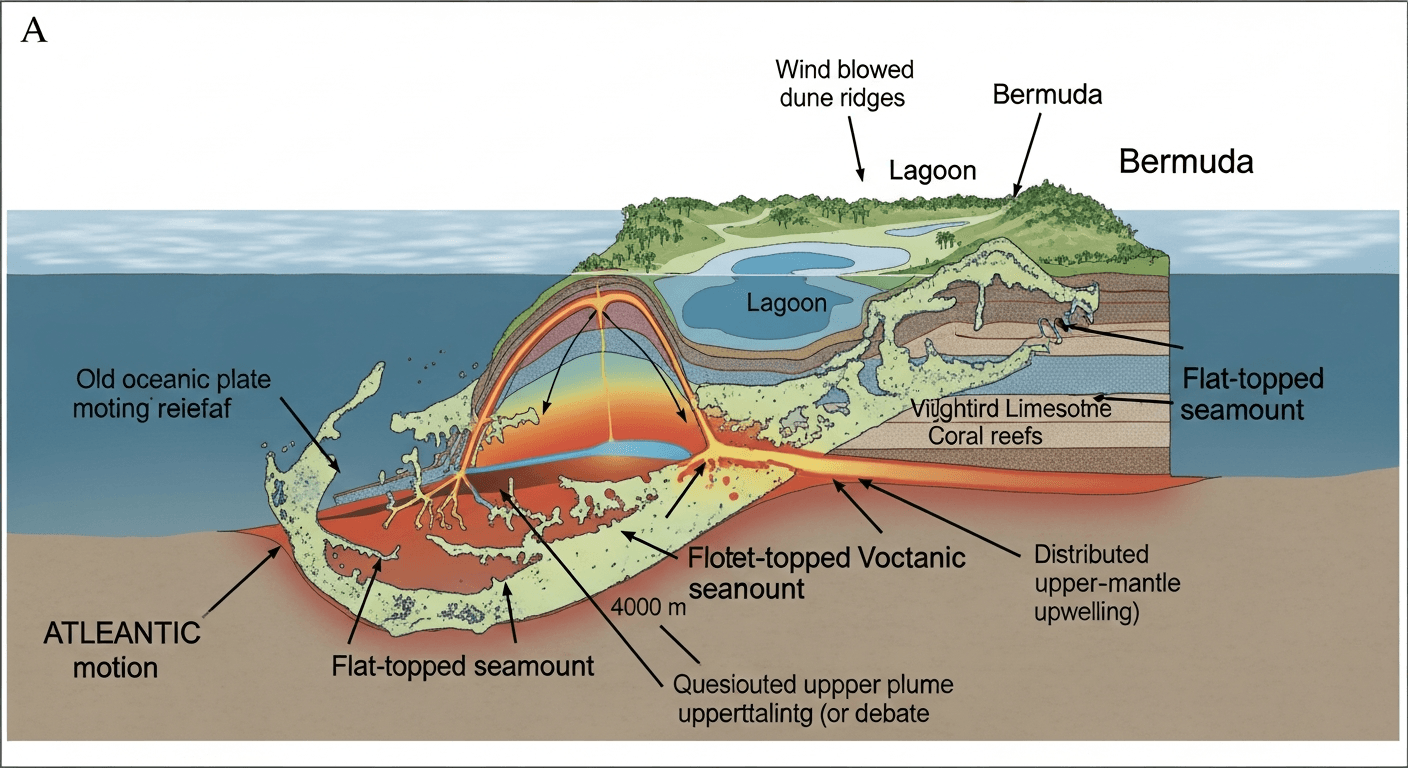
When I try to explain Bermuda to a friend I use a simple image: imagine a forgotten, flat-topped volcanic island that became a nursery for corals and then a wind-blown sand-dune island. The volcanic roots are mostly hidden beneath a blanket of limestone, but careful geological detective work — cores, radiometric dates, seismic profiles — has revealed the real story.
Bermuda’s basic geology and age
- Basement (volcanic) rocks: Bermuda sits on a drowned volcanic seamount (the Bermuda Pedestal). Deep drilling and radiometric dating show igneous activity mostly in the Eocene–Oligocene time window; some intrusive sheets date to about ~33 Ma, while other volcanic deposits point to activity in the mid-to-late Eocene as well [Vogt & Jung; NOAA].
- Oceanic crust age: The ocean floor beneath Bermuda is old — roughly 120–125 million years — formed at the Mid-Atlantic Ridge long before the volcano formed [Vogt & Jung].
- Carbonate cap: A relatively thin cap of carbonate rocks (limestones, cemented dune sands called eolianites, and paleosols) blankets the volcanic stump. This carbonate package accumulated during Miocene–Quaternary times as reefs grew, sea level changed repeatedly, dunes formed, and soils developed [NOAA; bermudageology.com].
The plate-tectonic context: Caribbean / North American plate setting
Bermuda is far from active subduction zones or spreading centers. It lies on the North American plate in the western North Atlantic on crust that was created at the Mid-Atlantic Ridge long before the volcanic event that built the seamount. That mismatch — old oceanic crust hosting a much younger volcanic pile — is what initially makes Bermuda feel anomalous.
The Bermuda Rise and the seamount cluster
Bermuda is not a lone cone sitting on flat seafloor; it occupies the top of a larger bathymetric swell called the Bermuda Rise. The rise is an elongated, oval swell hundreds of kilometers across, and the volcanic edifices (Bermuda plus several submerged seamounts like Challenger and Bowditch) form a roughly 100 km long cluster or lineament across that swell. Importantly, that volcanic line is oriented in a direction that does not match the way the plate has moved, which is a key clue about the cause of volcanism [Vogt & Jung; mantleplumes.org].
Volcanic hotspot vs. other hypotheses
Two broad classes of ideas have been offered to explain Bermuda:
Classic hotspot (mantle plume) model
Hotspots create long, age-progressive chains (think Hawaiian Islands): the plate moves over a relatively fixed deep-mantle upwelling, producing volcanism that gets older along the track.
If Bermuda were a typical hotspot track, we’d expect a clear progression of ages and a long chain.
Alternative models (lithosphere-controlled upwelling, edge-driven convection, plate reorganization)
The volcanic cluster at Bermuda lacks the clear age progression and long track of a Hawaiian-style plume. Instead, the volcanism is clustered, short, and oriented roughly perpendicular to plate motion.
Evidence suggests that structure in the old oceanic lithosphere and a regional mantle anomaly (or transient upwelling triggered by changes in mantle flow) played major roles. Some researchers link the timing to a global reorganization of plate motions in the Eocene–Oligocene, which could have changed mantle flow patterns and allowed melts to find weaknesses in the lithosphere [Vogt & Jung; mantleplumes.org].
Geochemical studies have also suggested an unusual magma source (not a textbook deep plume signature) for some Bermuda volcanics, hinting at melting of pyroxenite veins or shallow asthenospheric sources rather than a deep plume head.
Why the hotspot idea is insufficient here
- No long age-progressive chain. The Bermuda seamounts form a short cluster rather than a long track of progressively older volcanoes.
- Orientation mismatch. The volcanic line runs roughly perpendicular to plate motion, unlike classic hotspot tracks.
- Geological and geophysical clues (seismic structure, uplift history, lithospheric fabric) point to strong lithospheric control and/or upper-mantle processes rather than a single long-lived deep plume [Vogt & Jung; mantleplumes.org].
How the carbonate cap (limestone) formed
After the volcano was built and then eroded, shallow marine life — corals, calcareous algae, foraminifera, mollusks — began to deposit carbonate sediments on the flat-topped platform. Over time:
- Reefs grew on the shallow summit and margins while waves eroded the volcanic rocks, producing sand and rubble.
- During highstands (higher sea level) reef and marine carbonate layers accumulated; during lowstands (glacial periods) exposed seabed became a source of windswept carbonate sand that formed dunes.
- Those dune sands were cemented into eolianite (lithified dune rock) and interbedded with paleosols (terra rossas) — the sequence we see across Bermuda’s surface [NOAA; bermudageology.com].
Sea level, reef growth, subsidence and uplift: the vertical story
- Reef growth is a biological response to shallow water; reefs build upward but only as fast as conditions (temperature, light, accommodation space) allow.
- Many oceanic islands subside over time because the volcanic pile cools and the lithosphere flexes under load. Charles Darwin’s classic subsidence model explains many Pacific atolls.
- Bermuda, however, shows relatively little net subsidence over long timescales and, in some cases, episodes of uplift tied to the Bermuda Rise. Seismic and sediment records indicate the rise was anomalously uplifted during the Eocene–Miocene interval and may have experienced ongoing, modest uplift rather than the steady subsidence expected for typical volcanic islands [Vogt & Jung; mantleplumes.org].
A simple cross-section (ASCII) — how I picture the platform
(Atlantic surface) Sea level +----------------------------------+ <--- reefs, lagoon, islands (carbonate cap) | ~10–100 m of limestone / eolianites | +----------------------------------+ || <- carbonate cap || || <- thin sediment or shallow water || +---------------------------+ | Flat-topped volcanic | <- drowned volcanic pedestal (seamount) | seamount (basement) | +---------------------------+ || || <- oceanic crust ~120 Ma || ~4000 m sea floor (deep Atlantic)
(Plate motion) -->
This shows the modern snapshot: a carbonate cover on a subdued volcanic stump, sitting atop old oceanic crust and a broader Bermuda Rise.
Why Bermuda appears "anomalous"
- Location vs. timing mismatch: the ocean crust is very old, but the volcanic event is relatively young (Eocene–Oligocene). That makes the volcanic pile look out of place relative to plate-age expectations.
- Lack of a clear plume track: because there isn’t a long chain of progressively older volcanoes in the expected direction, the classic plume story is weak here.
- Strong lithospheric imprint: the volcanoes and rise align with older crustal structures, implying a pre-existing weakness or fabric in the lithosphere controlled where melting and eruption occurred.
Common misconceptions and pseudoscience
- “Bermuda is a supernatural or inexplicable spot in the ocean.” No — geological processes leave specific physical traces: dated rocks, seismic signatures, sedimentary layers, and chemical fingerprints in lavas. These are measurable and interpretable.
- “It must be a recent volcano.” Most of the igneous activity is tens of millions of years old. The carbonate cap is younger and can mislead casual observers because the visible rocks are mostly limestone, not basalt.
- Confusing the Bermuda geological story with the popular ‘Bermuda Triangle’ myths. Geological explanations concern rock types, ages and processes; they are independent of folklore.
What evidence supports the accepted explanations?
- Deep drilling cores (including the 1972 Deep Drill project) that penetrated the carbonate cap into volcanic rocks and allowed radiometric dating of intrusive sheets (~33 Ma) and identification of volcanic facies [NOAA; bermudageology.com].
- Seismic reflection and bathymetric data that define the Bermuda Rise, the pedestal, and the submerged seamount cluster; these show the swell and the volcanic edifices at depth [Vogt & Jung; mantleplumes.org].
- Sediment records (turbidites, hemipelagic sediments) that track uplift and erosion timing and indicate when volcanic material was shed into surrounding basins [Vogt & Jung].
- Geochemical studies of the volcanic rocks showing atypical signatures compared with classic deep plume basalts — consistent with melting of enriched or unusual mantle sources or lithospheric control.
- Coral and carbonate dating that document the timing of reef growth and the Pleistocene cycles that built the eolianite sequences on the emergent islands [bermudageology.com].
Takeaways
- Bermuda sits on a drowned volcanic seamount capped by carbonate rocks. The volcanic activity is young relative to the ocean floor beneath it.
- The simple “hotspot plume” idea doesn’t cleanly explain the observations. Instead, a combination of factors — lithospheric structure, upper-mantle anomalies or transient upwelling, and regional plate-mantle reorganization — offers a better fit to the data.
- The visible island — limestones, dunes and caves — is the late chapter of a much older volcanic story preserved in cores, seismic lines, and geochemistry.
Further reading (accessible sources)
- Vogt, P. R. & Jung, W.-Y., "Origin of the Bermuda volcanoes and Bermuda Rise" — a comprehensive technical review of geophysical and stratigraphic evidence (available online) [https://www.mantleplumes.org/P%5E4/P%5E4Chapters/VogtBermudaP4AcceptedMS.pdf].
- NOAA Ocean Explorer, "Origin of Bermuda and Its Caves" — a readable summary with drilling history and carbonate formation [https://oceanexplorer.noaa.gov/explorations/09bermuda/background/bermudaorigin/bermudaorigin.html].
- Wikipedia, "Geology of Bermuda" — an accessible overview with references for deeper study [https://en.wikipedia.org/wiki/GeologyofBermuda].
If you want to take this further, we can dig into the radiometric dates, show seismic transects, or explore how coral species at Bermuda adapted to marginal, cooler reef conditions. I enjoy these geological surprises because they remind me that Earth’s behavior is often a mix of simple rules and local quirks — and the quirks are where the best stories are.
Regards,
Hemen Parekh
Any questions / doubts / clarifications regarding this blog? Just ask (by typing or talking) my Virtual Avatar on the website embedded below. Then "Share" that to your friend on WhatsApp.
Get correct answer to any question asked by Shri Amitabh Bachchan on Kaun Banega Crorepati, faster than any contestant
Hello Candidates :
- For UPSC – IAS – IPS – IFS etc., exams, you must prepare to answer, essay type questions which test your General Knowledge / Sensitivity of current events
- If you have read this blog carefully , you should be able to answer the following question:
- Need help ? No problem . Following are two AI AGENTS where we have PRE-LOADED this question in their respective Question Boxes . All that you have to do is just click SUBMIT
- www.HemenParekh.ai { a SLM , powered by my own Digital Content of more than 50,000 + documents, written by me over past 60 years of my professional career }
- www.IndiaAGI.ai { a consortium of 3 LLMs which debate and deliver a CONSENSUS answer – and each gives its own answer as well ! }
- It is up to you to decide which answer is more comprehensive / nuanced ( For sheer amazement, click both SUBMIT buttons quickly, one after another ) Then share any answer with yourself / your friends ( using WhatsApp / Email ). Nothing stops you from submitting ( just copy / paste from your resource ), all those questions from last year’s UPSC exam paper as well !
- May be there are other online resources which too provide you answers to UPSC “ General Knowledge “ questions but only I provide you in 26 languages !


No comments:
Post a Comment