
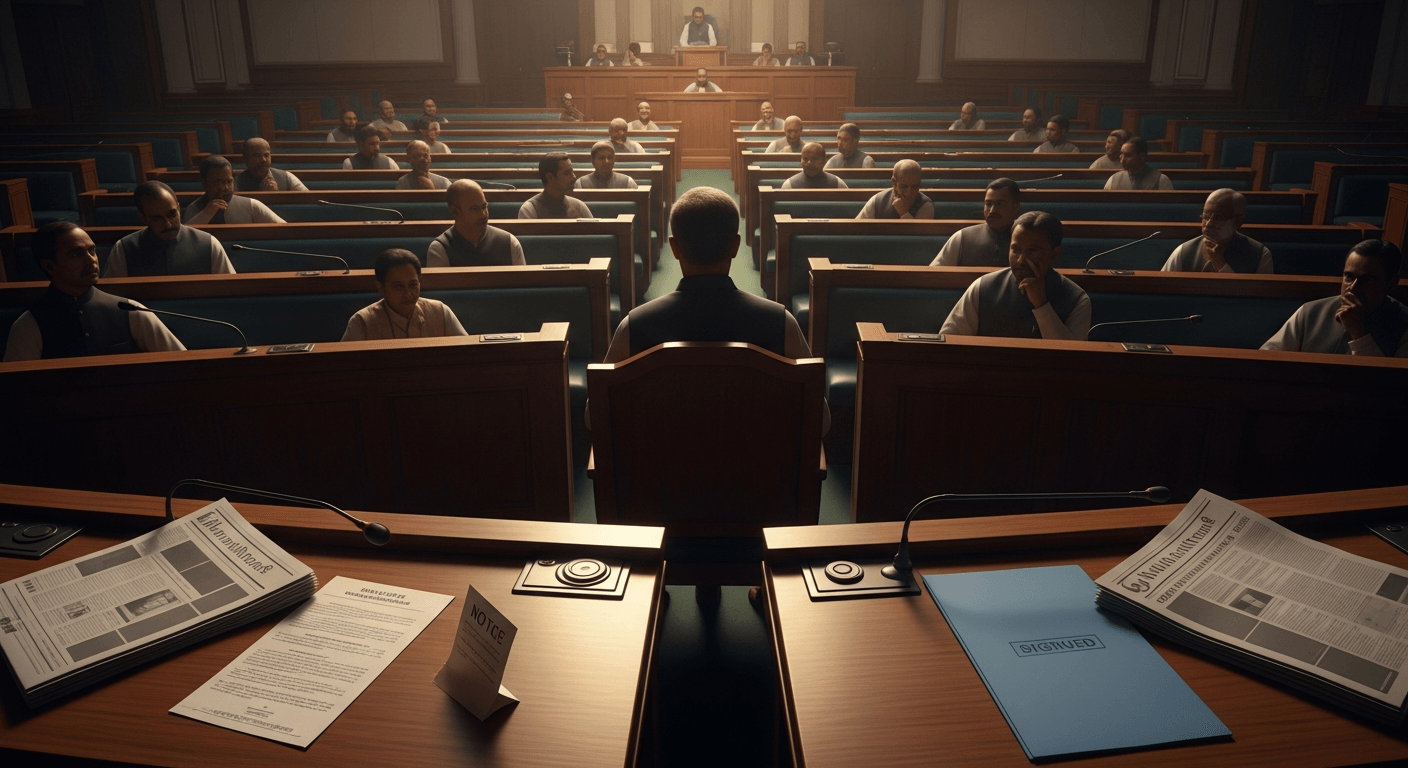
The Choice Not To Sign
I write this as someone who watches institutions with both optimism and a healthy dose of skepticism. Recently, a no-confidence notice was filed seeking the removal of the Lok Sabha Speaker. The twist that caught public attention was that the Leader of the Opposition did not append his signature to that notice. I want to unpack the parliamentary mechanics, the political context, and the mix of legal, strategic and ethical considerations that might explain such a choice.
Parliamentary procedure: how a Speaker can be removed
A few procedural points matter when we talk about removing a Speaker:
- The Constitution (Article 94(c)) allows the Lok Sabha to remove its Speaker by a resolution passed by the House.
- The Rules of Procedure (including Rule 94C in practice) require a formal notice — typically with a 14-day notice period — before such a resolution can be taken up.
- Removal is decided by a majority of members present and voting; there is no special majority threshold beyond the ordinary voting rule.
- The Secretary-General and the Chair (or acting Chair) have administrative roles: the notice is formally submitted and the House machinery examines admissibility and compliance with rules.
Understanding these steps makes clear that a no-confidence notice is both a constitutional instrument and a political signal. It can trigger administrative procedures, media cycles, and parliamentary debate even if it falls short of the numbers needed to succeed.
Political context (concise)
Tensions in the House had escalated following exchanges during the Motion of Thanks debate, suspensions of several opposition MPs, and allegations from opposition benches that the Chair had repeatedly denied opportunities to speak. Against that backdrop, opposition benches collectively moved a notice seeking the Speaker’s removal — a rare and dramatic parliamentary step designed to register institutional displeasure.
Why the Leader of the Opposition might refrain from signing
Several plausible reasons combine legal conventions, strategy and optics. I break them into categories.
Legal and convention-based reasons
- Parliamentary convention often treats the office of the Leader of the Opposition as distinct from agitational instruments. Some within parliamentary practice argue that the LoP should not be seen as the primary petitioner seeking the Speaker’s removal, because that could be construed as personalizing or diminishing the institutional neutrality the office is expected to embody.
- There are also procedural niceties: a notice submitted on behalf of a bloc or by several whips and leaders may be procedurally equivalent without the LoP’s personal signature.
Strategic reasons
- Legitimacy and optics: By not signing personally, the LoP may avoid presenting the move as a leadership vendetta; instead, it can be framed as a collective decision of many MPs and parties.
- Risk management: If the motion is unlikely to pass, a personal signature could be seized upon by opponents as theatrical posturing. Non-signature preserves flexibility for future negotiations.
- Coalition arithmetic: In a multi-party opposition, differences exist about timing and approach. The LoP’s restraint can be a way to respect those internal calculations while keeping the pressure on.
Ethical and reputational reasons
- Institutional respect: Some politicians balance the need for accountability with respect for the Speaker’s constitutional status. Not signing can be a way to express concern while upholding the dignity of the House.
- Personal responsibility: The LoP as a public office-bearer may weigh whether adding their name escalates an already fraught situation unnecessarily.
Party politics and internal dynamics
- Delegation: Often the party chief whip or a coalition convenor formally files such notices. The LoP’s abstention could be part of an internal division of roles.
- Messaging discipline: The party may prefer spokespeople and whips to take the procedural lead while the LoP focuses on broader political messaging.
Possible implications and reactions
- Procedural: The notice triggers mandatory administrative steps — examination by the Secretary-General and a 14-day window. That process itself can reshape parliamentary business and force responses from the Chair and the Treasury benches.
- Political: For the opposition, even an unsuccessful motion can cement public perception of grievance and place the Speaker’s conduct under scrutiny. For the government, it can be spun as an inability of the opposition to gather numbers or as theatrics.
- Public perception: Citizens often interpret such moments less through constitutional fine print and more through the frame of political morality — who looks reasonable, who appears obstructionist, who respects institutions.
Representative quotes (fabricated placeholders)
- [Fabricated quote — Public Figure Placeholder]: "This is about restoring norms, not settling scores."
- [Fabricated quote — Public Figure Placeholder]: "Parliament must remain the arena for debate; procedural moves should reflect that."
(These are placeholders for the kinds of public statements you would expect from senior leaders and commentators.)
Assessment and potential outcomes
There are three broad scenarios I see:
- Administrative resolution and de-escalation: The procedural review proceeds, the Speaker replies, and the matter cools down without a full House vote. This preserves parliamentary functioning but may leave underlying grievances unresolved.
- A full motion that fails: The notice is admitted, debated, and ultimately voted down. Politically, the opposition can claim moral high ground; numerically, the government demonstrates control.
- A successful removal (least likely in the immediate term): If the arithmetic shifts and a majority votes for removal, it would be a watershed moment — rare, constitutionally valid, and institutionally consequential.
My read is that the Leader of the Opposition’s non-signature is a calculated move blending constitutional caution, coalition politics and image management. It keeps the pressure on the Chair and the government while preserving the LoP’s institutional posture and future maneuverability.
In parliamentary democracies, how you file a notice matters almost as much as the notice itself. Sometimes restraint is a strategic argument in action: a signal that the opposition can escalate, but prefers to define the terms of escalation on its own timetable.
Regards,
Hemen Parekh
Any questions / doubts / clarifications regarding this blog? Just ask (by typing or talking) my Virtual Avatar on the website embedded below. Then "Share" that to your friend on WhatsApp.
Get correct answer to any question asked by Shri Amitabh Bachchan on Kaun Banega Crorepati, faster than any contestant
Hello Candidates :
- For UPSC – IAS – IPS – IFS etc., exams, you must prepare to answer, essay type questions which test your General Knowledge / Sensitivity of current events
- If you have read this blog carefully , you should be able to answer the following question:
- Need help ? No problem . Following are two AI AGENTS where we have PRE-LOADED this question in their respective Question Boxes . All that you have to do is just click SUBMIT
- www.HemenParekh.ai { a SLM , powered by my own Digital Content of more than 50,000 + documents, written by me over past 60 years of my professional career }
- www.IndiaAGI.ai { a consortium of 3 LLMs which debate and deliver a CONSENSUS answer – and each gives its own answer as well ! }
- It is up to you to decide which answer is more comprehensive / nuanced ( For sheer amazement, click both SUBMIT buttons quickly, one after another ) Then share any answer with yourself / your friends ( using WhatsApp / Email ). Nothing stops you from submitting ( just copy / paste from your resource ), all those questions from last year’s UPSC exam paper as well !
- May be there are other online resources which too provide you answers to UPSC “ General Knowledge “ questions but only I provide you in 26 languages !



No comments:
Post a Comment