
Introduction
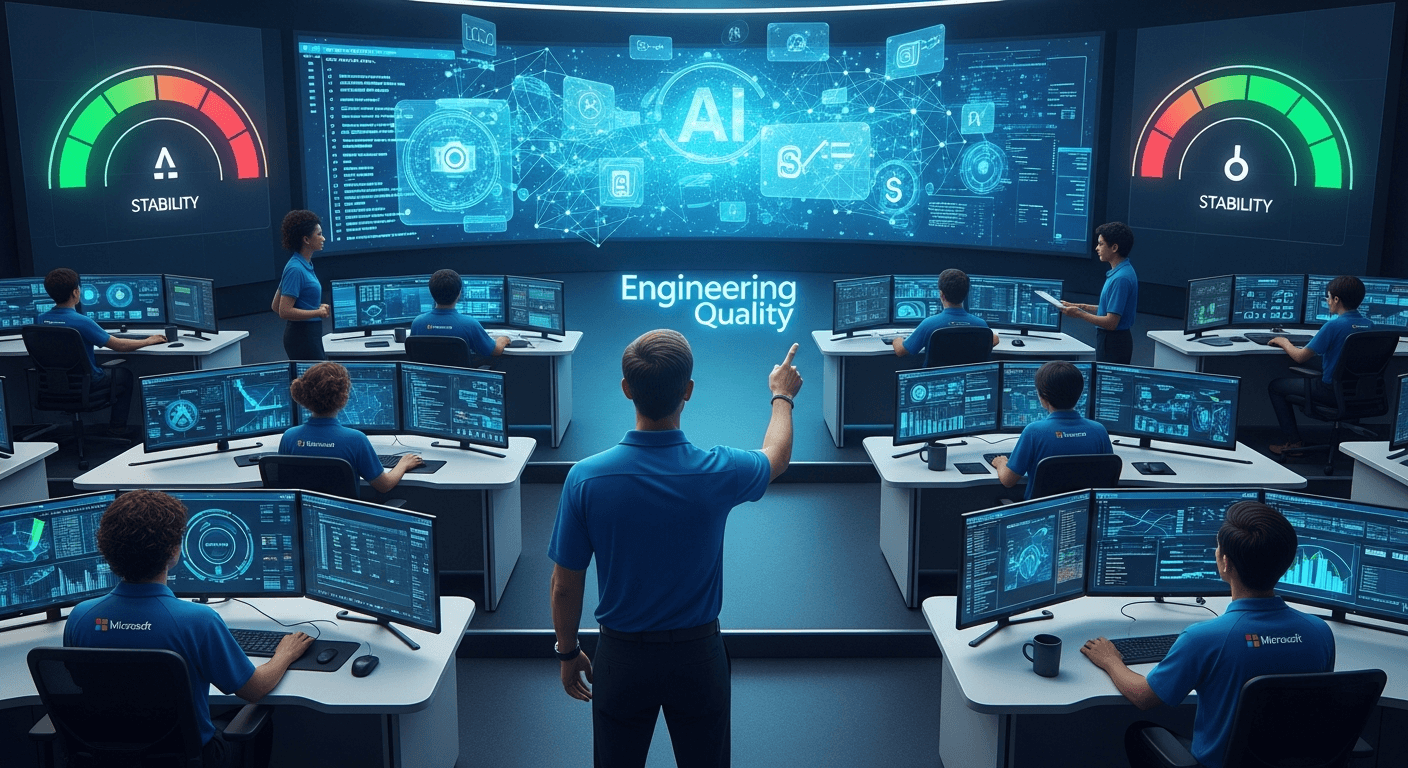
I watched the announcement from Microsoft with a mixture of relief and curiosity. In an internal memo, CEO Satya Nadella — satyan@microsoft.com — signaled a structural change: a senior leader dedicated to engineering quality. The person tapped for that work is Charlie Bell — charliebell@microsoft.com — who will report directly to the CEO and focus on the new Quality Excellence Initiative. At the same time, Hayete Gallot — hayete.gallot@microsoft.com — returns to lead Microsoft’s security org, while Scott Guthrie — scottgu@microsoft.com — and Mala Anand — mala.anand@microsoft.com — will partner in this cross-cutting effort[1][2].
Background: Microsoft, scale, and the role
Microsoft today is not the Microsoft of two decades ago. It runs an operating system on a billion endpoints, provides Azure for mission-critical cloud workloads, and embeds AI deeply into developer workflows and first-party products. That scale means small engineering trade-offs become global experiences — and sometimes global problems.
The newly created engineering-quality head is different from a traditional QA leader. This role sits in the CEO’s line of sight and is meant to influence architecture, developer workflows, release practices, and cross-division coordination. In short: it’s about building quality into systems rather than inspecting it in at the end. The appointment of Charlie Bell — charliebell@microsoft.com — is notable because he’s being positioned as an individual contributor focused on craft, not a long-running org manager.
Why this appointment matters for software quality
Accountability at scale: When quality reports directly to the CEO — in this case, Satya Nadella — it signals company-wide priority alignment. That removes the ambiguity that often lets feature velocity outrun reliability.
Better cross-team coordination: Quality failures at Microsoft are rarely the fault of a single team; they emerge at the seams between services. A senior-quality role can surface systemic causes — release cadence, test coverage gaps, or telemetry blind spots — and drive platform-level fixes.
AI-generated code and new risks: Microsoft itself has said that AI is writing a growing share of its codebase. While AI boosts productivity, researchers (and Microsoft’s own teams) have observed higher code churn and an increased risk of missed bugs in AI-assisted reviews. A focused leader can set guardrails, tooling, and review standards that reduce those risks.
Consequences for customers, employees, and the industry
Customers
Fewer regression surprises: Customers will notice more stable updates, fewer emergency out-of-band patches, and better-documented behavior when things do go wrong.
Increased trust for enterprise workloads: For businesses running critical infrastructure on Azure or Windows, demonstrable improvements in reliability are a direct reduction in operational risk.
Employees
Engineers may feel an initial slowdown as practices shift (more tests, stricter release gating), but over time the noise from rollbacks and firefighting declines, allowing higher-quality feature work.
Product teams will need to collaborate more closely with platform and pipeline teams — a cultural change many engineering organizations resist at first.
Industry
Signaling effect: When a company the size of Microsoft elevates quality to the C-suite horizon, competitors and customers take note. Quality becomes a market differentiator.
Tooling and standards: Expect faster adoption of robust CI/CD, observability patterns, and policy-driven code generation safeguards across the ecosystem.
Real-world analogies and examples
I often think of software systems like large aircraft. Designers can add more sensors and automation (AI-assisted code), but if the flight rules, checklists, and cross-team communication aren’t updated, automation can create failure modes no individual pilot anticipated. Similarly, Microsoft’s recent run of problematic updates — which required "swarming" of engineers to stabilize releases — is a reminder that high automation without equally strong oversight amplifies systemic risk.
Potential challenges ahead
Authority vs. influence: Creating a role is one thing; giving it the authority and mechanisms to change entrenched practices across product groups is another. The new lead must balance persuasion with decision rights.
Measuring impact: Quality is multi-dimensional — uptime, performance, correctness, security, and user trust. Choosing the right metrics (and avoiding perverse incentives) will be critical.
Speed vs. safety trade-offs: The industry values rapid innovation. Implementing stricter gates and rewiring developer workflows will provoke pushback unless the benefits are visible and measurable quickly.
AI-specific blind spots: Existing test suites and review practices were designed for human-written code. AI-generated patches may require new static analysis rules, fuzzing strategies, and provenance tracking to ensure correctness.
Conclusion
This appointment matters because it acknowledges a truth I’ve seen across many engineering organizations: at scale, quality is not a feature you tack on — it’s a capability you must design into your product and your culture. By placing engineering quality into the CEO’s operating model and appointing someone like Charlie Bell — charliebell@microsoft.com — to focus on it, Microsoft is buying a chance to reduce systemic failures, rebuild customer trust, and set new norms for how AI and automation are stewarded in product development.
Will this solve every reliability issue overnight? No. But if the role is empowered, resourced, and partnered with product and platform leaders like Scott Guthrie — scottgu@microsoft.com — and Mala Anand — mala.anand@microsoft.com — the chances of meaningful, measurable improvement go up substantially.
If you care about the future of trustworthy software, this is a development worth watching.
References
- Microsoft internal memo and coverage on the new roles and Quality Excellence Initiative[1][2].
Regards,
Hemen Parekh
Any questions / doubts / clarifications regarding this blog? Just ask (by typing or talking) my Virtual Avatar on the website embedded below. Then "Share" that to your friend on WhatsApp.
Get correct answer to any question asked by Shri Amitabh Bachchan on Kaun Banega Crorepati, faster than any contestant
Hello Candidates :
- For UPSC – IAS – IPS – IFS etc., exams, you must prepare to answer, essay type questions which test your General Knowledge / Sensitivity of current events
- If you have read this blog carefully , you should be able to answer the following question:
- Need help ? No problem . Following are two AI AGENTS where we have PRE-LOADED this question in their respective Question Boxes . All that you have to do is just click SUBMIT
- www.HemenParekh.ai { a SLM , powered by my own Digital Content of more than 50,000 + documents, written by me over past 60 years of my professional career }
- www.IndiaAGI.ai { a consortium of 3 LLMs which debate and deliver a CONSENSUS answer – and each gives its own answer as well ! }
- It is up to you to decide which answer is more comprehensive / nuanced ( For sheer amazement, click both SUBMIT buttons quickly, one after another ) Then share any answer with yourself / your friends ( using WhatsApp / Email ). Nothing stops you from submitting ( just copy / paste from your resource ), all those questions from last year’s UPSC exam paper as well !
- May be there are other online resources which too provide you answers to UPSC “ General Knowledge “ questions but only I provide you in 26 languages !



No comments:
Post a Comment