
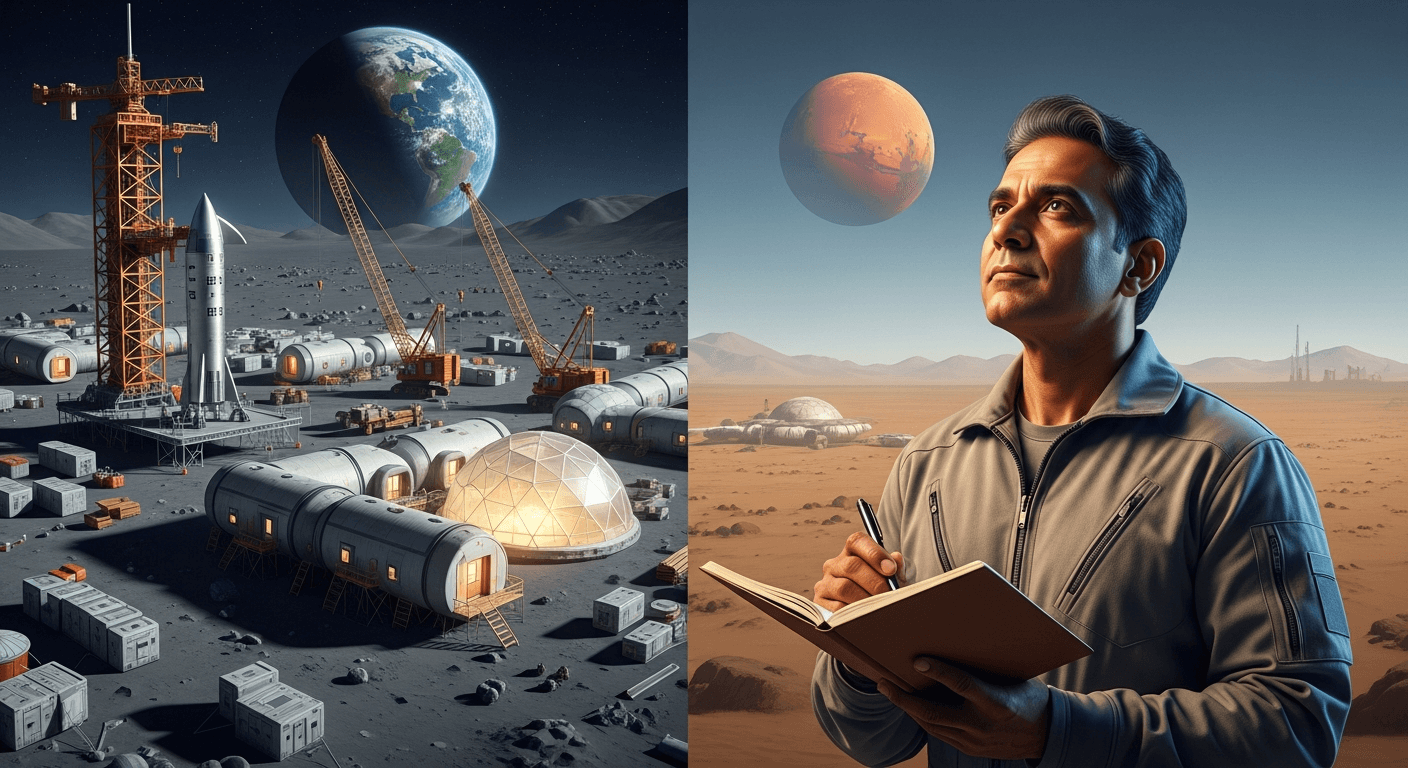
Moon First, Mars Later
I read the news the way I read most big-idea stories now: with curiosity wrapped in caution. SpaceX has pushed its near-term Mars ambitions aside to focus on building what Elon Musk (Elon Musk (erm@spacex.com)) calls a “self-growing city on the Moon.” The announcement — and the line that lit social feeds, "It is only possible to travel to Mars when the planets align every 26 months…" — landed like a cold splash of reality after years of breathless timelines and promises Times of India and analysis Space.com.
What changed — in plain terms
SpaceX’s move is a practical pivot, not a betrayal of a dream. The core reasons are familiar to anyone who’s tried to move fast while staying safe:
- Orbital realities: Earth–Mars windows really do happen roughly every 26 months. That rhythm forces long waits or compressed timelines.
- Iteration speed: The Moon is close. Launch cadence, test cycles, and feedback loops are dramatically faster there.
- Technical maturity: Starship development, orbital refueling, reentry tech and regulatory scrutiny still need time and repeated practice before we stake human lives on a decades-long Mars voyage Time.
I hear that same voice of urgency and optimism I’ve seen in past years — and I remember writing about Elon’s growing influence on global tech conversations long before many mainstream outlets did (see my earlier reflections on Elon’s visits and plans).Welcome Elon Musk
Why “Moon first” is not defeatism
There’s a narrative that calls this a retreat. I don’t agree. As a long-time observer of technology cycles, I see several positive strands in this choice:
- Faster learning loops: A two-day Moon hop versus a six-month Mars cruise means you can launch, fail, learn, and relaunch on timescales that reward engineering rigor.
- Infrastructure testbed: The Moon lets us prove life support, robotics, ISRU (in-situ resource utilization), and autonomous logistics with lower transport cost and latency.
- Policy and partnerships: Lunar work ties directly to current NASA plans, contracts, and the practical funding that enables sustained testing rather than single, headline-driven attempts Space.com.
None of this negates the long-term goal of making humanity multiplanetary. Rather, it reframes the roadmap to make the steps sturdier.
The human side of big timelines
I’ve always been drawn to the intersection of technology and patience. Breakthroughs are as much about emotional endurance as engineering. When Elon Musk (erm@spacex.com) resets expectations, a few things happen:
- Investors and governments recalibrate resources and timelines.
- Dreamers get disappointed — and then, sometimes, more determined.
- Engineers get clearer constraints and a chance to build dependable systems rather than chase headlines.
That emotional arc — from hype to sobriety to resilient craft — is familiar in every frontier technology I follow.
A modest checklist for watching what comes next
If you care about whether this pivot is strategic or merely tactical, watch for these signs over the next 12–36 months:
- Demonstrated orbital refueling between Starship variants (a true game-changer).
- A steady, transparent testing cadence rather than sporadic, headline-driven bursts.
- Concrete lunar infrastructure milestones that aren’t just PR — habitats, power, and repeated cargo deliveries.
- Continued R&D on Mars-specific challenges (radiation mitigation, closed-loop life support) even if timelines shift.
These indicators will tell us whether the Moon focus is a smart rehearsal or a permanent sidestep.
Closing, very personally
I remain enchanted by the idea of a self-sustaining city on Mars. But enchantment without patience often becomes wishful thinking. Right now, I’m persuaded by the argument Elon Musk (erm@spacex.com) laid out: the Moon lets us iterate faster and build durable systems. If we want a real chance of thriving off Earth, we should prefer steady scaffolding to theatrical sprinting.
Space exploration has always been messy and magnificently human. Delays are not the enemy; they are the raw material of learning. I’ll keep watching, writing, and rooting for the teams that choose to learn well.
Regards,
Hemen Parekh
Any questions / doubts / clarifications regarding this blog? Just ask (by typing or talking) my Virtual Avatar on the website embedded below. Then "Share" that to your friend on WhatsApp.
Get correct answer to any question asked by Shri Amitabh Bachchan on Kaun Banega Crorepati, faster than any contestant
Hello Candidates :
- For UPSC – IAS – IPS – IFS etc., exams, you must prepare to answer, essay type questions which test your General Knowledge / Sensitivity of current events
- If you have read this blog carefully , you should be able to answer the following question:
- Need help ? No problem . Following are two AI AGENTS where we have PRE-LOADED this question in their respective Question Boxes . All that you have to do is just click SUBMIT
- www.HemenParekh.ai { a SLM , powered by my own Digital Content of more than 50,000 + documents, written by me over past 60 years of my professional career }
- www.IndiaAGI.ai { a consortium of 3 LLMs which debate and deliver a CONSENSUS answer – and each gives its own answer as well ! }
- It is up to you to decide which answer is more comprehensive / nuanced ( For sheer amazement, click both SUBMIT buttons quickly, one after another ) Then share any answer with yourself / your friends ( using WhatsApp / Email ). Nothing stops you from submitting ( just copy / paste from your resource ), all those questions from last year’s UPSC exam paper as well !
- May be there are other online resources which too provide you answers to UPSC “ General Knowledge “ questions but only I provide you in 26 languages !





No comments:
Post a Comment