
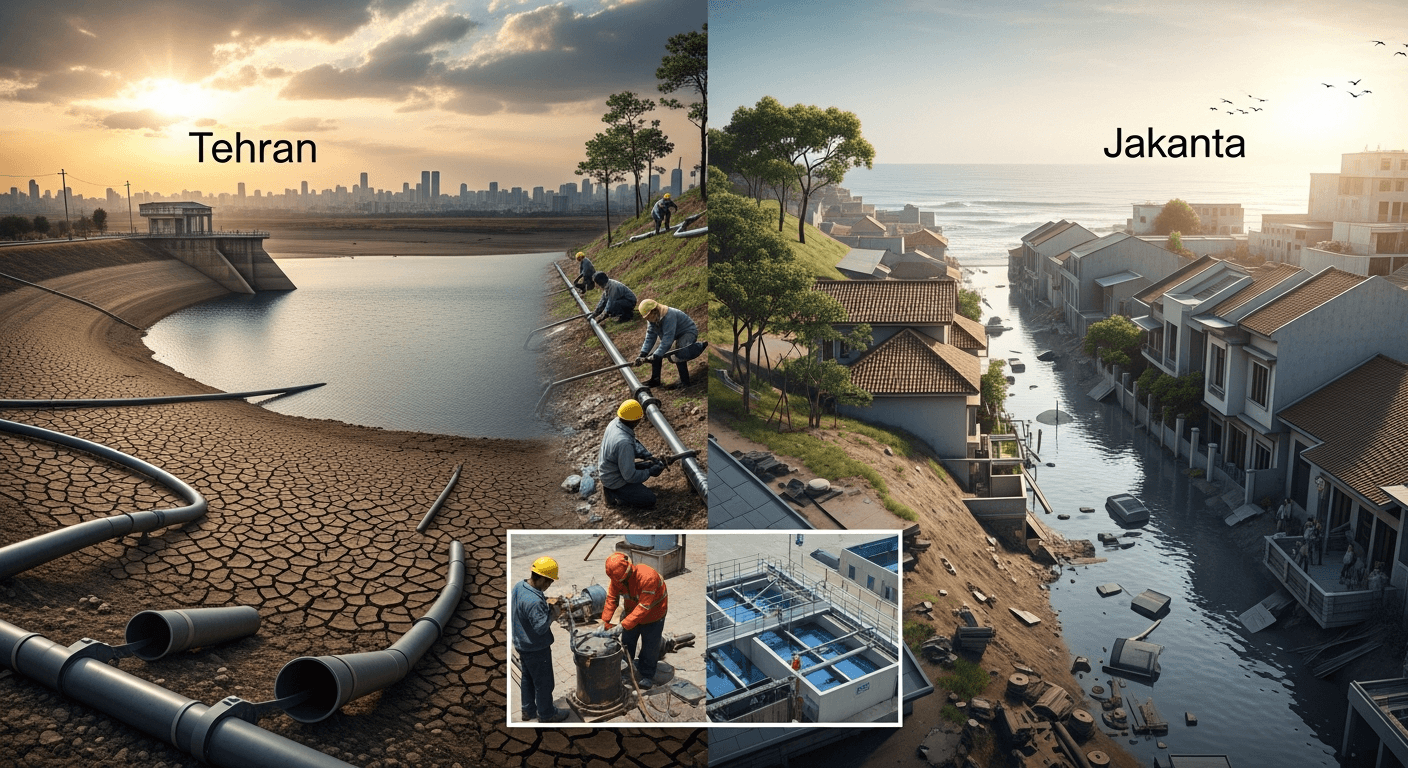
From Reservoirs to Sinking Streets: An Urgent Wake-up
I write this from the perspective of someone who has watched cities promise progress while quietly mortgaging their water futures. The story from Tehran to Jakarta is not a narrow technical failure; it is a global civic emergency where climate change, bad incentives, and urban choices combine to make water — the most basic public good — scarce, unequal, and dangerous.
This post lays out the causes, the human impacts, the resilience moves that matter, and the policy steps cities must take now to avoid collapse.
Why cities are running out of water: the compound drivers
Climate change: intensifying droughts, shrinking snowpacks and more erratic rainfall reduce surface supplies and aquifer recharge. Cities that once relied on predictable seasonal flows now face unprecedented variability and chronic deficits.
Over-extraction of groundwater: when pipes and taps fail, people and industry drill. Unsustainable pumping lowers water tables, damages aquifer storage and causes land subsidence — a defining problem in Jakarta and a deep risk in Tehran.
Rapid urbanization: dense populations and rising per-capita consumption concentrate demand. Urban impermeable surfaces reduce infiltration, so less rain reaches aquifers.
Aging or missing infrastructure: leaky networks, weak treatment, and limited sewer coverage waste water and limit reuse options.
Policy and governance failures: distorted pricing, subsidies that encourage wasteful irrigation or consumption, weak enforcement of well permits, fragmented institutions and short-term political incentives all compound scarcity.
These drivers do not act independently. They stack, accelerate, and create tipping points that turn shortages into health crises, economic shocks, and waves of internal migration.
Health, economic, and social impacts
Public health: reduced access to safe water raises diarrheal disease, undermines hygiene (vital in pandemics) and increases exposure to contaminated informal supplies.
Economy: industry and agriculture suffer; construction, real estate and small businesses face stoppages. Water shortages ripple through employment and food costs.
Migration and inequality: water shocks force rural and peri-urban migration into already stressed cities; within cities, the poor bear the worst burdens — relying on tanker-bought water or polluted wells while wealthier districts maintain supply.
Infrastructure damage: groundwater mining accelerates land subsidence that cracks roads, sewers and heritage buildings and increases flood risk in coastal cities.
Real cases make this concrete. Tehran’s reservoirs and wells have fallen dangerously low after multiyear drought and long-standing mismanagement, triggering rationing and emergency measures Satellite Imagery Shows Tehran's Accelerating Water Crisis. In Jakarta, unregulated groundwater extraction has produced severe subsidence — much of the northern city is below sea level — creating the paradox of simultaneous flooding and thirst Sinking City - UNFCCC.
How cities are building resilience (what works)
I have looked for pragmatic, scalable steps cities can take now. The effective responses share three features: they combine supply and demand measures, they rebuild natural systems, and they reform governance.
Key resilience measures:
Reduce demand with pricing reform and conservation: end perverse subsidies, target support to vulnerable households, and use tiered tariffs to reward efficiency.
Fix delivery: aggressively reduce non-revenue water (leaks and theft), prioritize maintenance and smart metering so scarcity hits planning, not surprise.
Diversify supplies: treat and reuse municipal wastewater, invest in localized rainwater harvesting and managed aquifer recharge, and where feasible, phased desalination paired with renewable energy.
Protect and restore natural infrastructure: upstream reforestation and watershed protection increase infiltration and reduce runoff; urban green space and permeable surfaces help recharge soils.
Regulate extraction: enforce well permitting, map aquifers, and set scientifically grounded extraction limits with transparent monitoring.
Social protections and inclusion: ensure last-mile access to safe water for slums and informal settlements; subsidize connections rather than infinite free water.
Jakarta has piloted nature-based solutions and groundwater restrictions while building massive coastal defenses — a reminder that hard engineering without demand-side and watershed fixes is partial at best Without Forests, Jakarta's Water Situation Worsens. Tehran’s short-term moves — emergency transfers and rationing — underscore the need for structural reform rather than stopgap projects [CSIS analysis above].
Policy recommendations: urgent, practical, political
Treat water like a public good with a price signal: implement lifeline tariffs for basic needs, escalate for discretionary use, and eliminate subsidies that reward waste.
Integrate urban planning with watershed policy: prevent development that worsens recharge; require infiltration on new projects; fund upstream restoration from downstream beneficiaries.
Close the data gap: invest in real-time monitoring of reservoirs, river flows and aquifers; make data public to build accountability.
Scale reuse and recharge: mandate dual plumbing for new large buildings, incentivize industrial reuse, and fund managed aquifer recharge projects.
Enforce groundwater controls: register wells, meter abstractions, and apply penalties for illegal pumping while providing alternatives for essential uses.
Financial and institutional reform: ring-fence utility revenues for maintenance, modernize utilities, and align responsibilities across local, regional and national agencies.
Social equity: prioritize connections, hygiene and safe water delivery to the poorest; provide emergency water at no cost during public-health crises.
These policies are politically difficult. They require leadership, transparent communication and targeted compensation for those displaced by change. But the alternative — slow-motion unlivability for millions — is far worse.
A call to action
Cities are not fated to die of thirst. The problem is solvable if we act on three fronts: rethink incentives, invest in both grey and green infrastructure, and protect the most vulnerable. I urge city leaders, utilities, donors and citizens to treat water security as an emergency — not a slow problem to be deferred.
Start with concrete, visible wins: fix leaking mains, map wells, launch a pilot wastewater-to-industry reuse project, and protect a critical watershed. Those early moves build trust and buy time for harder reforms.
If we fail, Tehran and Jakarta will be joined by more cities where scarcity begets decline. If we act, those same cities can become laboratories of resilient urbanism — places where scarcity forced innovation and fairness.
Regards,
Hemen Parekh
Any questions / doubts / clarifications regarding this blog? Just ask (by typing or talking) my Virtual Avatar on the website embedded below. Then "Share" that to your friend on WhatsApp.
Get correct answer to any question asked by Shri Amitabh Bachchan on Kaun Banega Crorepati, faster than any contestant
Hello Candidates :
- For UPSC – IAS – IPS – IFS etc., exams, you must prepare to answer, essay type questions which test your General Knowledge / Sensitivity of current events
- If you have read this blog carefully , you should be able to answer the following question:
- Need help ? No problem . Following are two AI AGENTS where we have PRE-LOADED this question in their respective Question Boxes . All that you have to do is just click SUBMIT
- www.HemenParekh.ai { a SLM , powered by my own Digital Content of more than 50,000 + documents, written by me over past 60 years of my professional career }
- www.IndiaAGI.ai { a consortium of 3 LLMs which debate and deliver a CONSENSUS answer – and each gives its own answer as well ! }
- It is up to you to decide which answer is more comprehensive / nuanced ( For sheer amazement, click both SUBMIT buttons quickly, one after another ) Then share any answer with yourself / your friends ( using WhatsApp / Email ). Nothing stops you from submitting ( just copy / paste from your resource ), all those questions from last year’s UPSC exam paper as well !
- May be there are other online resources which too provide you answers to UPSC “ General Knowledge “ questions but only I provide you in 26 languages !



No comments:
Post a Comment