
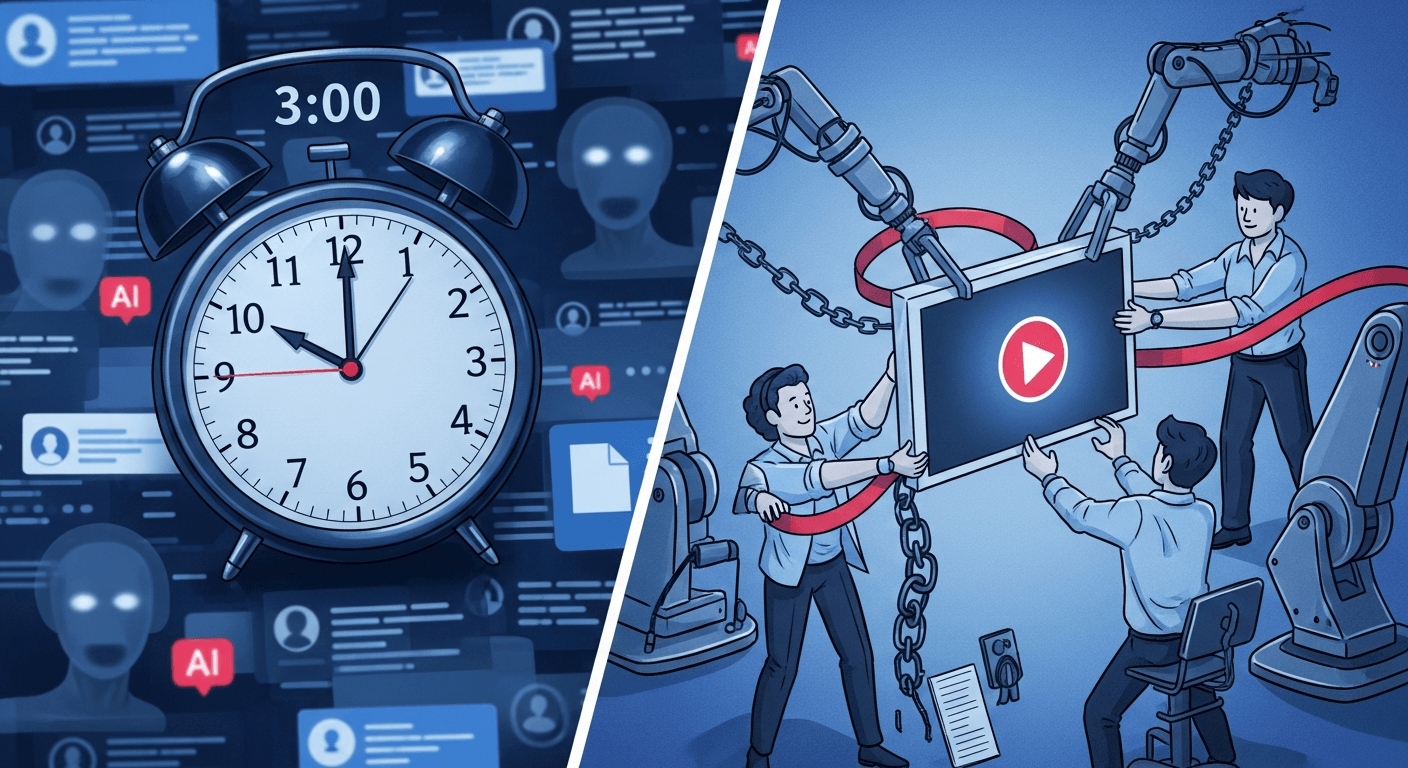
I write this as someone who has watched the conversation about synthetic media move from academic curiosity to urgent public policy in a few short years. This week the government amended its intermediary rules to require that social platforms label AI‑generated or manipulated audio/visual content and—critically—remove flagged deepfakes within three hours of a lawful direction or order. The measure, framed as an emergency public‑safety timeline, is already reshaping how platforms, users and regulators think about synthetic content India Today News18.
What the policy says, in plain terms
- Platforms must clearly label AI‑generated or synthetically altered audio, images and video. Labels and embedded provenance metadata must be persistent (not removable).
- For certain high‑risk cases—harmful, illegal or time‑sensitive material—the platform must take content down within a three‑hour window after receiving a lawful flag or court order.
- Platforms are required to deploy reasonable technical measures (including automated tools) to verify user declarations and to detect unlawful synthetic content.
- Non‑compliance can mean loss of safe‑harbour protections and exposure to regulatory or legal action.
(These changes formalize what many of us feared was coming and follow earlier guidance and public consultation. I explored some of these themes in an earlier post, "I am not worried about my Deep Fake," where I urged public figures to embrace provenance and digital avatars as a defensive strategy I am not worried about my Deep Fake).
Why the government moved so fast
There are three practical drivers:
- Speed and scale: Deepfakes spread quickly and can cause immediate, irreversible harm—political unrest, financial fraud or reputational damage—if not removed promptly.
- Difficult attribution: Without persistent labels and provenance, ordinary users cannot distinguish real from synthetic; the rules push platforms to provide that clarity.
- Harm to vulnerable groups: Synthetic sexual content, impersonation and scams (including voice cloning) have real victims; shorter timelines aim to limit exposure.
Legal and technical challenges
- Detection accuracy: Automated detectors produce false positives and false negatives. Over‑reliance on imperfect classifiers risks both under‑blocking harmful content and over‑censoring legitimate speech.
- Metadata and tampering: Mandating persistent provenance helps, but metadata can be stripped or re‑encoded across tools and platforms.
- Jurisdiction and due process: Platforms operate globally; a three‑hour takedown order from one jurisdiction may conflict with laws or court processes elsewhere.
- Resource constraints: Smaller platforms and niche communities may struggle to build or license rapid detection systems and 24/7 response teams.
Impact on platforms and users
For platforms:
- Operationally heavy: shorter timelines require faster legal review, automated triage and human escalation pipelines.
- Costly: investing in detection, provenance standards and audit trails is expensive.
- Liability pressure: losing safe‑harbour changes incentives—platforms will either over‑remove to avoid risk or build stronger verification.
For users:
- Safer in theory: harmful deepfakes should disappear faster.
- Risk of chilling: legitimate parody, satire or politically sensitive content might be removed by mistake.
- Transparency needs: users deserve clear explanations when content is taken down and a usable appeals channel.
Enforcement and penalties
The new rules tie fast takedown obligations to the existing intermediary framework. Repeated or systemic non‑compliance can mean loss of safe‑harbour protections, fines or other regulatory actions. That creates a serious legal lever—but also raises the stakes for careful, transparent enforcement.
Rights: free speech and due process
A healthy balance must be struck. Emergency takedowns make sense for imminent harm, but democracy depends on procedural safeguards:
- Clear definitions of “harm” and “lawful direction” so takedowns aren’t arbitrary.
- Notice to creators where feasible and a rapid, meaningful appeals process.
- Independent transparency reporting so the public can see how takedown power is used.
Practical suggestions — for platforms and policymakers
For platforms:
- Adopt layered moderation: automated detection for triage, human review for edge cases, and an expedited legal workflow for lawful government or court directions.
- Invest in provenance standards (persistent watermarks/metadata) and open APIs so third‑party researchers can audit systems.
- Publish transparent transparency reports and a quick appeals pathway.
For policymakers:
- Define narrow, time‑limited emergency criteria for three‑hour takedowns.
- Encourage standardized provenance formats that travel with content across services.
- Support technical assistance for smaller platforms and fund independent audits.
Practical tips for users: spot and report deepfakes
- Look for visual glitches: mismatched lighting, inconsistent blinking, odd ear and hair movement.
- Trust source, not look: check the original publisher and corroborating coverage.
- Reverse image search: a quick check can reveal re‑used faces or recycled clips.
- Listen: audio artifacts, unnatural breaths or prosody can betray synthetic speech.
- Preserve evidence: screenshot, save the URL and download the file before it disappears.
- Report effectively: use the platform’s report feature, include timestamps and the reason you believe it’s synthetic, and keep records.
My takeaway
I support fast action where real and imminent harm is clear. But policy should be surgical, not blunt: we need better provenance, robust appeals, shared technical standards and cross‑border cooperation. The three‑hour rule signals urgency—and it rightly prioritizes safety—but the long‑term answer will be a mix of technology, governance and public literacy. We should push platforms and regulators to move fast and to build safeguards that protect speech and due process at the same time.
Regards,
Hemen Parekh
Any questions / doubts / clarifications regarding this blog? Just ask (by typing or talking) my Virtual Avatar on the website embedded below. Then "Share" that to your friend on WhatsApp.
Get correct answer to any question asked by Shri Amitabh Bachchan on Kaun Banega Crorepati, faster than any contestant
Hello Candidates :
- For UPSC – IAS – IPS – IFS etc., exams, you must prepare to answer, essay type questions which test your General Knowledge / Sensitivity of current events
- If you have read this blog carefully , you should be able to answer the following question:
- Need help ? No problem . Following are two AI AGENTS where we have PRE-LOADED this question in their respective Question Boxes . All that you have to do is just click SUBMIT
- www.HemenParekh.ai { a SLM , powered by my own Digital Content of more than 50,000 + documents, written by me over past 60 years of my professional career }
- www.IndiaAGI.ai { a consortium of 3 LLMs which debate and deliver a CONSENSUS answer – and each gives its own answer as well ! }
- It is up to you to decide which answer is more comprehensive / nuanced ( For sheer amazement, click both SUBMIT buttons quickly, one after another ) Then share any answer with yourself / your friends ( using WhatsApp / Email ). Nothing stops you from submitting ( just copy / paste from your resource ), all those questions from last year’s UPSC exam paper as well !
- May be there are other online resources which too provide you answers to UPSC “ General Knowledge “ questions but only I provide you in 26 languages !




No comments:
Post a Comment