
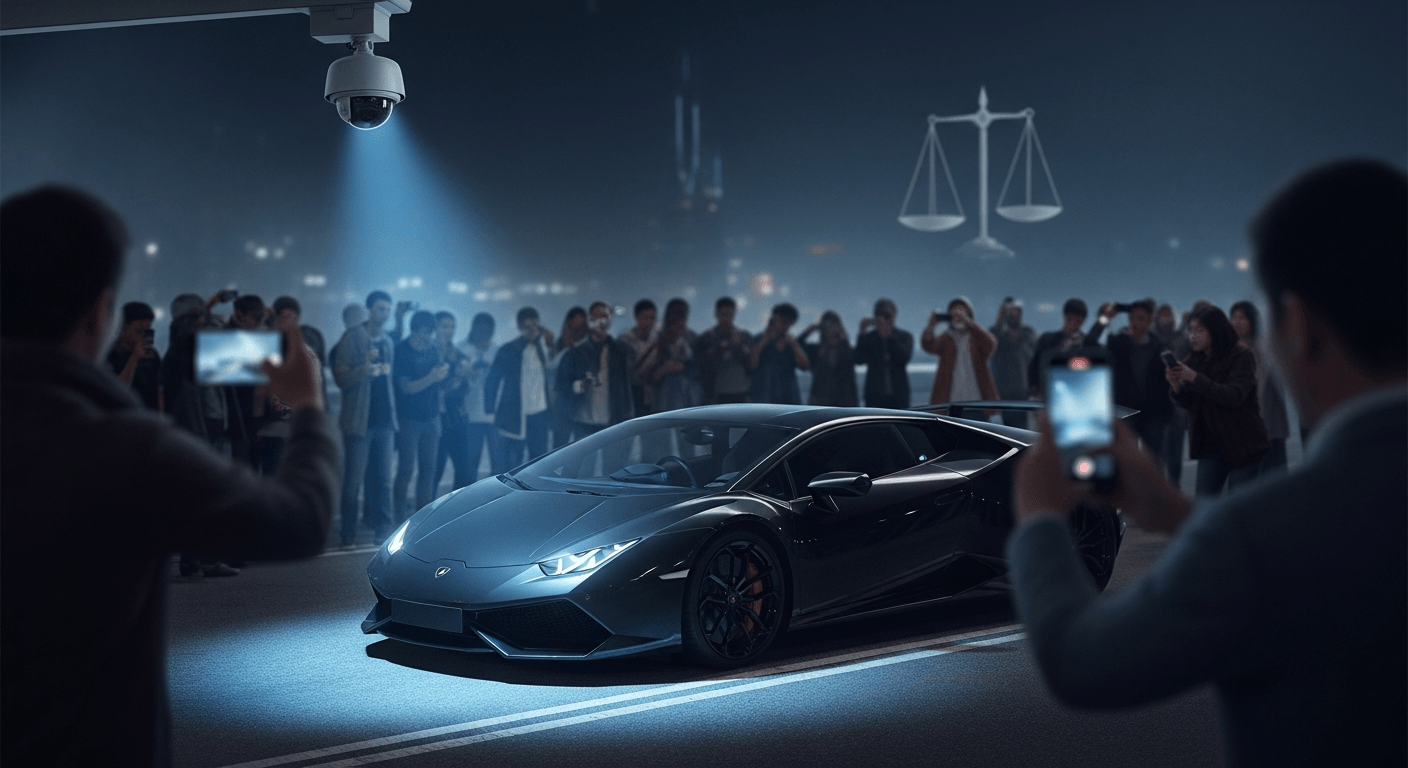
I watched the footage of a luxury sports car tearing through a busy city street and felt that familiar mix of anger and helplessness — not at the machine, but at the systems around it.
What happened (brief)
A high-end Italian sports car lost control on a VIP road, first striking other vehicles and then mounting a motorcycle before colliding with a street fixture. Several pedestrians and riders were injured. CCTV clips and on-the-ground videos circulated within hours; the formal investigation, the FIR and the charging decisions followed over the next few days. Authorities eventually seized the vehicle and arrested an accused person after a period of public outrage and legal wrangling NDTV report and Times of India account.
Why this matters beyond a single crash
- Systems fail faster than machines. When there’s delay in naming an accused, conducting immediate medical/forensic tests, or securing evidence, public trust drains away quickly.
- Visible wealth and private entourages make ordinary citizens ask whether the law applies equally in practice as it does on paper.
- Technology (CCTV, mobile video, forensics) can both expose and be undermined — timeliness, chain-of-custody and independent examination matter.
I’ve been writing for years about how technology can make transport safer — from vehicles that talk to infrastructure to systems that automatically immobilize dangerously driven vehicles. Those ideas aren’t theoretical anymore; incidents like this force us to ask why we haven’t implemented them faster (Internet of Vehicles (IoV)?).
The troubling timeline
- First response: a chaotic scene, injured people, and immediate video evidence shared by bystanders.
- Investigation: initial FIR named an unknown driver; later, investigators updated the FIR based on CCTV and witness accounts.
- Claims and counterclaims: competing narratives (medical emergency, designated driver, technical defect) surfaced publicly while evidence was being gathered.
- Enforcement action: vehicle taken for technical examination; arrest came days later, after public pressure and court proceedings Moneycontrol summary.
Those gaps — between incident and decisive, transparent action — are where trust is lost and suspicion of privilege grows.
Evidence, technology and the limits of delay
- CCTV and smartphone videos are vital, but they must be authenticated and preserved. Once time passes, tests for intoxication or impairment become far less conclusive.
- Forensics on vehicles (ECU data, brake-system logs, locking/seat-position information) can tell a detailed story — if investigators get timely access.
- Medical claims (seizure, fainting, medical emergency) are legitimate possibilities; they must be evaluated quickly and independently so they don’t become tools for obfuscation.
In short: the speed of the investigation must match the speed of the incident.
What I think we should demand — practical steps
- Rapid-response forensic protocols: mandatory seizure and secured examination of involved vehicles within hours, not days.
- Immediate, court-monitored medical and toxicology testing for drivers in serious crashes.
- Transparent public reporting of evidence custody (who accessed the vehicle, when and why).
- Faster administrative checks on ownership, service history and prior complaints against vehicles that routinely appear in high-risk incidents.
- Wider adoption of safety tech: in-vehicle event data recorders, alcohol interlocks for commercial and high-performance vehicles, and IoV measures that can flag dangerous behaviour to authorities in real time.
I’ve argued previously for automatic immobilisation and IoV solutions as practical tools to reduce reckless driving. Those solutions aren’t about punishing the wealthy — they are about removing opportunities for any driver to cause harm when they become a danger on the road (My earlier IoV post).
A civic ask
I’m not asking for a spectacle of punishment. I’m asking for two things: clarity and speed. Clarity in evidence and in public communication. Speed in medical tests, technical forensics and legal processes. Victims need restitution and clear answers; citizens need to see that institutions work equally for everyone.
We can be fascinated by speed and power, but we cannot allow fascination to replace accountability. As a country and as a community of road users, our job is to make sure technology and law protect the vulnerable faster than privilege can shield the powerful.
Regards,
Hemen Parekh
Any questions / doubts / clarifications regarding this blog? Just ask (by typing or talking) my Virtual Avatar on the website embedded below. Then "Share" that to your friend on WhatsApp.
Get correct answer to any question asked by Shri Amitabh Bachchan on Kaun Banega Crorepati, faster than any contestant
Hello Candidates :
- For UPSC – IAS – IPS – IFS etc., exams, you must prepare to answer, essay type questions which test your General Knowledge / Sensitivity of current events
- If you have read this blog carefully , you should be able to answer the following question:
- Need help ? No problem . Following are two AI AGENTS where we have PRE-LOADED this question in their respective Question Boxes . All that you have to do is just click SUBMIT
- www.HemenParekh.ai { a SLM , powered by my own Digital Content of more than 50,000 + documents, written by me over past 60 years of my professional career }
- www.IndiaAGI.ai { a consortium of 3 LLMs which debate and deliver a CONSENSUS answer – and each gives its own answer as well ! }
- It is up to you to decide which answer is more comprehensive / nuanced ( For sheer amazement, click both SUBMIT buttons quickly, one after another ) Then share any answer with yourself / your friends ( using WhatsApp / Email ). Nothing stops you from submitting ( just copy / paste from your resource ), all those questions from last year’s UPSC exam paper as well !
- May be there are other online resources which too provide you answers to UPSC “ General Knowledge “ questions but only I provide you in 26 languages !



No comments:
Post a Comment