
Why I worry when speed outruns structure
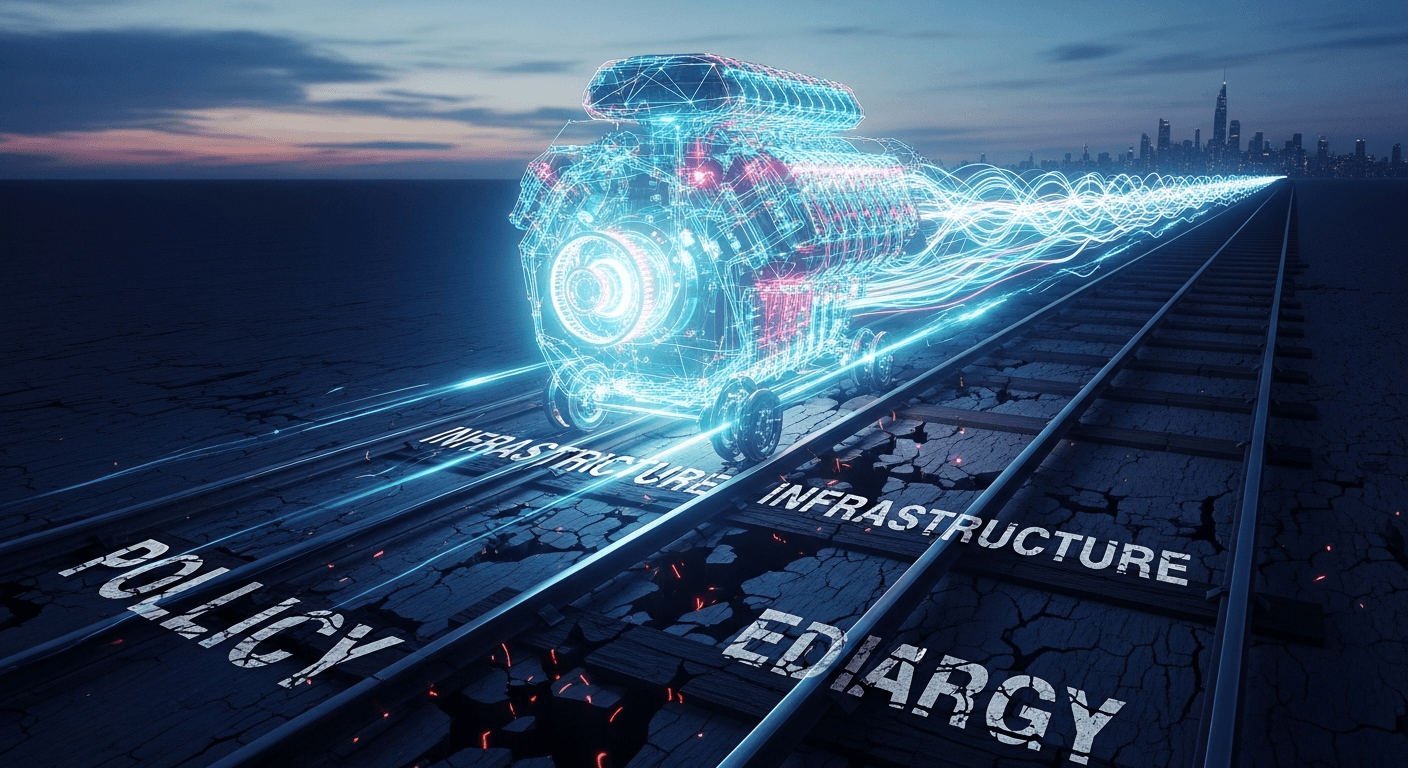
Lately I find myself haunted by a simple image: a jet engine strapped to a wooden cart. The engine wants to fly; the cart is still learning wheels. That mismatch—speed without structure—is where a lot of our present AI moment lives.
I write as someone who has followed and written about infrastructure and industry responses to AI for years, and who believes tools and systems should be built to serve people, not the other way around. I've noted the push for large-scale compute and partnerships in India and beyond Largescale AI Infrastructure, and argued that traditional firms must "hitch an AI ride" into front-office functions to remain relevant Hitching an AI Ride. Those posts were optimistic about potential—but they also assumed the supporting systems would keep pace. Too often, they don't.
Connect with Hemen Parekh (hcp@recruitguru.com)
The central mismatch
AI capability is accelerating along several dimensions: model scale, accessible tooling, cloud availability, and even the number of people who can prompt and deploy models. But the surrounding systems—policy, governance, business processes, workforce skills, energy and hardware supply chains, and public understanding—are not accelerating at the same rate.
This creates four predictable frictions:
- Safety and oversight gaps: Rapid model improvements outpace audit practices, incident response, and safety frameworks.
- Operational mismatch: Organizations adopt models without reworking workflows, causing brittle or unsafe behavior in production.
- Social and economic shocks: Job roles change faster than retraining programs, and public services struggle to absorb new capabilities.
- Infrastructure strain: Energy, networking, and data governance limits become bottlenecks even as models demand more compute and bandwidth.
Where I see the danger
- When companies bolt an LLM on top of legacy processes, the results look like automation without accountability: faster but not wiser.
- When regulators lag, we get uneven protections—good actors bear costs to be careful; bad actors benefit from delay.
- When national infrastructure (power, data centers, fiber) can't sustain demand, the winners are those with privileged access to specialized compute—widening inequality.
These are not hypothetical. They are practical problems that show up in procurement meetings, product launch timelines, and the design of user experiences.
What I believe needs to happen now
- Design for the system, not the model
- Treat a model like a component, not a product. Build observability, rollback, and human-in-the-loop checkpoints into deployments.
- Invest in "societal compilers"
- Translate fast-moving technical capability into policy, certifications, procurement standards, and workforce curricula.
- Prioritize compute & energy realism
- Ambitions for model training must account for grid impact, localized cooling, and supply resilience. Public–private coordination matters here.
- Rebuild business processes intentionally
- Use pilots to redesign workflows around the model's strengths, then scale those redesigned processes rather than retrofitting old ones.
- Democratize safe access
- Support shared, auditable infrastructure (public testbeds, certified cloud stacks) so safety and fairness can be validated by independent parties.
A practical checklist for leaders
- Ask: do we have incident playbooks tied to model outputs?
- Require: third-party audits for high-risk use-cases before wide rollout.
- Train: reskilling programs tied to new roles that models create (e.g., AI integrators, validators, and ethicists).
- Partner: with infrastructure builders—both private and public—to forecast capacity and energy needs.
Why optimism still wins
I remain optimistic because the same speed that creates risk also creates opportunity. Faster iteration lets us learn quickly; modular systems let us replace failing components without collapsing everything. My earlier posts celebrated partnerships and the front-office transformations AI enables (Largescale AI Infrastructure, Hitching an AI Ride). But those opportunities will be meaningful only if we accelerate the systems that support them—governance, infrastructure investment, workforce transition, and public literacy—at the same pace.
A closing thought
Speed is seductive. It brings headlines and funding. Systems are unspectacular; they bring stability and trust. I prefer the less glamorous work of building foundations. If we want to enjoy AI's speed without living with its unintended consequences, we have to invest in the slow work now.
Regards,
Hemen Parekh
Any questions / doubts / clarifications regarding this blog? Just ask (by typing or talking) my Virtual Avatar on the website embedded below. Then "Share" that to your friend on WhatsApp.
Get correct answer to any question asked by Shri Amitabh Bachchan on Kaun Banega Crorepati, faster than any contestant
Hello Candidates :
- For UPSC – IAS – IPS – IFS etc., exams, you must prepare to answer, essay type questions which test your General Knowledge / Sensitivity of current events
- If you have read this blog carefully , you should be able to answer the following question:
- Need help ? No problem . Following are two AI AGENTS where we have PRE-LOADED this question in their respective Question Boxes . All that you have to do is just click SUBMIT
- www.HemenParekh.ai { a SLM , powered by my own Digital Content of more than 50,000 + documents, written by me over past 60 years of my professional career }
- www.IndiaAGI.ai { a consortium of 3 LLMs which debate and deliver a CONSENSUS answer – and each gives its own answer as well ! }
- It is up to you to decide which answer is more comprehensive / nuanced ( For sheer amazement, click both SUBMIT buttons quickly, one after another ) Then share any answer with yourself / your friends ( using WhatsApp / Email ). Nothing stops you from submitting ( just copy / paste from your resource ), all those questions from last year’s UPSC exam paper as well !
- May be there are other online resources which too provide you answers to UPSC “ General Knowledge “ questions but only I provide you in 26 languages !



No comments:
Post a Comment