
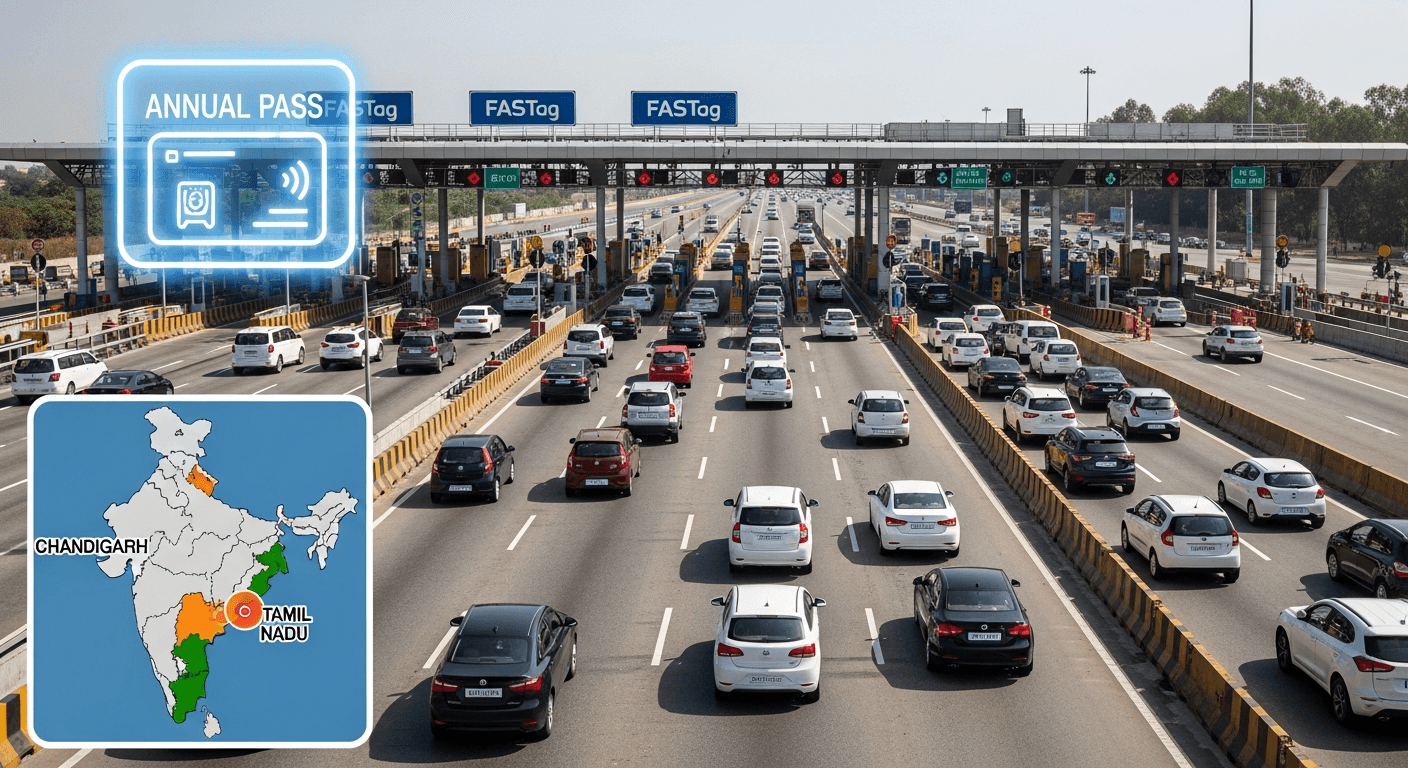
FASTag Annual Pass crosses 50 lakh users — a quick read
I watched the numbers and, like many commuters, I found the rapid uptake striking: within six months of launch the FASTag Annual Pass has been activated on over 50 lakh passenger vehicles and has facilitated roughly 26.5 crore toll transactions across the national highway network Times of India.
Key figures at a glance
- 50 lakh private vehicles bought the FASTag Annual Pass since mid‑August launch.
- ~26.5 crore transactions processed using the pass.
- Annual pass accounts for about 28% of all car transactions on national highways.
- Pass price: Rs. 3,000 for one year or up to 200 toll crossings (whichever comes first).
- Valid at roughly 1,150 toll plazas on national highways and expressways.
- Region highlights: Chandigarh ~14% of pass transactions, Tamil Nadu ~12.3%, Delhi ~11.5%.
- High‑use plazas: Bijwasan (Delhi NCR) ~57% of car crossings via the pass; Mundka and Jhinjholi ~53%.
Why adoption climbed quickly
There are several plausible reasons for the fast adoption curve:
- Cost incentive: at Rs. 3,000, the effective per‑trip cost falls dramatically for frequent users — the math favors the pass for anyone doing multiple highway crossings each week.
- Convenience: the pass removes repeated top‑ups and routine micro‑transactions, cutting friction for habitual travellers.
- Rapid activation and digital access: purchase and activation through Rajmargyatra/NHAI portals within hours made onboarding easy.
- Behavioural nudge: a pre‑paid, capped offer encourages users who were near the break‑even point to start taking more short highway trips — data show a roughly 50% rise in trips among motorists who previously took up to ~100 trips per year.
- Co‑benefit for operators: higher pass penetration makes the case stronger for faster, barrier‑less toll systems such as MLFF (Multi Lane Free Flow), which authorities are rolling out.
What this means for commuters
- Time savings: fewer payment interactions at plazas should shorten queues at plazas where pass uptake is high.
- Cost calculus: commuters should check historical toll usage before purchasing. The pass is attractive if you consistently approach the 200‑trip threshold or high annual toll bills.
- Balance monitoring: commuters must watch their remaining trip count and expiry — unused trips do not carry over beyond the pass validity.
- Route specificity: the pass works only on notified national highway/expressway plazas; state highway tolls and some local passes remain outside its coverage.
Policy and operational implications
- Revenue forecasting: a large shift to prepaid passes changes the timing of toll receipts and may affect cash‑flow models for concessionaires and NHAI.
- MLFF rollout: increased pass penetration makes MLFF more viable; authorities can scale barrier‑less tolls with lower gate‑side friction.
- Inter‑government coordination: states that operate their own toll plazas need policy conversations if the goal is a seamless national subscription product.
- Tariff revisions: the MoRTH/NHAI has signalled a price revision in April; authorities must communicate changes well in advance to prevent customer dissatisfaction.
- Fraud and eligibility controls: with prepaid passes tied to vehicle FASTags, robust verification and anti‑misuse checks are essential (e.g., misuse on commercial vehicles should be prevented).
Potential risks and gaps
- Local/State coverage: many regular short‑distance trips rely on state highways and municipal toll regimes — exclusion may blunt benefits for some users.
- Unequal benefits: the pass primarily benefits private non‑commercial vehicles; commercial operators and smaller users may not see comparable advantages.
- Overuse of short trips: a nudge toward more short highway trips could increase wear and environmental externalities unless balanced by broader transport planning.
Practical next steps (for authorities and commuters)
For authorities
- Publish clear, plaza‑level lists of pass applicability and work with states to broaden coverage or create complementary packages.
- Improve user interfaces for balance and trip tracking (apps, SMS alerts).
- Fast‑track MLFF in high‑uptake corridors and publish metrics showing time and emissions savings.
- Consider flexible pricing tiers (monthly, regional bundles) to capture more user segments.
For commuters
- Audit last 12 months of toll history before buying — the pass pays off for frequent highway users.
- Monitor remaining trips and activation/expiry dates closely; use app dashboards and SMS alerts.
- If you cross many state‑run plazas, check combined cost before opting in.
- Watch for the announced April tariff changes and lock in decisions accordingly.
Final take
The rapid acceptance of the FASTag Annual Pass is a clear signal: when pricing, convenience and digital access align, users adopt quickly. The challenge now is to translate that momentum into durable operational improvements (barrier‑free tolling, tighter fraud controls, better inter‑governmental integration) without shifting costs or creating patchy benefits across regions.
I’ll be watching how authorities use this adoption data to accelerate MLFF rollouts and whether product variations appear to serve commuters whose travel patterns differ from the frequent‑highway user.
Regards,
Hemen Parekh
Get correct answer to any question asked by Shri Amitabh Bachchan on Kaun Banega Crorepati, faster than any contestant
Hello Candidates :
- For UPSC – IAS – IPS – IFS etc., exams, you must prepare to answer, essay type questions which test your General Knowledge / Sensitivity of current events
- If you have read this blog carefully , you should be able to answer the following question:
- Need help ? No problem . Following are two AI AGENTS where we have PRE-LOADED this question in their respective Question Boxes . All that you have to do is just click SUBMIT
- www.HemenParekh.ai { a SLM , powered by my own Digital Content of more than 50,000 + documents, written by me over past 60 years of my professional career }
- www.IndiaAGI.ai { a consortium of 3 LLMs which debate and deliver a CONSENSUS answer – and each gives its own answer as well ! }
- It is up to you to decide which answer is more comprehensive / nuanced ( For sheer amazement, click both SUBMIT buttons quickly, one after another ) Then share any answer with yourself / your friends ( using WhatsApp / Email ). Nothing stops you from submitting ( just copy / paste from your resource ), all those questions from last year’s UPSC exam paper as well !
- May be there are other online resources which too provide you answers to UPSC “ General Knowledge “ questions but only I provide you in 26 languages !



No comments:
Post a Comment