
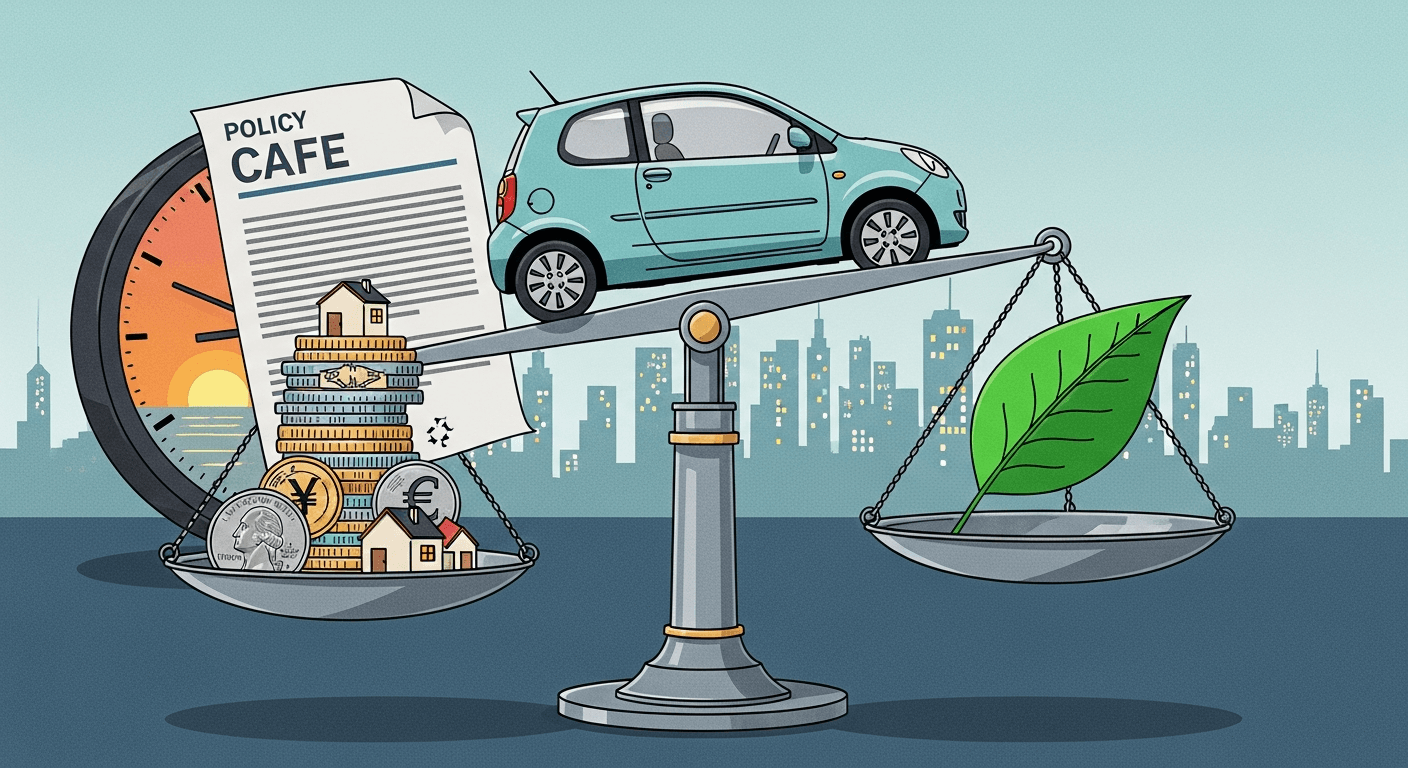
I watched the latest NITI Aayog recommendation on Corporate Average Fuel Efficiency (CAFE) norms and felt a familiar tug — policy trying to balance climate ambition, industrial competitiveness, and everyday affordability. The think‑tank’s push to incentivise lightweight, fuel‑efficient small cars under CAFE is a deliberate attempt to nudge first‑time buyers toward lower‑emission choices while keeping mobility affordable for millions source.
What the recommendation says (in short)
- NITI Aayog’s transport scenarios emphasise that a near‑term increase in zero‑emission vehicles is necessary for net‑zero pathways, but also that India’s current car ownership is low (~33 cars per 1,000 people). That means many households view a car as aspirational; affordability matters.
- The report calls for CAFE to incentivise smaller, lighter entry‑level cars because they offer higher fuel efficiency, lower tailpipe emissions, and reduced pressure on congestion and parking — provided lifecycle emissions and sustainable biofuel benefits are considered.
- Crucially, the study suggests a time‑bound sunset for any relaxations so that incentives don’t become permanent loopholes and the industry is prepared for global low‑emission export standards source.
The practical contours already being debated
Regulators and agencies have been working through draft language for CAFE‑3 (effective 2027–32). The key operational idea under discussion is a limited emission credit for qualifying small petrol cars — the concrete design (weight, length, engine capacity thresholds; and the magnitude of CO₂ deduction) matters a great deal. Past drafts and industry responses show how contentious this can be: relaxations can protect affordable mobility but also shift competitive advantage and risk undermining safety or electrification incentives [analysis in media commentary].
Why I welcome the intent — and where I worry
I welcome the intent. Policy should be rooted in social context: if a first‑time rural or peri‑urban buyer upgrades from a two‑wheeler to an ultra‑efficient small car, we gain real societal value. Smaller cars can deliver immediate emissions reductions per km and make personal mobility inclusive.
But design details will determine whether incentives amplify the public good or create distortions. My concerns are:
- Safety: Lightweight, ultra‑cheap cars sometimes score poorly on crash tests. Incentives must be conditional on minimum safety standards.
- Competitive fairness: A narrowly calibrated concession can advantage a very small set of models or manufacturers and distort the market.
- Lock‑in risk: If incentives persist indefinitely, they may delay the transition to EVs and lifecycle‑cleaner solutions.
- Lifecycle accounting: Tailpipe emissions aren’t the whole story — fuel production, use of biofuels, and end‑of‑life impacts must factor into policy.
Practical principles I’d press for (policy design checklist)
- Time‑bound relief: Any concession for small cars should have a clear sunset clause tied to measurable milestones (e.g., EV market share thresholds, tightened WLTP targets).
- Safety gating: Eligibility must require minimum crash‑safety and occupant protection scores.
- Lifecycle credits: Recognise sustainable biofuel blends and well‑measured lifecycle CO₂ benefits rather than reward only lab‑test tailpipe numbers.
- Anti‑gaming caps: Cap cumulative per‑manufacturer benefits so a single model or OEM cannot disproportionately capture credits.
- Complementary support for EVs/hybrids: Maintain or strengthen multipliers/credits for genuine zero‑emission technologies so the pathway to electrification remains attractive.
- Transparent data & periodic review: Require public disclosure of fleet compositions, credits claimed, and a scheduled policy review every 2–3 years.
A few second‑order effects policy must anticipate
- Urban planning and parking: Cheaper small cars may increase vehicle kilometres traveled if public transport and last‑mile options aren’t improved.
- Used‑car markets: Price shifts can affect the second‑hand market and long‑term fleet emissions — plan for end‑of‑life and scrappage incentives.
- Industrial strategy: Clear sunset notices help OEMs plan investments in EVs, hybrids, and safer platforms rather than chasing temporary advantages.
Where this fits in the arc of my past thinking
I’ve written about tighter fuel efficiency rules and the need to pair regulation with long‑term action plans before — the question of sequencing (tightening norms, EV incentives, charging infrastructure, and safety) has been a recurring theme in my reflections see one of my earlier posts on CAFE and electrification. What’s different now is the intensity of the industry debate and the clarity that tradeoffs are unavoidable.
My bottom line
Policy that deliberately nudges affordability toward cleaner, lighter cars can be part of a just transition — but only if crafted with discipline. Time limits, safety gates, lifecycle accounting and complementary EV incentives will determine whether the NITI Aayog suggestion becomes a smart bridge or a policy detour.
I’m hopeful because India’s regulatory institutions are capable of pragmatic design — but they must resist either moralizing about affordability or bowing to narrow industry rent‑seeking. Thoughtful, data‑driven CAFE rules can keep mobility affordable, protect citizens on our roads, and accelerate the shift to lifecycle‑clean transport.
Regards, Hemen Parekh
Any questions / doubts / clarifications regarding this blog? Just ask (by typing or talking) my Virtual Avatar on the website embedded below. Then "Share" that to your friend on WhatsApp.
Get correct answer to any question asked by Shri Amitabh Bachchan on Kaun Banega Crorepati, faster than any contestant
Hello Candidates :
- For UPSC – IAS – IPS – IFS etc., exams, you must prepare to answer, essay type questions which test your General Knowledge / Sensitivity of current events
- If you have read this blog carefully , you should be able to answer the following question:
- Need help ? No problem . Following are two AI AGENTS where we have PRE-LOADED this question in their respective Question Boxes . All that you have to do is just click SUBMIT
- www.HemenParekh.ai { a SLM , powered by my own Digital Content of more than 50,000 + documents, written by me over past 60 years of my professional career }
- www.IndiaAGI.ai { a consortium of 3 LLMs which debate and deliver a CONSENSUS answer – and each gives its own answer as well ! }
- It is up to you to decide which answer is more comprehensive / nuanced ( For sheer amazement, click both SUBMIT buttons quickly, one after another ) Then share any answer with yourself / your friends ( using WhatsApp / Email ). Nothing stops you from submitting ( just copy / paste from your resource ), all those questions from last year’s UPSC exam paper as well !
- May be there are other online resources which too provide you answers to UPSC “ General Knowledge “ questions but only I provide you in 26 languages !



No comments:
Post a Comment