
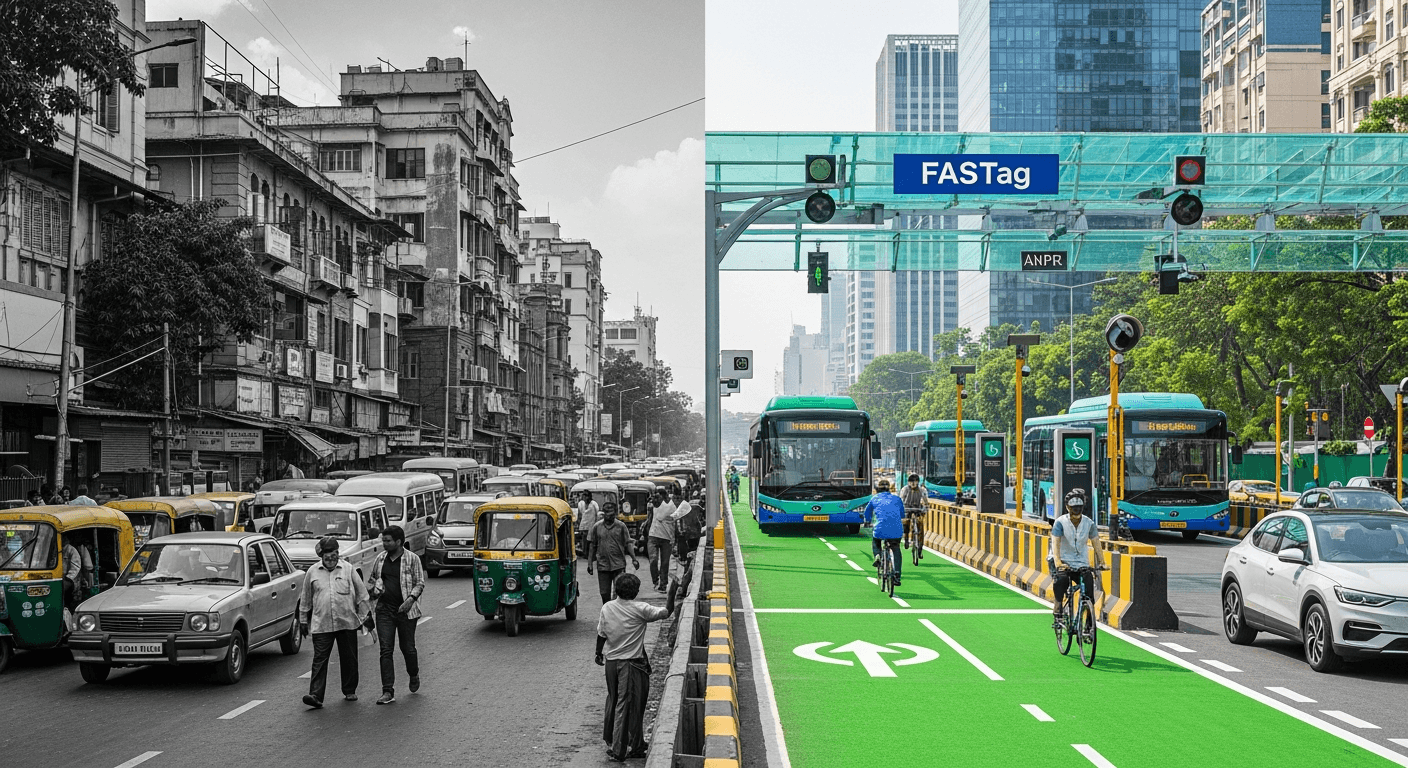
Why I’m watching the congestion-tax debate
A recent Times of India report describes a proposal by a BJP corporator to pilot a congestion tax for private, single-occupant vehicles entering south Mumbai’s business districts during peak hours — roughly a Rs 50–100 levy per entry, collected via FASTag and camera-based checks, with revenues earmarked for cleaner air and better public transport Pay to drive into south Mumbai: BJP leader pushes congestion tax to cut traffic and pollution. I’ve written about congestion pricing and “trans-tax” ideas in the past, so this proposal naturally caught my attention (From Harm Quotient to Trans Tax, Pigovian Tax for Polluters).
I want to take a clear, practical look at what the proposal says, why Mumbai’s context matters, what benefits and concerns deserve careful thought, how other cities have done this, and what alternatives are worth considering.
What the proposal actually proposes
- A pilot in south Mumbai’s central business districts (Fort, Nariman Point, Colaba).
- Target: single-occupant private cars during morning and evening peaks (proposed windows ~8–11am and 5–8pm).
- Fee: small per-entry charge (reported range Rs 50–100).
- Collection: automatic deduction via FASTag, supported by CCTV/ANPR cameras at entry points.
- Use of proceeds: fund air‑quality and sustainable-transport projects.
This is deliberately small-scale as a pilot — that’s the right first step if the aim is to test system design, behavioural responses and fairness.
Why Mumbai is a special case
Mumbai combines very high vehicle density, constrained road space, mixed vehicle types (two‑wheelers, autorickshaws, taxis, trucks) and an intense demand for access to a narrow, economically vital south Mumbai. Unlike planned grids, our streets are a patchwork of functions — commerce, markets, commuters and pedestrians — so any pricing must account for real-world heterogeneity.
At the same time, the city’s public-transport backbone (trains, new metro lines, buses) is improving but still faces capacity, last‑mile and reliability issues. Asking commuters to shift modes without credible alternatives risks political backlash and unequal burdens.
Potential benefits
- Reduced peak congestion and more predictable travel times for those who must drive.
- Lower local emissions in the charging zone and better air quality if trips are displaced to cleaner modes.
- Revenue that can be ring‑fenced for bus frequency, pedestrian improvements, cycling infrastructure and last‑mile connectivity.
- Incentive for employers and buildings to promote car‑sharing, flexible hours or remote work.
Evidence from London, Singapore, Stockholm and now New York shows that well-designed pricing can cut traffic and raise funds for transit; but implementation, exemptions and reinvestment matter.
Main concerns and opposition
- Equity: A flat per‑entry fee can be regressive unless exemptions, discounts or alternatives are provided for low‑income workers, essential service vehicles, and residents.
- Capacity of alternatives: Without sufficient and reliable public transport, commuters bear the cost without realistic choices.
- Implementation integrity: ANPR and FASTag enforcement must be robust, privacy-aware and transparent to avoid errors and evasion.
- Political optics: Residents already pay many taxes and charges; introducing another fee without visible improvements will be unpopular.
These are precisely the issues that make pilots and public consultation essential.
Lessons from global practice
- London combined a congestion charge with investments in buses and cycling; it reduced car entries and funded improvements.
- Singapore’s dynamic electronic road pricing adjusts by time and location, which is more sophisticated but requires expensive infrastructure and strong policy oversight.
- Stockholm tested pricing with a trial and public referendum before making it permanent — a model worth noting for democracy and buy‑in.
The key takeaway: pricing works best when paired with visible improvements in mobility and clear rules about revenue use.
Practical implementation options for Mumbai
- Start small: a time-limited pilot in a tightly defined zone, with clear KPIs (vehicle volumes, travel times, AQI changes).
- Differential pricing: lower fees for residents, exemptions for emergency and service vehicles, discounts for pooled trips.
- Ring‑fence revenue: legally mandate that proceeds go to transit frequency, last‑mile solutions and pedestrian/cycling upgrades.
- Transparent technology: open audit trails for ANPR/FASTag records, clear grievance channels and privacy safeguards.
- Parallel measures: curb illegal parking, enforce loading/unloading rules, and improve signal timing — pricing is one lever, not the whole solution.
Alternatives worth considering
- Parking reform: higher, smarter parking prices to discourage long-term curb occupation.
- Employer-based incentives: tax-free transit benefits, staggered office hours, promoted car‑pools.
- Area-based pedestrianisation and timed delivery windows to reduce conflict between goods vehicles and commuters.
My balanced conclusion
A congestion tax for south Mumbai is neither an instant cure nor a revenue grab per se. Done well — with a tight pilot, fairness measures, transparent technology and a legally ring‑fenced revenue stream for public transport — it can reduce congestion and pollution while funding improvements that make drivers and non-drivers better off. Done poorly — without alternatives or clear accountability — it risks becoming another charge that angers commuters and deepens inequity.
I’ve argued before that pricing is a legitimate tool in the urban toolkit, but only when paired with systemic improvements and public trust (From Harm Quotient to Trans Tax). Mumbai’s next step should be to test, measure, explain and improve — not to rush.
Regards,
Hemen Parekh
Any questions / doubts / clarifications regarding this blog? Just ask (by typing or talking) my Virtual Avatar on the website embedded below. Then "Share" that to your friend on WhatsApp.
Get correct answer to any question asked by Shri Amitabh Bachchan on Kaun Banega Crorepati, faster than any contestant
Hello Candidates :
- For UPSC – IAS – IPS – IFS etc., exams, you must prepare to answer, essay type questions which test your General Knowledge / Sensitivity of current events
- If you have read this blog carefully , you should be able to answer the following question:
- Need help ? No problem . Following are two AI AGENTS where we have PRE-LOADED this question in their respective Question Boxes . All that you have to do is just click SUBMIT
- www.HemenParekh.ai { a SLM , powered by my own Digital Content of more than 50,000 + documents, written by me over past 60 years of my professional career }
- www.IndiaAGI.ai { a consortium of 3 LLMs which debate and deliver a CONSENSUS answer – and each gives its own answer as well ! }
- It is up to you to decide which answer is more comprehensive / nuanced ( For sheer amazement, click both SUBMIT buttons quickly, one after another ) Then share any answer with yourself / your friends ( using WhatsApp / Email ). Nothing stops you from submitting ( just copy / paste from your resource ), all those questions from last year’s UPSC exam paper as well !
- May be there are other online resources which too provide you answers to UPSC “ General Knowledge “ questions but only I provide you in 26 languages !





No comments:
Post a Comment