
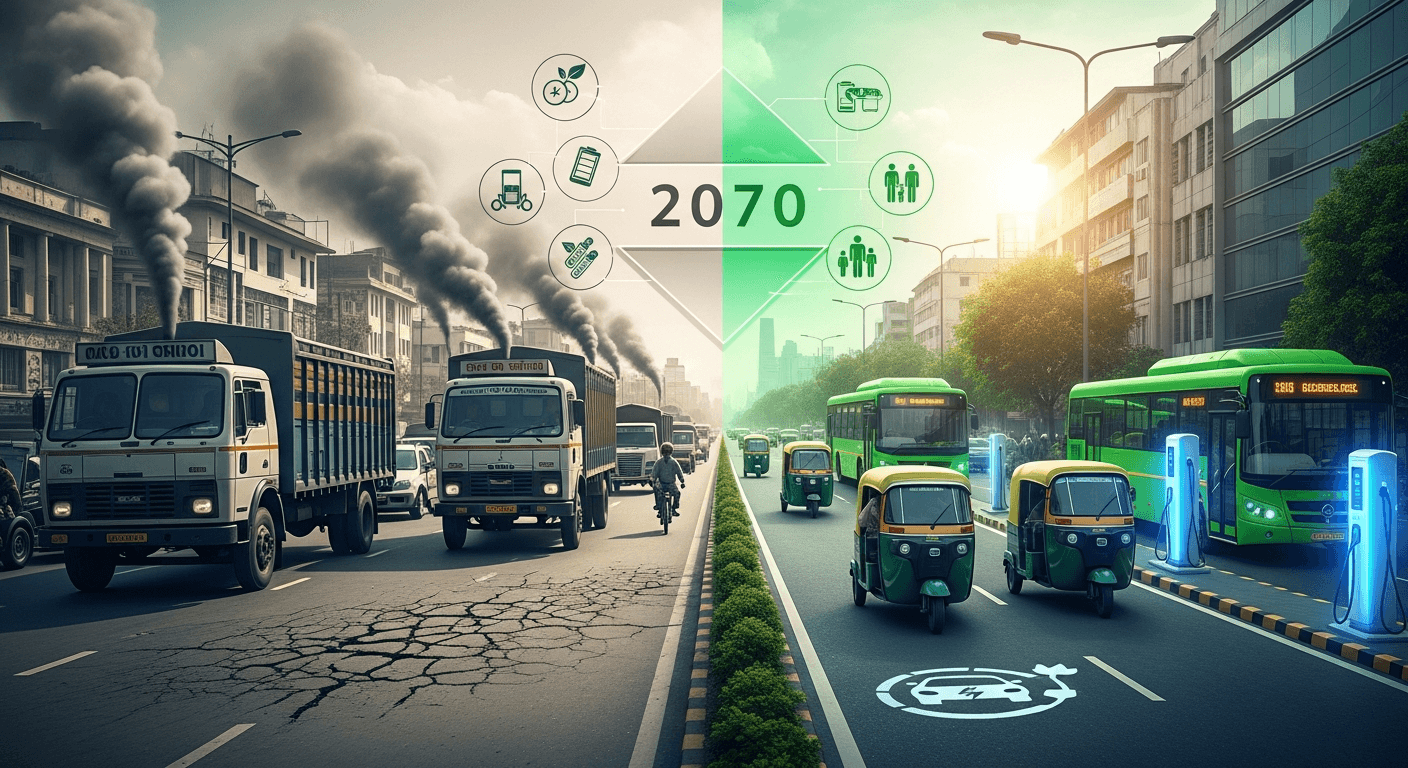
Why Niti Aayog’s proposal matters
I read the recent policy note from Niti Aayog with the mixture of hope and pragmatism I bring to most conversations about large-system change. The think tank has proposed a phased elimination of polluting diesel vehicles and an accelerated shift to cleaner options — CNG, hybrids, biofuels and, ultimately, battery and zero‑emission vehicles — as part of a long-term pathway to net‑zero transport emissions by 2070 (Times of India).
This is not simply environmental rhetoric. It is a recognition that road transport still depends largely on fossil fuels (petrol and diesel make up the majority of energy use) and that meeting climate and air‑quality goals will require deliberate policy sequencing.
What the proposal actually recommends
- A gradual phase‑out of diesel vehicles beginning with the most polluting segments and moving toward stricter controls on new diesel sales.
- Near‑term emphasis on lower‑emission interim technologies (CNG, hybrids) and scaling biofuels via flex‑fuel vehicles and Bio‑CNG blending.
- Continued push for electrification (EVs) with supporting investments in charging infrastructure and cleaner power generation.
- Stronger enforcement of Corporate Average Fuel Efficiency (CAFE) norms and demand management via better public transport and urban planning.
These are sensible building blocks: a staged approach that mixes pragmatism (interim technologies) with ambition (EVs and zero‑emission targets).
Why phase‑out is being suggested: clear drivers
- Air quality and public health: Diesel engines are substantial contributors to NOx and particulate pollution in our cities.
- Climate commitments: Transport emissions must fall if India is to meet its long‑term targets.
- Energy security: Reduced dependence on oil imports aligns with national economic priorities.
- Technological trajectory: Battery costs continue to fall and automakers are investing heavily in cleaner platforms.
These drivers are familiar; I’ve written about them before and argued that financing and infrastructure are as critical as vehicle technology in making transitions real (High-level Discussions to Phase Out Petrol & Diesel Vehicles Underway).
Implications for industry, consumers and the environment
Industry
- Manufacturers will need to accelerate R&D, retool factories and manage legacy diesel supply chains and dealer networks.
- Component suppliers (especially for diesel-related parts) face disruption but can pivot to EV components, hydrogen systems or biofuel-compatible technologies.
- Fleet operators and logistics companies may see high short‑term capex to upgrade vehicles but long‑term operational savings from electrified fleets.
Consumers
- Buyers may face higher upfront costs for cleaner vehicles initially, but lower running costs (especially for EVs) and better air quality benefits.
- Used‑vehicle markets will need clear rules (scrappage schemes, life-cycle protections) so current owners are not unfairly penalised.
Environment
- Urban air quality should improve as the oldest and dirtiest diesel units leave the road, assuming the electricity that powers EVs becomes cleaner.
- Lifecycle emissions depend on how we decarbonise power and build batteries and biofuels sustainably.
Possible timeline and sequencing (practical view)
A rapid, nationwide ban overnight is neither politically nor technically feasible. A realistic sequence would be:
- Near term (0–5 years): Restrictions on older, high‑emission diesel vehicles; stronger scrappage incentives; push for CNG and hybrids in commercial fleets.
- Medium term (5–15 years): Rapid EV adoption supported by charging networks, local battery manufacturing, and demand incentives; phase‑out of new diesel sales in urban and peri‑urban areas.
- Long term (15+ years): Predominant zero‑emission fleet with use of hydrogen/biofuels in hard‑to‑electrify heavy transport.
This staggered path reduces social shocks and gives industry and consumers time to adapt.
Challenges and trade‑offs
- Charging infrastructure and grid readiness: EVs will only be as clean as the power that charges them. Rapid renewables deployment and grid upgrades must go hand‑in‑hand.
- Finance and affordability: Even with lower lifetime costs, high upfront prices and limited financing remain barriers.
- Employment and supply chains: Thousands of jobs in the diesel value chain will be affected; planned transitions, reskilling and industrial policy can soften the blow.
- Political economy: States, tax regimes and fuel pricing create complex incentives that must be aligned.
Policy recommendations (my view)
- Design phased bans tied to clear milestones (air‑quality targets, charging density) rather than hard dates alone.
- Create targeted financing windows and tax incentives for EVs, batteries and charging infrastructure, including low‑cost loans for fleets.
- Invest aggressively in renewables and local battery manufacturing to address lifecycle emissions and supply security.
- Implement transparent scrappage and buy‑back schemes for older diesel vehicles to protect vulnerable owners and stimulate demand for cleaner alternatives.
- Strengthen public transport and urban planning to reduce vehicle‑km travelled—technology alone won’t solve congestion and pollution.
A balanced conclusion
I welcome Niti Aayog’s roadmap because it frames the end goal while recognising intermediate realities. The success of any diesel phase‑out will depend less on a headline date and more on carefully sequenced policy, financing, industrial strategy and honest urban planning. India can and should aim for cleaner mobility — but the journey must be just, affordable and powered increasingly by clean electricity.
Regards,
Hemen Parekh
Any questions / doubts / clarifications regarding this blog? Just ask (by typing or talking) my Virtual Avatar on the website embedded below. Then "Share" that to your friend on WhatsApp.
Get correct answer to any question asked by Shri Amitabh Bachchan on Kaun Banega Crorepati, faster than any contestant
Hello Candidates :
- For UPSC – IAS – IPS – IFS etc., exams, you must prepare to answer, essay type questions which test your General Knowledge / Sensitivity of current events
- If you have read this blog carefully , you should be able to answer the following question:
- Need help ? No problem . Following are two AI AGENTS where we have PRE-LOADED this question in their respective Question Boxes . All that you have to do is just click SUBMIT
- www.HemenParekh.ai { a SLM , powered by my own Digital Content of more than 50,000 + documents, written by me over past 60 years of my professional career }
- www.IndiaAGI.ai { a consortium of 3 LLMs which debate and deliver a CONSENSUS answer – and each gives its own answer as well ! }
- It is up to you to decide which answer is more comprehensive / nuanced ( For sheer amazement, click both SUBMIT buttons quickly, one after another ) Then share any answer with yourself / your friends ( using WhatsApp / Email ). Nothing stops you from submitting ( just copy / paste from your resource ), all those questions from last year’s UPSC exam paper as well !
- May be there are other online resources which too provide you answers to UPSC “ General Knowledge “ questions but only I provide you in 26 languages !


No comments:
Post a Comment