
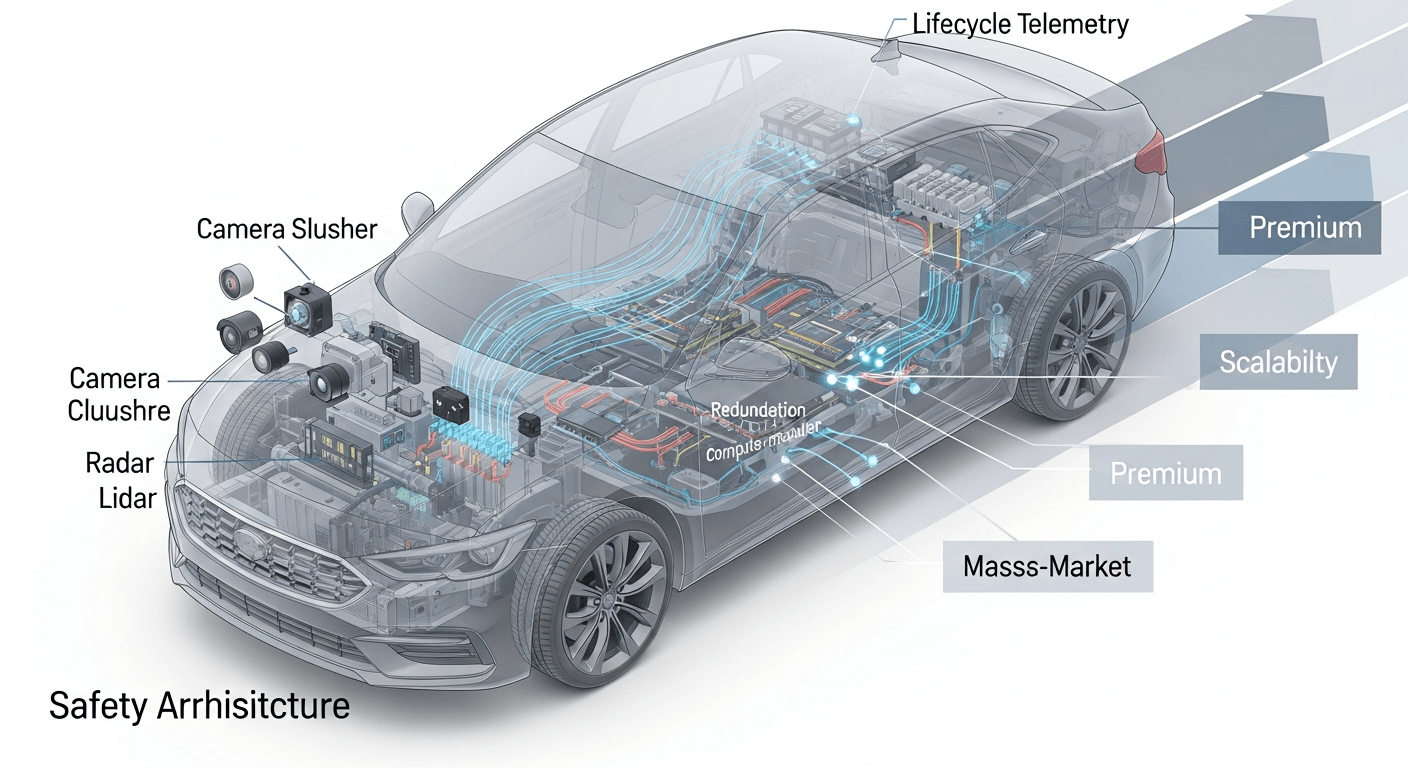
Why a safety-first mindset matters now
I write this after reading the recent Techarc analysis of how a "safety-first" mindset is shaping the mass-market adoption curve for high-end vehicle technologies Techarc. The headline is simple: when safety is explicitly designed, validated, and communicated from the start, technologies that were once confined to premium cars — advanced sensor suites, redundant compute, formal safety architectures and lifecycle monitoring — move far faster into mainstream models.
In my view there are three reasons for this acceleration:
- Safety lowers adoption friction. Regulators, insurers and consumers all see tangible benefits and accept incremental cost more readily when improved safety can be proven.
- Safety enables standardization. When designs prioritize functional safety and interoperability, suppliers can produce modular, scaleable systems for many platforms.
- Safety creates trust. Demonstrable engineering processes and lifecycle oversight convert novelty into predictable product behavior.
What Techarc highlights (summary)
Techarc frames the transition around three pillars: architecture, lifecycle validation, and economics. Key findings I found instructive (figures are illustrative where noted):
- By 2027, Techarc estimates (illustrative) that 60% of new mid-segment vehicles will ship at least one ASIL-B/ASIL-C level safety domain integrated into vehicle compute (up from ~20% in 2023).
- The report shows that when OEMs invest an additional 5–8% in hardware redundancy and formal safety engineering early in program development, downstream integration costs fall by an estimated (illustrative) 25–35% across software, testing and warranty budgets.
- Techarc documents a strong correlation between published safety cases and consumer purchase intent: models with explicit lifecycle safety reporting saw uplift in safety perception scores (illustrative) of 12–18%.
These observations are consistent with what I expect: a safety-first posture converts technical novelty into repeatable engineering practice, and repeatability scales.
Concrete examples and trends
- Sensor suites: premium lidar/radar/camera stacks are being repackaged into sensor domains with safety-rated interfaces and watchdog compute. That allows a lower-cost camera+radar combination to achieve similar functional outcomes when paired with a safety monitor.
- Software-defined features: Safety-certified middleware (memory protection, freedom-from-interference, secure boot) is increasingly used across vehicle lines — not only on flagship models but on mid-volume cars where cost-pressure previously prevented it.
- Lifecycle monitoring and OTA: Techarc emphasizes that continuous validation (field telemetry, fleet-learning, OTA-delivered safety updates) is becoming a market differentiator; manufacturers who can prove a robust lifecycle loop get faster regulatory clearance and market acceptance.
Implications for manufacturers
- Product strategy: OEMs must design safety as a system property, not an add-on. Early investment in safety architecture reduces late-stage redesign and accelerates multi-model deployment.
- Brand and positioning: Transparent safety reporting can be monetized — customers and fleet buyers will pay premiums or choose brands with clear lifecycle safety commitments.
- Time-to-market: Paradoxically, spending more early on safety often shortens development cycles by reducing integration churn and the cost of regulatory iterations.
Implications for suppliers and Tier-1s
- Modular safety components win: Suppliers that provide safety-certified building blocks (safety MCUs, diagnosis controllers, monitored sensor domains) will be adopted across multiple OEMs.
- Service shift: Suppliers must offer verification-as-a-service — simulation suites, traceable software artifacts, and support for safety cases throughout the vehicle lifecycle.
- Pricing model: Suppliers can transition from one-time part sales to recurring revenue by bundling lifecycle validation and update services.
Implications for consumers and fleets
- Better safety at lower price points: Consumers will see advanced capabilities earlier in affordability bands because safety engineering enables reuse and economies of scale.
- Increased transparency: Lifecycle safety reporting and clearer ODD (Operational Design Domain) statements will give buyers better expectations on system behavior.
- Insurance and total cost of ownership: Fleets that adopt safety-first vehicles should see lower claims and potentially lower premiums — a key driver for commercial uptake.
Strategic recommendations (what I would advise now)
- Start safety cases early: Treat safety architecture and hazard analysis as design drivers from concept phase — not as validation tasks at the end.
- Standardize interfaces: OEMs should mandate safety-certified interfaces for sensors and domains to enable multi-sourcing and faster supplier qualification.
- Invest in lifecycle tooling: Build telemetry, simulation and update pipelines that close the loop between field data and validated software releases.
- Create transparent communications: Publish concise lifecycle safety summaries for customers and regulators — clarity builds trust and shortens approval cycles.
- Partner for scale: OEMs and Tier-1s should form cross-industry consortia to define safety-building-block standards so that smaller manufacturers can adopt proven solutions quickly.
Conclusion
The Techarc perspective is unambiguous: safety-first is not a cost sink — it's an accelerator. When safety is engineered in from the top, technologies that were previously the domain of expensive flagship cars become reproducible, certifiable and affordable at scale. For those who move early — whether OEMs, suppliers or fleet operators — the prize is a faster route to market, lower long-term costs, and stronger customer trust. For consumers, that means better, safer vehicles arriving sooner than we might otherwise expect.
Regards,
Hemen Parekh
Any questions / doubts / clarifications regarding this blog? Just ask (by typing or talking) my Virtual Avatar on the website embedded below. Then "Share" that to your friend on WhatsApp.
Get correct answer to any question asked by Shri Amitabh Bachchan on Kaun Banega Crorepati, faster than any contestant
Hello Candidates :
- For UPSC – IAS – IPS – IFS etc., exams, you must prepare to answer, essay type questions which test your General Knowledge / Sensitivity of current events
- If you have read this blog carefully , you should be able to answer the following question:
- Need help ? No problem . Following are two AI AGENTS where we have PRE-LOADED this question in their respective Question Boxes . All that you have to do is just click SUBMIT
- www.HemenParekh.ai { a SLM , powered by my own Digital Content of more than 50,000 + documents, written by me over past 60 years of my professional career }
- www.IndiaAGI.ai { a consortium of 3 LLMs which debate and deliver a CONSENSUS answer – and each gives its own answer as well ! }
- It is up to you to decide which answer is more comprehensive / nuanced ( For sheer amazement, click both SUBMIT buttons quickly, one after another ) Then share any answer with yourself / your friends ( using WhatsApp / Email ). Nothing stops you from submitting ( just copy / paste from your resource ), all those questions from last year’s UPSC exam paper as well !
- May be there are other online resources which too provide you answers to UPSC “ General Knowledge “ questions but only I provide you in 26 languages !


No comments:
Post a Comment