
Why this blueprint matters to me
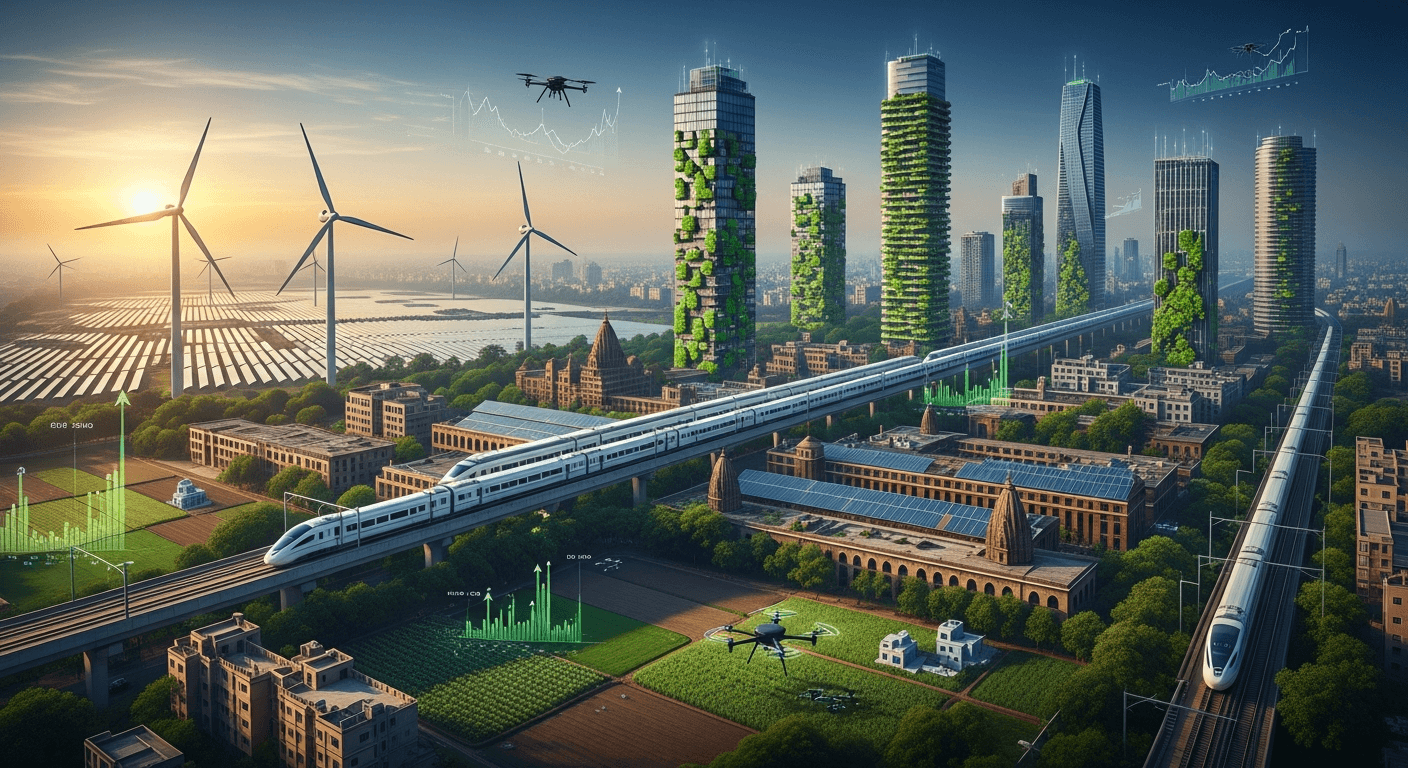
When NITI Aayog released its multi‑report study, "Scenarios Towards Viksit Bharat and Net Zero," I read it as more than a technical exercise — it is a national map for how a growing India can decouple prosperity from emissions. The study integrates power, transport, industry, buildings and agriculture into a single set of development scenarios and policy levers. I see this as the difference between ad hoc fixes and systems thinking: the choices we make now determine whether India builds its future on clean foundations or expensive lock‑ins.NITI Aayog: Scenarios Towards Viksit Bharat and Net Zero
I’ve been writing about transport, energy pricing and pragmatic policy nudges for years — this blueprint validates many of those themes and gives them rigorous numeric pathways to 2047 and beyond.Good Advice by Energy Transition Advisory Committee
The headline targets and finance realities
- The report aligns the ambition of a developed India by 2047 (Viksit Bharat) with a Net Zero trajectory by 2070, showing they are technically consistent when linked through integrated modelling.NITI Aayog Releases First Set of Reports
- It projects a massive capital requirement over the coming decades (order of magnitude: tens of trillions of dollars) and identifies a sizeable financing gap that will need to be filled with domestic reforms and global capital partnerships.NITI Aayog study summary
These numbers are not a scare tactic — they are a budgeting reality. If we underprice the transition, the bill will arrive as stranded assets, higher import vulnerabilities, and lost competitiveness.
Sectoral strategies — what NITI Aayog recommends (and what I believe matters)
Power
- Rapid scale up of renewables plus storage, transmission expansion and investments in firm low‑carbon capacity (including nuclear and emerging SMRs) to give large‑scale electrification reliability.
- Focus on grid flexibility, round‑the‑clock procurement models and critical minerals planning for the clean energy value chain.NITI Aayog: Power pathways
Transport
- Electrification of passenger and freight vehicles where feasible, combined with modal shift to public transport, rail and waterways; support for zero‑emission fleets and clean fuels for segments where batteries are less suitable.
- Policy levers include vehicle standards, procurement priorities, charging infrastructure roadmaps and urban mobility design.
Industry
- A four‑pillar approach: aggressive efficiency, electrification where possible, circularity (material efficiency and recycling), and low‑carbon fuels such as green hydrogen.
- Recognition that hard‑to‑abate processes will need CCUS, process innovation, and long lead‑time R&D support.Sectoral insights — industry PDF
Agriculture
- Productivity and resilience improvements that reduce emissions intensity: precision nutrient management, lower‑emission rice practices, better residue management, methane mitigation in livestock and use of bioenergy from waste.
- Policies must balance farmer incomes, food security and decarbonisation.
Buildings
- Strict energy‑efficient building codes, electrification of cooking and heating where feasible, appliance standards and large scale retrofits for existing stock.
- The insight here: 85% of the built environment of 2047 is yet to be constructed — that is an opportunity we cannot squander.NITI Aayog synthesis
Key cross‑cutting challenges
- Finance: a persistent gap between required capital and available cheap long‑term finance.
- Technology readiness: many low‑carbon levers (green H₂ at scale, CCUS, SMRs) need cost reductions and demonstrations.
- Minerals & supply chains: critical minerals demand for batteries, electrolyzers and wind/solar components will stress supply chains unless proactively managed.
- Implementation for MSMEs and informal sectors: access to finance, technology and institutional support is uneven.
- Social and skill transitions: worker reskilling, district economic diversification and inclusive policy design are essential.
My practical recommendations (policy and implementation)
- Build blended public‑private finance vehicles and a National Green Finance Institution to de‑risk early deployments and crowd in patient global capital.
- Use public procurement as a demand anchor (RE‑RTC, green steel, low‑carbon cement) and adopt product‑level standards and digital product passports to scale circular markets.
- Prioritise MSME transition via a dedicated National Project Management Agency with cluster‑level SPVs and blended grants/loans for retrofits and equipment.
- Accelerate strategic manufacturing incentives (PLI‑style) for electrolysers, batteries and critical upstream inputs — couple this with scaled R&D centres.
- Invest in skills and social safety nets: national retraining roadmaps, verified worker IDs and relocation support for communities affected by structural shifts.
- Strengthen data‑driven monitoring: integrated modelling must be paired with a live dashboard to track investments, emissions and social outcomes.
Final thought
This blueprint is a roadmap — not a guarantee. The modelling is invaluable: it translates targets into technologies, investments and institutional tasks. But route maps require disciplined execution, honest accounting of trade‑offs, and a willingness to mobilise both public stewardship and private innovation. If India treats the next two decades as a one‑time chance to build durable, low‑carbon infrastructure, we can secure growth and climate goals together.
Regards,
Hemen Parekh
Any questions / doubts / clarifications regarding this blog? Just ask (by typing or talking) my Virtual Avatar on the website embedded below. Then "Share" that to your friend on WhatsApp.
Get correct answer to any question asked by Shri Amitabh Bachchan on Kaun Banega Crorepati, faster than any contestant
Hello Candidates :
- For UPSC – IAS – IPS – IFS etc., exams, you must prepare to answer, essay type questions which test your General Knowledge / Sensitivity of current events
- If you have read this blog carefully , you should be able to answer the following question:
- Need help ? No problem . Following are two AI AGENTS where we have PRE-LOADED this question in their respective Question Boxes . All that you have to do is just click SUBMIT
- www.HemenParekh.ai { a SLM , powered by my own Digital Content of more than 50,000 + documents, written by me over past 60 years of my professional career }
- www.IndiaAGI.ai { a consortium of 3 LLMs which debate and deliver a CONSENSUS answer – and each gives its own answer as well ! }
- It is up to you to decide which answer is more comprehensive / nuanced ( For sheer amazement, click both SUBMIT buttons quickly, one after another ) Then share any answer with yourself / your friends ( using WhatsApp / Email ). Nothing stops you from submitting ( just copy / paste from your resource ), all those questions from last year’s UPSC exam paper as well !
- May be there are other online resources which too provide you answers to UPSC “ General Knowledge “ questions but only I provide you in 26 languages !



No comments:
Post a Comment