
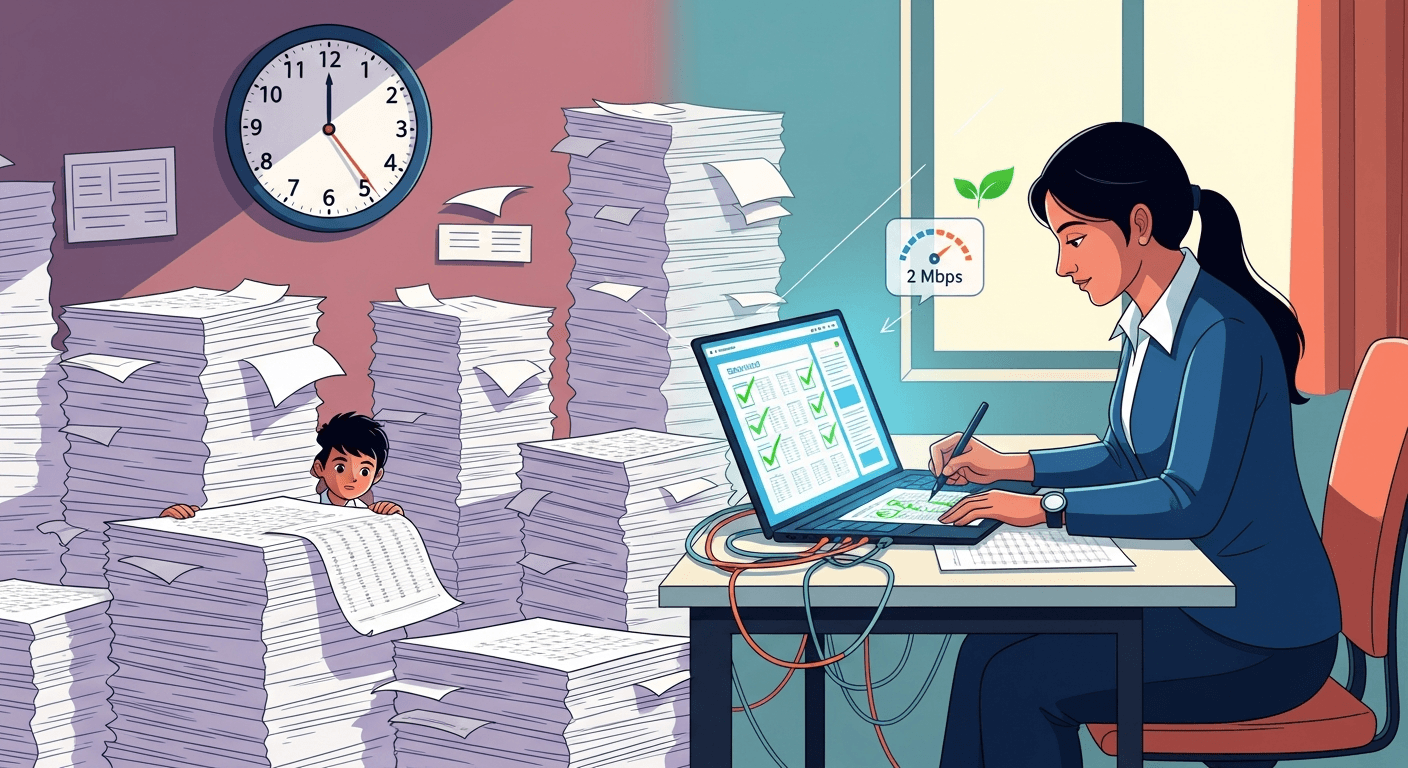
I read the announcement with a mix of relief and scrutiny: the Central Board of Secondary Education will introduce On-Screen Marking (OSM) for Class 12 answer books starting with the 2026 exams CBSE announces on screen marking system for 2026 Class 12 exams — The Tribune.
Why this matters to me
As someone who has long argued that technology must be harnessed to bring fairness and scale to education, this feels like the logical next step. The change is targeted: keep pen-and-paper exams, but shift the evaluation to a digital platform. The expected benefits are clear in the board’s communication — fewer totalling errors, faster processing, broader teacher participation and reduced logistical overhead.
What CBSE expects schools to do
The move isn't just a software flip. Schools will need to meet concrete technical requirements before they can participate in evaluation:
- A computer lab with a public static IP.
- Machines running Windows 8 or above, with minimum 4 GB RAM and 1 GB free on C: drive.
- Updated web browsers and Adobe Reader.
- Reliable internet (minimum 2 Mbps) and uninterrupted power supply.
CBSE plans training, dry runs, instructional videos and a call centre to smooth the transition — sensible, but not sufficient on its own.
The immediate upsides
- Elimination of arithmetic/totalling errors via automated calculation.
- Faster turnaround and less physical transport of answer books (time and carbon savings).
- Wider pool of examiners: teachers can evaluate from their own schools, increasing flexibility.
- Potentially reduced need for manpower in post-result verification procedures.
These are practical wins. But the policy's success will depend on equitable access and rigorous implementation.
My concerns (and what I’d watch for)
- Digital divide: many schools — especially smaller or resource-constrained ones — will struggle to meet the stated infrastructure requirements. Without targeted funding or phased concessions, the change could widen inequities.
- Security and integrity: scanned answer scripts, access controls, audit logs and encryption must be bulletproof. Dry runs and call centres help, but robust, independently audited security is essential.
- Training and calibration: evaluation uniformity depends on well-calibrated rubrics and sustained training. A screen-based interface can standardise some elements, but human judgment still dominates.
- Change management: the logistics of assigning scripts, monitoring evaluations, and handling exceptions need operational playbooks that account for connectivity outages, hardware failures and local constraints.
Where this fits in a longer story
This is not an isolated reform. Over the last couple of years I’ve written about CBSE’s push toward surveillance and tech-assisted exam administration — for example, when the board mandated CCTV in exam rooms and we discussed how technology can reduce malpractices and improve transparency CBSE mandates CCTVs in class for 10 & 12 board exams in 2025. That conversation anticipated many of the operational and ethical trade-offs we now face with OSM.
The pattern is familiar: incremental, back-end digitalisation aimed at improving fairness while keeping the visible experience for students unchanged. That’s a pragmatic approach — but it obliges policymakers to address access gaps and privacy safeguards proactively.
Practical advice for schools, teachers and parents
- Schools: audit your infrastructure now. If you lack a public static IP or reliable bandwidth, start conversations with local ISPs and education authorities about subsidies or pooled evaluation centres.
- Teachers: request hands-on training and insist on calibration sessions so marking standards remain consistent across evaluators.
- Parents and students: ask schools how OSM will affect re-check processes, timelines for results, and data privacy policies.
A note on governance and equity
Digital reforms succeed when accompanied by governance: clear SLAs for the tech platform, external audits for security and privacy, compensation or support for schools that lack readiness, and transparent escalation routes for students who believe their answers were mishandled. Without these, a well-intentioned reform risks leaving the most vulnerable behind.
In closing
I welcome the move toward on-screen marking because it addresses concrete pain points — arithmetic errors, slow processing, and logistical cost. But we must be vigilant: scale the rollout with fairness, secure the systems, and invest in training. Done well, OSM can be a building block toward an examination system that is faster, fairer and more sustainable. Done poorly, it will be another layer of digital bureaucracy that deepens existing divides.
Regards,
Hemen Parekh
Any questions / doubts / clarifications regarding this blog? Just ask (by typing or talking) my Virtual Avatar on the website embedded below. Then "Share" that to your friend on WhatsApp.
Get correct answer to any question asked by Shri Amitabh Bachchan on Kaun Banega Crorepati, faster than any contestant
Hello Candidates :
- For UPSC – IAS – IPS – IFS etc., exams, you must prepare to answer, essay type questions which test your General Knowledge / Sensitivity of current events
- If you have read this blog carefully , you should be able to answer the following question:
- Need help ? No problem . Following are two AI AGENTS where we have PRE-LOADED this question in their respective Question Boxes . All that you have to do is just click SUBMIT
- www.HemenParekh.ai { a SLM , powered by my own Digital Content of more than 50,000 + documents, written by me over past 60 years of my professional career }
- www.IndiaAGI.ai { a consortium of 3 LLMs which debate and deliver a CONSENSUS answer – and each gives its own answer as well ! }
- It is up to you to decide which answer is more comprehensive / nuanced ( For sheer amazement, click both SUBMIT buttons quickly, one after another ) Then share any answer with yourself / your friends ( using WhatsApp / Email ). Nothing stops you from submitting ( just copy / paste from your resource ), all those questions from last year’s UPSC exam paper as well !
- May be there are other online resources which too provide you answers to UPSC “ General Knowledge “ questions but only I provide you in 26 languages !



No comments:
Post a Comment