
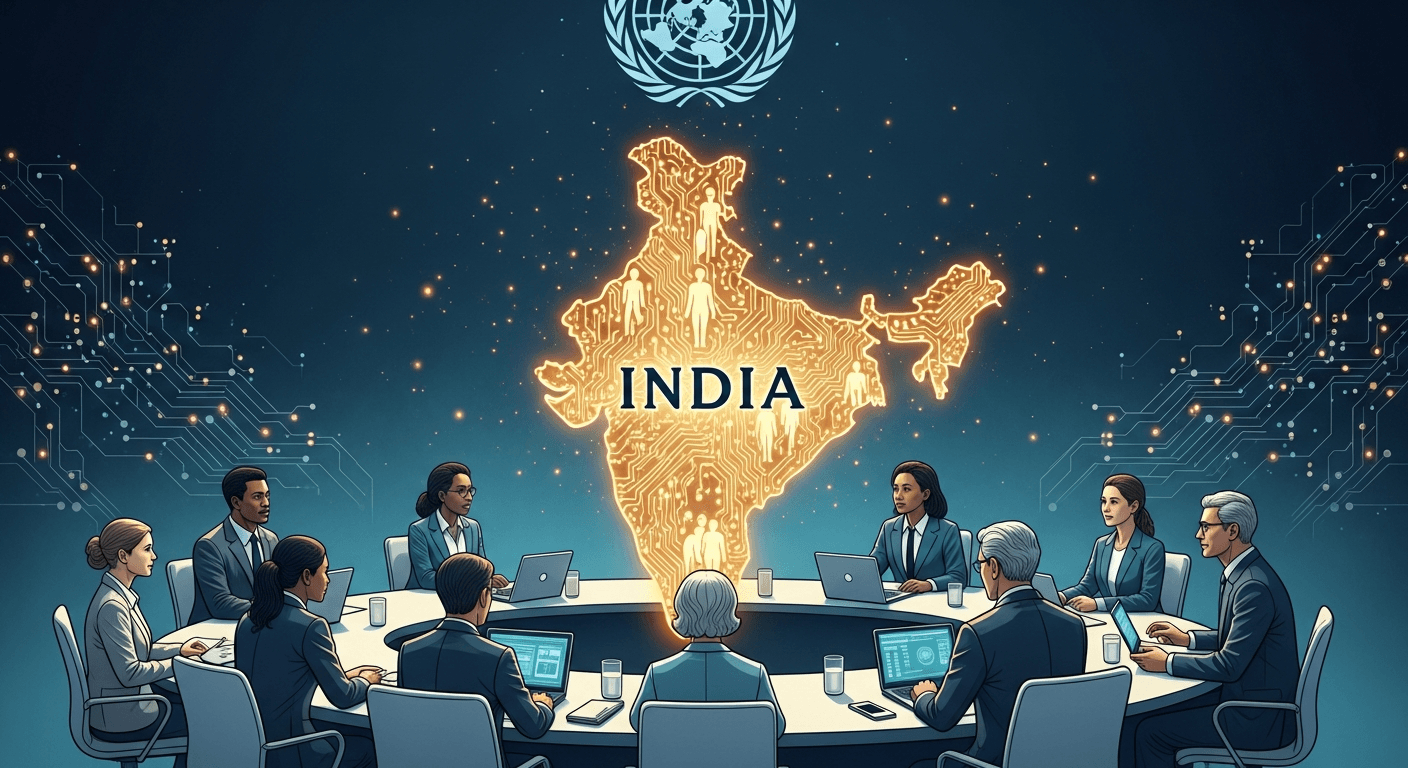
Why India hosting the AI Impact Summit matters
When I read the words of the UN Secretary‑General, Antonio Guterres (sgcentral@un.org), calling India “a very successful emerging economy” and the “right place” to host the India–AI Impact Summit, I felt a mix of optimism and caution. The summit — convened in New Delhi under the themes of People, Planet and Progress — is the first major AI gathering held in the Global South and signals a shift in where the global conversation about the future of AI is taking place source.
I write as someone who has tracked India’s AI trajectory for years; I argued earlier that India is moving to the centre of efforts to frame global AI regimes and build coalitions that reflect a broader set of interests and values “India taking lead in framing global regime”. This summit is an inflection point for that argument: hosting matters as much as the agenda.
Context: what the summit brings together
The India–AI Impact Summit is intended not just as a showcase but as a working meeting — bringing government leaders, private sector innovators, civil society and multilateral institutions into a single conversation. That inclusive ambition is reflected in the presence of senior policymakers and technology executives, including leaders from firms and UN technology officials such as Amandeep Gill (amandeep.gill@un.org), who has been central to linking the summit to broader UN work on the Global Digital Compact.
I also note the role of industry voices on the stage. For example, Shantanu Narayen (snarayen@adobe.com) and Dario Amodei (dario@anthropic.com) represent a slice of the private sector that will be crucial to translating summit commitments into products, investment and standards.
What hosting the summit signals
- A claim for voice and leadership: India hosting signals that the Global South expects to be a co‑author of the rules that will govern AI, not merely a recipient of norms set elsewhere.
- A practical push for capacity building: convening experts and institutions creates the space to map what developing countries need — from compute and data infrastructure to skilling and research partnerships.
- A soft‑power moment: summits change narratives. They can reframe India as a convenor that blends technological ambition with development priorities.
Opportunities and realistic challenges
Opportunities
- Governance innovation: India can pilot hybrid governance models that combine technical standards, public‑interest audits, and community oversight.
- Investment flow: clarity on regulatory direction tends to unlock capital. Policy signals from this summit could accelerate domestic and foreign investment into AI startups, data centres and education.
- Talent development: India’s demographic dividend and growing research base mean meaningful gains if skilling and research funding are scaled.
Challenges
- Equitable distribution: translating global commitments into benefits for rural India and other Global South communities is not automatic; it requires targeted policy, funding and measurement.
- Regulatory coherence: domestic rules must balance innovation with safety; misalignment across jurisdictions can fragment markets and slow deployment.
- Ethics in practice: high‑level principles are necessary but insufficient — operational standards, enforcement mechanisms, and redress pathways must follow.
Global cooperation, ethics and inclusion
A repeated refrain from the UN’s remarks is that AI should not become the exclusive preserve of a few powers. That is both a political and a technical challenge. Politically, it demands multipolar cooperation; technically, it requires investment in open models, shared benchmarks and mechanisms that lower entry barriers for researchers and regulators from lower‑income countries.
Ethical AI must be practical: privacy‑preserving data architectures, interoperable standards for transparency, and funding for independent evaluation hubs. If the summit helps build an Independent International Scientific Panel on AI or similar mechanisms, that could be the kind of shared reference point global policymakers need.
What the summit might change for governance, investment, and talent
- Governance: expect momentum toward multistakeholder frameworks that link technical standards to human‑rights impact assessments and procurement policies.
- Investment: clearer rules and public‑private partnerships can unlock capital for infrastructure and startups, especially those focused on health, agriculture and education.
- Talent: the summit can catalyse cross‑border research partnerships, scholarships, and industry–academia pipelines — but only if commitments become funded programs.
A balanced ask
I believe the India–AI Impact Summit can be a meaningful pivot toward more inclusive global AI governance. But summits succeed or fail in the details: the commitments must convert into funded roadmaps, capacity‑building, independent evaluation and measurable outcomes. My hope is that India uses this moment to translate the rhetoric of “AI for all” into operational instruments that the Global South can use to build resilient digital economies.
Regards,
Hemen Parekh
Any questions / doubts / clarifications regarding this blog? Just ask (by typing or talking) my Virtual Avatar on the website embedded below. Then "Share" that to your friend on WhatsApp.
Get correct answer to any question asked by Shri Amitabh Bachchan on Kaun Banega Crorepati, faster than any contestant
Hello Candidates :
- For UPSC – IAS – IPS – IFS etc., exams, you must prepare to answer, essay type questions which test your General Knowledge / Sensitivity of current events
- If you have read this blog carefully , you should be able to answer the following question:
- Need help ? No problem . Following are two AI AGENTS where we have PRE-LOADED this question in their respective Question Boxes . All that you have to do is just click SUBMIT
- www.HemenParekh.ai { a SLM , powered by my own Digital Content of more than 50,000 + documents, written by me over past 60 years of my professional career }
- www.IndiaAGI.ai { a consortium of 3 LLMs which debate and deliver a CONSENSUS answer – and each gives its own answer as well ! }
- It is up to you to decide which answer is more comprehensive / nuanced ( For sheer amazement, click both SUBMIT buttons quickly, one after another ) Then share any answer with yourself / your friends ( using WhatsApp / Email ). Nothing stops you from submitting ( just copy / paste from your resource ), all those questions from last year’s UPSC exam paper as well !
- May be there are other online resources which too provide you answers to UPSC “ General Knowledge “ questions but only I provide you in 26 languages !


No comments:
Post a Comment