
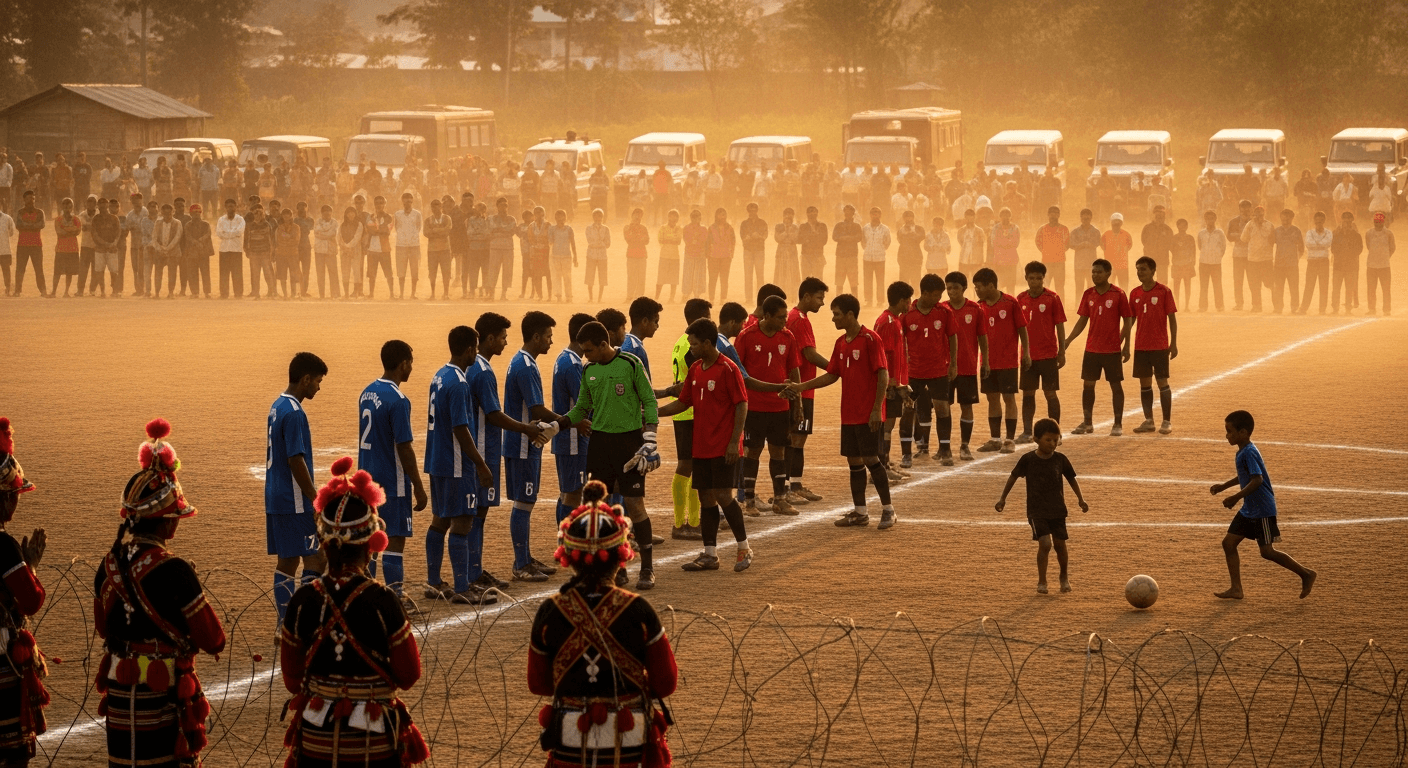
The pitch where silence turned into conversation
I have watched conflict from a distance and up close. I have written in the past about how sport, story and ritual can stitch people back together — most notably in a piece I wrote years ago called We are all one Nation where I argued that shared public rituals can cool the heat of partisan anger “We are all one Nation”. The recent images from Keithelmanbi — a dusty ground along the seam of valley and hills where Meitei and Kuki teams met under the lights of an Assam Rifles-organised tournament — returned that conviction with new force. The match was, in a simple and stubborn way, a refusal to let separation become permanent (Times of India report; coverage also in local wire reports and national outlets).
A history of lines, then a line-up of players
Manipur’s recent years have been scarred by an ethnic rupture that turned neighbours into strangers, villages into fortified islands, and everyday movement into a calculated risk. Buffer zones, night patrols, and detours that add hours to journeys have re-drawn ordinary geography into an invisible map of mistrust. Against that landscape, a football ground is deceptively small — ninety metres of earth where difference can be put aside for 90 minutes.
When teams from different communities cross those buffers to enter the same field, it is not just a sporting act. It is an act of courage and negotiation. Players came from places where night patrols became routine; some still carry the weight of displacement or the memory of burned houses. Yet they crossed the line, per rules and escorted by security, and took their positions.
The match as story: tension, skill, handshake
The final I watched described in reportage ended 5–2. The scoreline matters less than the choreography: hard tackles followed by steady handshakes; a crowd that had feared a flare-up but instead clapped at a well-timed pass; musical interludes where both communities danced at the edge of the ground. During the final, a heavy tackle prompted gasps and a brief flare of words — hands went up, officials intervened, the game resumed. At the whistle, players formed lines and shook hands. It looked, in that instant, ordinary. But ordinary was the rarity.
A young defender who returned to the pitch after weeks of village vigil said later in the way only a person half-smiling can: “For the ninety minutes, I thought I was eighteen again and not on duty.” An elder in the crowd pressed his palms together and said, quietly, that seeing the two teams play together had made him cry. These are the human moments that reportage cannot always carry — the tug between relief and the knowledge that the next morning the patrols will resume.
What this unity means for the region
Sport does not erase the causes of conflict. It will not by itself return houses, reopen closed roads, or unpick grievances that go back generations. But sport can create neutral time and neutral ground — a place to practice trust before larger political work bears fruit. There are three shifts to notice:
- Psychological thaw: Shared play reduces dehumanising distance. When opponents trade passes and applause, it weakens narratives that present the other as wholly alien.
- Social rehearsal: Teams practice rules, refereeing, fairness — small routines that can be scaled into community fora where process matters.
- Visible precedent: When Kukis and Meiteis are seen exiting the same gate together, it becomes harder for leaders on any side to insist separation is the only option.
The match at Keithelmanbi, organised under Operation Sadbhavana by a security force with civic outreach aims, shows how institutions can nudge contact into being. But institutional scaffolding must be followed by civic invention.
Human stories I keep returning to
I think of the coach who stayed in his village to protect elders and returned to lead a young side onto the field. I think of a goalkeeper who once ran a small school where teachers from different communities worked together — the school is closed now, but he stood under the crossbar and, for 90 minutes, taught another lesson: that interdependence is possible.
These are not grand gestures. They are practical acts of resilience: turning up, fixing a shin guard, celebrating a teammate’s goal. The quotidian gestures — sharing a bottle of water at half-time, exchanging jerseys after the final — are the scaffolding of reconciliation.
How this can be sustained: practical suggestions
Unity seeded on a football pitch will wither if it is only symbolic. Here are proposals to turn episodic contact into durable change:
- Regular inter-community leagues with neutral venues and jointly agreed rules — not one-off tournaments, but seasonal calendars that create routine interaction.
- Protected corridors for athletes and students with guaranteed safe passage backed by community monitors (not just armed escorts), so travel becomes a shared problem to solve, not a sign of dominance.
- Youth exchange programmes that pair clubs across the divide for coaching, cultural evenings, and skill clinics; these programmes should include trauma-informed counsellors to help young people process loss and fear.
- Economic incentives: small grants for mixed-team community projects (fields, equipment, schools) that deliver local employment and mutual stake-holding.
- Local council and civil-society convenors trained in sports diplomacy to translate the trust built on fields into broader dialogue on markets, schools and joint governance.
These suggestions are modest, deliberately so. Peace is built from many small bricks, not the occasional manifesto.
A caution and a promise
I am wary of romanticising one match. There are moments when sport has amplified division rather than healed it in other parts of the world. We should be alert to those warning signals: inflammatory chants, unequal access to resources, or one-sided narratives that convert a game into a theatre of grievance.
At the same time, I am convinced by the stubborn generosity of small acts. When people who have been kept apart begin to trade passes and nods, it is not trivial. It is the beginning of a vocabulary for living together again.
Closing — what I feel when I watch them play
On the field, under floodlights that catch dust and sweat, I see the possible future of a place that the headlines have reduced to lines on a map. I see young men who, for a few hours, choose teamwork over guarding their houses; I see elders who let themselves clap; I see parents who allow their children to dream again.
If that sounds sentimental, it is because hope can be pragmatic and sentimental at once. The challenge now is to convert that hope into systems — repeated leagues, safe corridors, youth exchanges, economic projects — so that a handshake at the final whistle becomes the first of many.
Regards,
Hemen Parekh
Any questions / doubts / clarifications regarding this blog? Just ask (by typing or talking) my Virtual Avatar on the website embedded below. Then "Share" that to your friend on WhatsApp.
Get correct answer to any question asked by Shri Amitabh Bachchan on Kaun Banega Crorepati, faster than any contestant
Hello Candidates :
- For UPSC – IAS – IPS – IFS etc., exams, you must prepare to answer, essay type questions which test your General Knowledge / Sensitivity of current events
- If you have read this blog carefully , you should be able to answer the following question:
- Need help ? No problem . Following are two AI AGENTS where we have PRE-LOADED this question in their respective Question Boxes . All that you have to do is just click SUBMIT
- www.HemenParekh.ai { a SLM , powered by my own Digital Content of more than 50,000 + documents, written by me over past 60 years of my professional career }
- www.IndiaAGI.ai { a consortium of 3 LLMs which debate and deliver a CONSENSUS answer – and each gives its own answer as well ! }
- It is up to you to decide which answer is more comprehensive / nuanced ( For sheer amazement, click both SUBMIT buttons quickly, one after another ) Then share any answer with yourself / your friends ( using WhatsApp / Email ). Nothing stops you from submitting ( just copy / paste from your resource ), all those questions from last year’s UPSC exam paper as well !
- May be there are other online resources which too provide you answers to UPSC “ General Knowledge “ questions but only I provide you in 26 languages !


No comments:
Post a Comment