
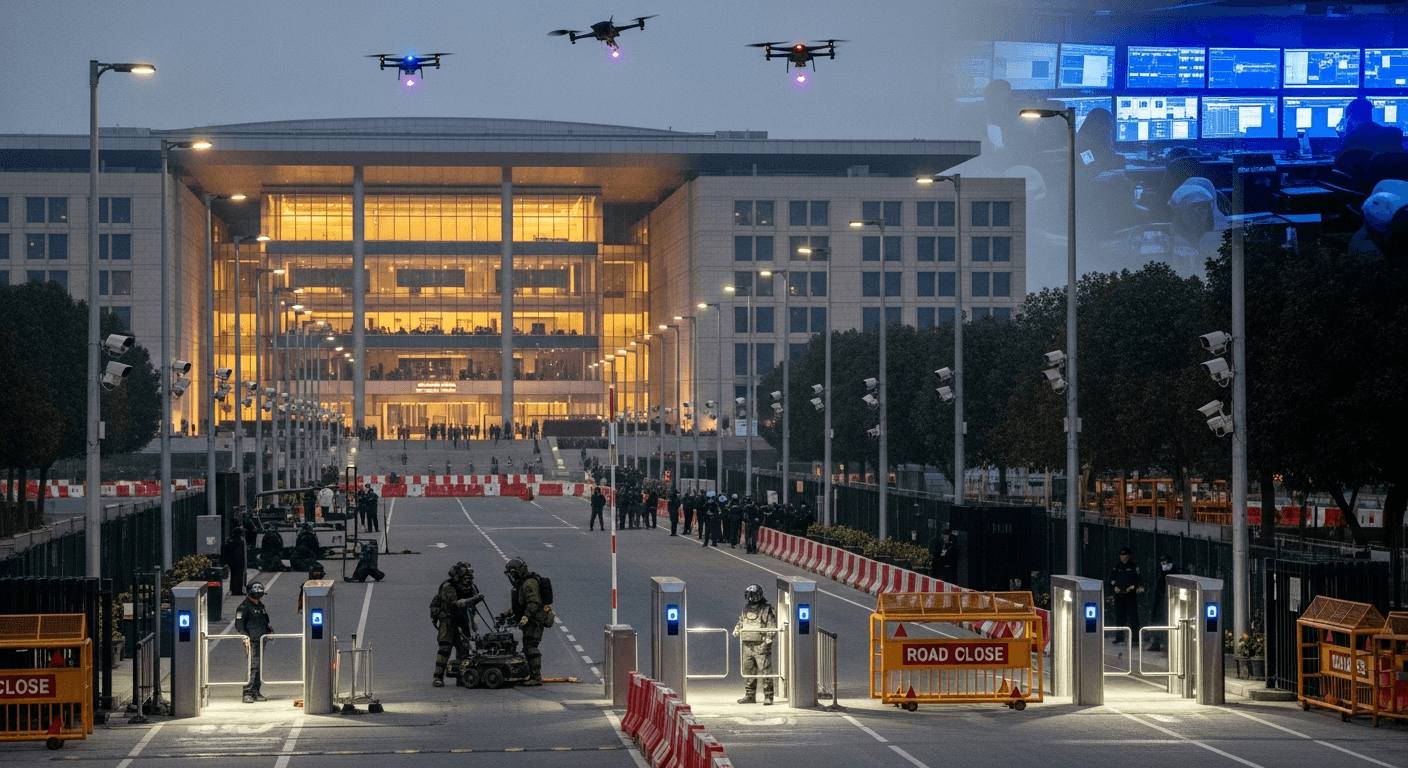
A G20-Style Security Posture for an AI Summit in Delhi
I watched the preparations unfold with a mix of professional curiosity and civic concern. When a high-profile AI summit is hosted in Delhi—drawing global researchers, company leaders and policymakers—the city responds not unlike it would for a G20 summit: visible, layered and uncompromising security.
In the weeks leading up to the event, authorities described a security posture that included bomb squads, 500 CCTVs focused on the venue perimeter and inner rings, biometric access control at entry points, armed checkpoints with metal detectors, drones for aerial monitoring, pre-planned road closures and temporary airspace restrictions. From my vantage point, these measures are understandable: a concentrated gathering of thought leaders and sensitive technological demos is, by definition, a high-value target.
Why security is heightened
There are several overlapping reasons for a G20-like setup:
- Symbolic value: An international AI summit is high-visibility, making it attractive for actors seeking attention.
- Concentration of assets: Panels, prototype systems and delegates together create dense risk vectors—physical, digital and reputational.
- Technology sensitivity: AI demonstrations and data exchanges may be considered critical intellectual property and, in some cases, national strategic assets.
- Crowd management: Large delegations and public protests can complicate security calculations.
One senior security official told reporters, "We must plan for scenarios ranging from targeted attacks to accidental hazards; redundancy and layered defenses reduce risk." Similarly, a security expert I spoke with emphasized the need to integrate physical and cyber monitoring: "Cameras and checkpoints are necessary, but they must be paired with threat intelligence and rapid incident response."
Specific security measures on site
The reported mix of measures is comprehensive and, in many ways, standard for summits of this scale:
- Bomb squads and explosive ordinance teams staged nearby, ready to conduct rapid searches of vehicles and suspicious packages.
- Deployment of 500 CCTVs covering access points, parking areas, adjacent streets and crowd flow hotspots; feeds are funneled to a central command-and-control room with real-time analytics.
- Metal detectors and handheld scanners at all public and delegate entrances, with layered screening for visitors and staff.
- Biometric access control (fingerprint or face recognition) for delegate-only zones to prevent tailgating and unauthorized entry.
- Surveillance drones for aerial situational awareness and rapid response coordination.
- Temporary road closures and vehicle exclusion zones around the venue to limit vehicular threats and manage parade routes.
- Short-term airspace restrictions (NOTAMs) to prevent unauthorized aircraft from approaching the summit airspace.
These measures are meant to be complementary: cameras detect anomalies, bomb squads neutralize explosive threats, and biometric gates reduce impersonation or stolen-credential risks.
Coordination and contingency planning
A summit of this nature requires intense coordination among municipal police, central security agencies, intelligence units, airport authorities and emergency services. Joint command centers are set up to fuse inputs—from CCTV analytics to drone feeds and human intelligence—and to drive decision-making.
Contingency plans typically include:
- Evacuation routes and assembly points for delegates and staff.
- Medical response units staged to manage mass-casualty or chemical incidents.
- Rapid communication protocols between on-ground teams and command centers.
- Red-team exercises prior to the event to test access points and response times.
I was reminded of themes I have long written about: the increasing role of AI-enabled surveillance and the need for human-centric oversight in such systems (AI Powered surveillance). There is a historical arc from passive cameras to intelligent, proactive monitoring—useful for safety, but fraught with governance questions (Supreme Surveillance Solution).
Expected operational challenges
Implementing these measures is not straightforward:
- False positives: Large CCTV networks and automated analytics can generate alerts that sap response capacity.
- Logistics: Deploying and managing 500 cameras, drone corridors and biometric points requires sustained technical staffing.
- Traffic and public inconvenience: Road closures and parking restrictions will disrupt local commerce and daily life.
- Inter-agency friction: Multiple authorities with overlapping jurisdictions must align communications and authority.
An official noted, "The challenge is not just the gear—it's sustained coordination and public cooperation." I agree: technology is necessary but insufficient without disciplined processes and community buy-in.
Privacy and civil liberties concerns
Large-scale surveillance invites scrutiny. Citizens will rightly ask: how long is footage retained? Who can access biometric logs? What safeguards prevent mission creep?
I have discussed the tension between surveillance and privacy before, arguing that augmented intelligence should keep humans at the center of decision-making (Supreme Solution: AI Can Simulate Third Eye). Transparency measures can help: public advisories about CCTV locations, clear retention policies, independent audit mechanisms and strict limits on biometric data reuse.
Public advisories and community impact
Authorities typically issue advisories recommending route diversions, early arrival for attendees, and alternate transport options. Residents and businesses near the venue are usually told about expected noise, temporary checkpoints and the locations where ID checks will be enforced.
From my conversations, the most effective advisories are those that are clear, localized and accompanied by complaint or feedback channels. When people understand the "why" and the expected duration, compliance and patience follow.
Final Observations
A G20-like security architecture for an AI summit in Delhi is a proportional response to complex threats, but it must be balanced. My own view is that security investments should be paired with robust privacy safeguards and community engagement. Technology can make us safer; only democratic governance can keep that safety from becoming an enduring surveillance architecture.
I will continue to watch how authorities deploy these measures and how they respond to operational and civic concerns—because while summits end, the precedents they set often endure.
Regards,
Hemen Parekh
Any questions / doubts / clarifications regarding this blog? Just ask (by typing or talking) my Virtual Avatar on the website embedded below. Then "Share" that to your friend on WhatsApp.
Get correct answer to any question asked by Shri Amitabh Bachchan on Kaun Banega Crorepati, faster than any contestant
Hello Candidates :
- For UPSC – IAS – IPS – IFS etc., exams, you must prepare to answer, essay type questions which test your General Knowledge / Sensitivity of current events
- If you have read this blog carefully , you should be able to answer the following question:
- Need help ? No problem . Following are two AI AGENTS where we have PRE-LOADED this question in their respective Question Boxes . All that you have to do is just click SUBMIT
- www.HemenParekh.ai { a SLM , powered by my own Digital Content of more than 50,000 + documents, written by me over past 60 years of my professional career }
- www.IndiaAGI.ai { a consortium of 3 LLMs which debate and deliver a CONSENSUS answer – and each gives its own answer as well ! }
- It is up to you to decide which answer is more comprehensive / nuanced ( For sheer amazement, click both SUBMIT buttons quickly, one after another ) Then share any answer with yourself / your friends ( using WhatsApp / Email ). Nothing stops you from submitting ( just copy / paste from your resource ), all those questions from last year’s UPSC exam paper as well !
- May be there are other online resources which too provide you answers to UPSC “ General Knowledge “ questions but only I provide you in 26 languages !



No comments:
Post a Comment