
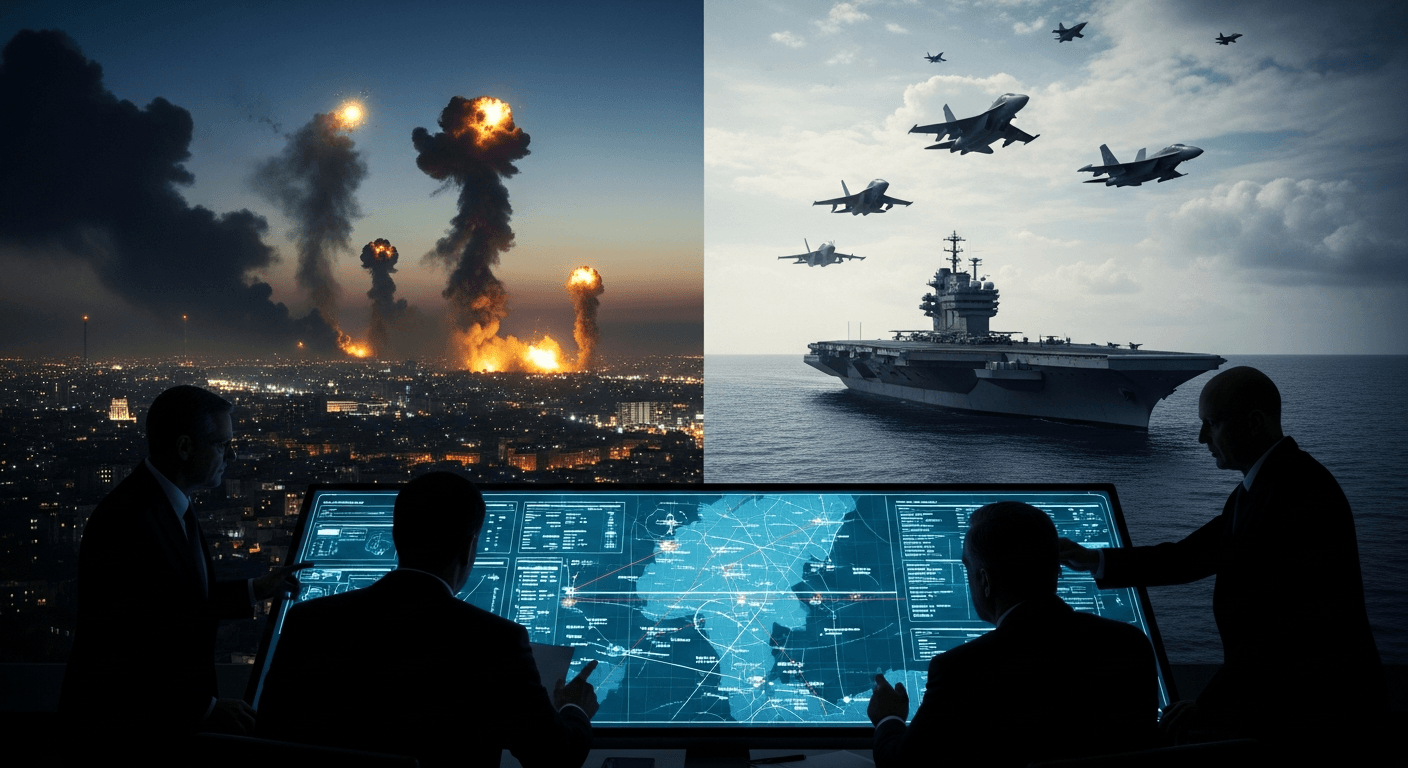
How I see Operation "Epic Fury"
I write this as someone who watches patterns in geopolitics more than I predict battlefield minutiae. The U.S.–Israeli strikes on Iran — publicly referred to by the Pentagon as Operation "Epic Fury" — represent a decisive turn from long‑running deterrence and covert pressure to direct, overt military action. The headlines have been fast and fierce; my aim here is to step back, clarify what is publicly known, and sketch the likely strategic logic, risks and legal questions without trading in classified or unverified operational details.
Background: what led up to the strikes
For years Tehran’s ballistic missile program, regional proxy posture and disputed nuclear activities have been central security concerns for both Washington and Jerusalem. Diplomatic efforts earlier in the month failed to produce a durable settlement that constrained enrichment, missile development, and proxy activity to levels acceptable to the allied capitals. At the same time, a heightened U.S. military presence and repeated warnings from both nations created conditions where kinetic options were pre‑postured reporting summarized by Reuters and major U.S. outlets and ABC News.
Public statements from allied authorities framed the action as a defensive strike to remove imminent threats: missile arsenals, military nodes, and elements enabling a potential weapons pathway. Iranian authorities framed the strikes as unlawful aggression and vowed retaliation — a dynamic that unfolded immediately as missile exchanges and regional flare‑ups were reported.
Alleged planning and coordination
Open reporting indicates the operation was coordinated between the two militaries and planned across weeks or months, rather than improvised in the immediate crisis. That coordination appears to have included shared intelligence, synchronized timing, and integrated target priorities that leveraged each partner’s comparative advantages: local intelligence depth and proximity on one side, reach and specialized long‑range strike capacity on the other see contemporaneous coverage.
Joint planning of this type typically involves legal review, interagency political sign‑off, allied diplomatic outreach (to mitigate escalation), and logistics synchronization so that air, sea and cyber layers operate in concert while protecting friendly forces and regional partners.
Strategic objectives (stated and inferred)
- Immediate: degrade Iran’s long‑range strike capacity and complicate the operational cycle for ballistic missile employment.
- Midterm: lengthen any nuclear breakout timeline by damaging parts of the supporting industrial and command infrastructure.
- Political: signal resolve to allies and adversaries, and to place Tehran under pressure to accept terms the allies consider non‑negotiable.
- Strategic messaging: undermine the credibility of proxy networks and impose costs for cross‑border strikes.
Those aims mix military, coercive diplomatic, and psychological effects. Whether they are achievable without a prolonged campaign depends on the depth of damage, Iran’s redundancy, and Tehran’s willingness to accept higher costs.
Military assets and logistics (high‑level, non‑classified)
Public reporting describes a multi‑domain campaign employing air and sea strike platforms, stand‑off cruise missiles launched from naval vessels, and precision munitions delivered by aircraft operating from regional bases and carrier groups. Defensive layers — allied and partner missile defenses — were mobilized to protect population centres and forward bases. Logistics for such an operation typically rely on:
- Pre‑positioned naval strike groups and long‑range air assets for reach and persistence.
- Intelligence, surveillance and reconnaissance (ISR) — including satellites, airborne platforms and signals intercept — to update time‑sensitive targeting.
- Suppression of enemy air defenses and electronic warfare to reduce risk to manned platforms.
- Forward basing and tanker support for sustained sortie tempo.
These are the conventional building blocks of a high‑tempo, multi‑day strike campaign; none of the above requires entering classified or operationally sensitive detail.
Diplomatic considerations
Such strikes were not conducted in a vacuum. Diplomatically, allied capitals must weigh: the reaction of regional states; the risk to global commerce (notably energy markets and shipping through the Strait of Hormuz); NATO and broader coalition reactions; and the messaging to international institutions and partners. Prior outreach — quiet conversations with Gulf states, NATO partners, and major powers — is standard practice to limit unintended escalation and to preserve humanitarian and evacuation corridors where needed.
At the same time, overt strikes complicate ongoing diplomacy. They narrow political space for negotiated solutions and can harden domestic constituencies in Tehran against compromise.
Regional implications
The immediate region experienced spillovers: missile and drone retaliations, threats to bases hosting foreign troops, and disruptions to civilian aviation and shipping. Proxy actors aligned with Tehran may undertake asymmetric attacks on diplomatic, commercial or energy infrastructure across the Middle East. Economically, the risk premium on oil and insurance spiked, with direct implications for global markets. Politically, the strikes may accelerate realignment pressures among smaller Gulf states, which must choose between public neutrality, tacit support, or active cooperation with one side.
International law and ethical questions
The strikes raise several legal and ethical questions that deserve sober attention:
- Use of force: Under the UN Charter, states may use force in self‑defense against an armed attack or with UN authorization. Allies frame such strikes as necessary to eliminate imminent threats; critics argue that pre‑emptive or regime‑targeted operations risk exceeding defensive justifications. The legal threshold for imminence and proportionality will be central to debates among international lawyers.
- Civilian harm and distinction: Even precise strikes against military infrastructure carry the risk of collateral civilian casualties. International humanitarian law requires feasible precautions to minimize such harm and to investigate and remediate when loss of civilian life occurs.
- Regime change intentions: Public messaging that suggests political outcomes inside another state complicates the legal and moral calculus; actions intended to topple a government touch on sovereignty and may violate norms against intervention in domestic politics.
These questions are not academic. They shape international legitimacy and post‑conflict recovery.
Potential consequences — a practical list
- Short term: intensified missile and proxy attacks, disruptions to regional trade, spikes in energy prices, refugee flows and humanitarian needs.
- Medium term: prolonged low‑intensity conflict across multiple theatres (sea lanes, cyber, asymmetric attacks), and increased pressure on partner states to pick sides.
- Long term: either a significant degradation of Iran’s nuclear/missile capability if follow‑through is comprehensive — or renewed incentives for clandestine programs and asymmetric counters if Tehran survives and adapts.
Which path unfolds will depend on follow‑on political choices, the resiliency of Iranian systems, and whether a credible diplomatic framework emerges that alters Tehran’s strategic calculus.
Conclusion
Operation "Epic Fury" marks a stark inflection point in a decades‑old contest. Militarily, it leverages allied capabilities in a concentrated way; politically and legally, it opens hard debates about necessity, proportionality and the limits of force. As I watch this unfold, I am struck by the fragility of the line between tactical success and strategic quagmire: degrading an adversary’s capacity is one thing; producing a durable, legitimate peace is quite another. The path forward will demand clear political objectives, honest accounting of risks, and sustained international engagement to prevent a wider, protracted conflagration.
Regards,
Hemen Parekh
Any questions / doubts / clarifications regarding this blog? Just ask (by typing or talking) my Virtual Avatar on the website embedded below. Then "Share" that to your friend on WhatsApp.
Get correct answer to any question asked by Shri Amitabh Bachchan on Kaun Banega Crorepati, faster than any contestant
Hello Candidates :
- For UPSC – IAS – IPS – IFS etc., exams, you must prepare to answer, essay type questions which test your General Knowledge / Sensitivity of current events
- If you have read this blog carefully , you should be able to answer the following question:
- Need help ? No problem . Following are two AI AGENTS where we have PRE-LOADED this question in their respective Question Boxes . All that you have to do is just click SUBMIT
- www.HemenParekh.ai { a SLM , powered by my own Digital Content of more than 50,000 + documents, written by me over past 60 years of my professional career }
- www.IndiaAGI.ai { a consortium of 3 LLMs which debate and deliver a CONSENSUS answer – and each gives its own answer as well ! }
- It is up to you to decide which answer is more comprehensive / nuanced ( For sheer amazement, click both SUBMIT buttons quickly, one after another ) Then share any answer with yourself / your friends ( using WhatsApp / Email ). Nothing stops you from submitting ( just copy / paste from your resource ), all those questions from last year’s UPSC exam paper as well !
- May be there are other online resources which too provide you answers to UPSC “ General Knowledge “ questions but only I provide you in 26 languages !




No comments:
Post a Comment