
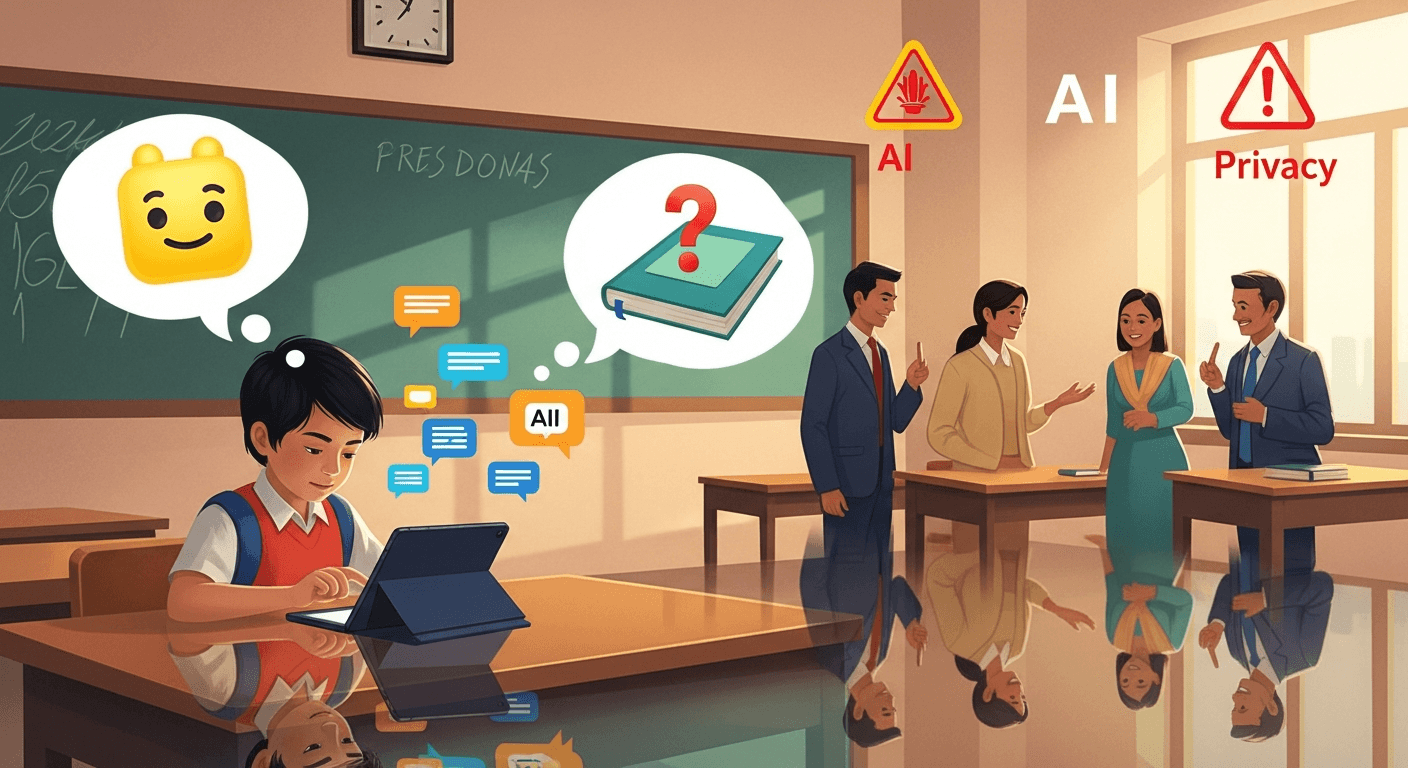
I read the Times of India story on the Central Square Foundation’s Bharat Survey for EdTech 2025 with a mix of optimism and concern. The headline — “Survey: Kids use AI daily, but most don’t know how it works” — captures a reality I’ve seen for years: access to powerful tools has raced ahead of understanding and stewardship (Times of India).
What the survey found (short version)
In brief: the survey covered about 12,500 households and 2,500 teachers across ten states and found rapid GenAI adoption by children using edtech. Some headline figures:
- ~35% of children who use edtech are already using generative AI tools for learning.
- Among those aware of GenAI, nearly three-quarters wrongly equate it with a search engine.
- Usage patterns skew strongly toward academic help: 73% use AI for doubt-solving and practice, 48% for new skills or translation, and 32% for test prep.
- For many low-income students the tools are routine: the report notes very high weekly and daily usage figures.
These numbers are striking because they show not just experimentation but routine reliance — without matched understanding.
Why I find this important (my perspective)
I’ve been working on AI-first learning tools and thinking about how they scale to India’s diversity for a long time (My-Teacher.in and earlier posts on practical AI in classrooms). What this survey confirms is a common pattern: when technology becomes convenient, people — including children — adopt it quickly. But convenience does not equal comprehension.
Kids like AI because it’s immediate, conversational and forgiving: it explains things in plain language, translates between languages, and can generate a practice exercise or a quick essay draft. My worry is that without foundational AI literacy, students will treat probabilistic outputs as facts.
Concrete examples of how kids are using AI today
- Chatbots for homework help and brainstorming — quick outlines, math hints, language corrections.
- Creative tools — image or story generators used for school projects or play.
- Study aids — instant summaries, flashcards, mock tests and translations.
- Gaming and mods — AI-driven characters and content generators in games that shape play and social interactions.
These are beneficial when used smartly. They become risky when used as a shortcut to bypass thinking, or when children can’t tell an AI-made error from a trustworthy source.
Major concerns: what keeps parents and educators awake at night
- Privacy: many edtech and AI tools collect data. For children, that data footprint can be long-lived and sensitive.
- Misinformation: generative models can hallucinate or invent plausible-sounding but false answers. Surveys flag “wrong information” as a top risk.
- Dependence: over-reliance on AI can blunt foundational skills — reasoning, verification, problem solving.
- Equity and quality: uneven access or poorly designed AI can reinforce gaps instead of closing them.
Experts say the most dangerous gap isn’t access — it’s literacy: students believe they “understand” AI while misunderstanding its limits.
Practical steps for parents, teachers and policymakers
We need a layered response — something that combines education, design, and governance.
For parents and caregivers:
- Talk openly: ask children how they used an AI tool today. Ask what made them trust the answer.
- Encourage verification: teach kids to cross-check AI outputs with a textbook, a teacher, or another reliable source.
- Set boundaries: time limits, clear academic-use rules, and model good digital habits.
For teachers and schools:
- Introduce basic AI literacy in class: what models do and don’t do, the idea of probability and bias, and simple verification skills.
- Use AI as tutor, not crutch: structure activities where students must explain, defend, or correct AI-generated answers.
- Train teachers: short, practical workshops on classroom use-cases and safe tool choices.
For policymakers and product-makers:
- Mandate privacy-by-default and age-appropriate data protections for edtech.
- Fund AI literacy modules in the national curriculum and local-language resources so teachers can adopt them quickly.
- Support independent audits of educational AI for accuracy, bias and safety.
A short, hopeful conclusion
Technology has always outpaced policy and practice. The survey’s message is clear: the genie is out of the bottle — kids are using AI — but we have a choice about how they use it. If we teach them to question, verify, and use AI as an assistant rather than a substitute for thinking, we can turn a potential problem into a generational advantage.
I’ve tried to build tools that make learning accessible and accountable. The next urgent step is to pair those tools with curricula, teacher support and common-sense safeguards so the next generation uses AI well.
Regards,
Hemen Parekh
Any questions / doubts / clarifications regarding this blog? Just ask (by typing or talking) my Virtual Avatar on the website embedded below. Then "Share" that to your friend on WhatsApp.
Get correct answer to any question asked by Shri Amitabh Bachchan on Kaun Banega Crorepati, faster than any contestant
Hello Candidates :
- For UPSC – IAS – IPS – IFS etc., exams, you must prepare to answer, essay type questions which test your General Knowledge / Sensitivity of current events
- If you have read this blog carefully , you should be able to answer the following question:
- Need help ? No problem . Following are two AI AGENTS where we have PRE-LOADED this question in their respective Question Boxes . All that you have to do is just click SUBMIT
- www.HemenParekh.ai { a SLM , powered by my own Digital Content of more than 50,000 + documents, written by me over past 60 years of my professional career }
- www.IndiaAGI.ai { a consortium of 3 LLMs which debate and deliver a CONSENSUS answer – and each gives its own answer as well ! }
- It is up to you to decide which answer is more comprehensive / nuanced ( For sheer amazement, click both SUBMIT buttons quickly, one after another ) Then share any answer with yourself / your friends ( using WhatsApp / Email ). Nothing stops you from submitting ( just copy / paste from your resource ), all those questions from last year’s UPSC exam paper as well !
- May be there are other online resources which too provide you answers to UPSC “ General Knowledge “ questions but only I provide you in 26 languages !



No comments:
Post a Comment