
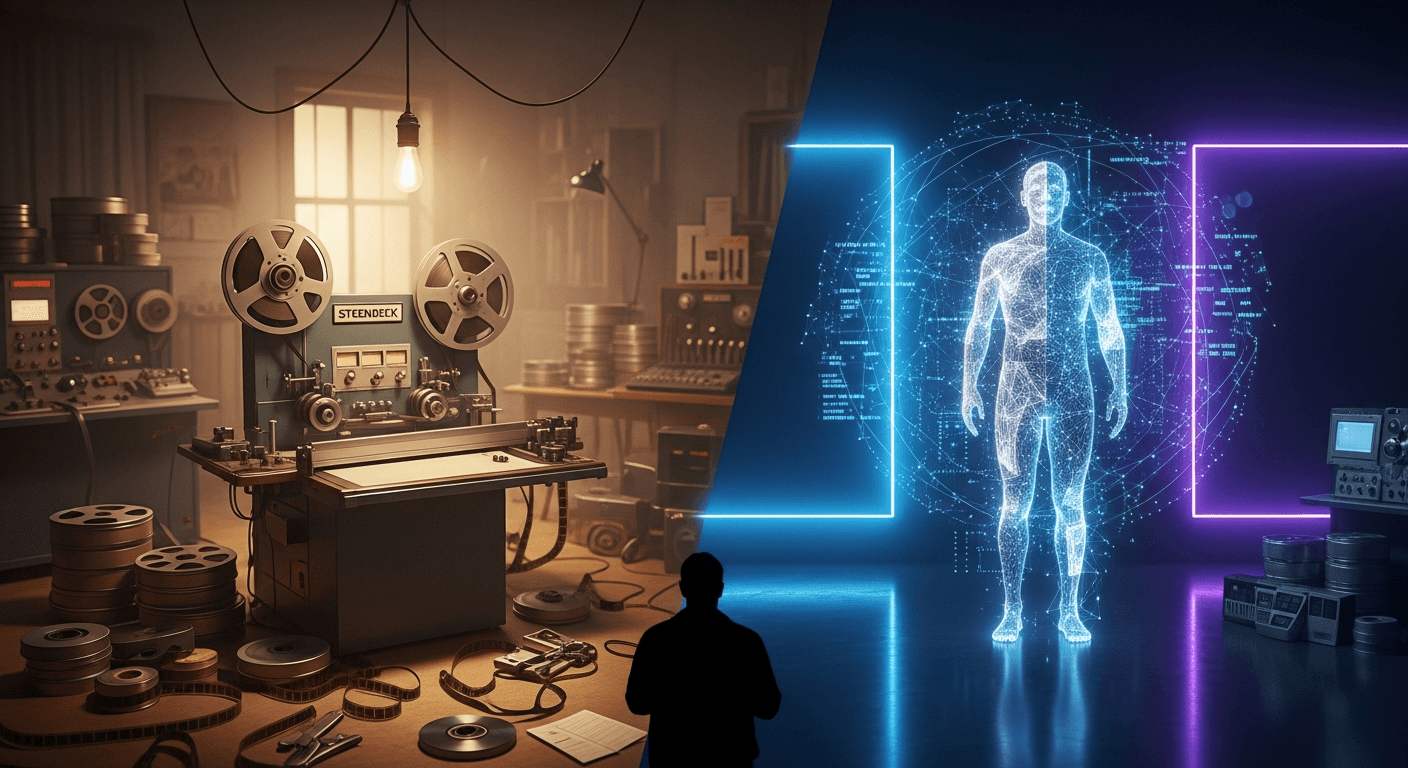
AI: From Bit Role to Lead
Connect with me: Hemen Parekh (hcp@recruitguru.com)
I remember when AI in entertainment felt like a neat special effect—an assist, a background tool. Today, it’s carrying entire narratives, creating characters, composing scores, and even standing in for actors. In this post I’ll map that arc: where AI started in media, the breakthroughs that put it center stage, the thorny ethics and legal questions that followed, how the industry is adopting these tools, and practical takeaways for creators and executives.
A short history: from utility to protagonism
AI first entered entertainment as a toolbox: motion-capture cleanup, color correction, recommendation algorithms. For years it played a bit part—helpful, but anonymous.
Then came the turning points. Neural networks capable of generating convincing faces, voices, text and motion matured quickly; suddenly AI could do more than tidy frames—it could create frames that never existed. I’ve been writing about this shift for some time; in earlier notes I urged public figures to create their own “deep real” before the deepfake era made copies inevitable (An unusual AI as your assistant). That line—build intentionally or risk someone else building you—captures the new landscape.
Key breakthroughs that made AI a lead actor
Deepfakes and face/voice synthesis: AI can convincingly re-create human likeness and voice with surprisingly little data. That capability moved AI from background effects to scene-stealing performance.
Generative media (text, image, audio, video): Large language models and diffusion/transformer-based image and audio models can write scripts, generate storyboards, compose music, and create frames—sometimes end-to-end.
Virtual actors and synthetic characters: Fully generated personalities—complete with faces, mannerisms, and backstories—are being cast in ads, social campaigns, and interactive experiences.
AI in writing and composing: Tools help writers explore plot permutations, generate alternate dialogues, or compose scores that adapt to emotional beats in real time.
Personalization engines: Modern streaming services use advanced models to tailor art directions, trailers, and recommendations to micro-audiences—changing consumption from one-size-fits-all to curated experiences.
Examples and brief case studies
Digital resurrection: Studios have used AI-driven synthesis to recreate the likeness of past performers for flashback sequences or to finish incomplete work. These uses show technical possibilities—and raise deep questions about consent and legacy.
AI-generated festival entries: Independent creators have experimented with short films generated or co-directed by AI. Festivals have begun to receive such entries, testing definitions of authorship.
Streaming personalization: Large streaming platforms apply AI to craft personalized thumbnails, recommend niche sub-genres, and even test alternate edits for different demographics—raising engagement and watch-time metrics.
Virtual influencers and branded avatars: Brands commission synthetic personalities to represent them online. These virtual influencers can post, interact, and be available 24/7 without the realities of human scheduling.
Ethical and legal challenges
Copyright and authorship: When an AI model trains on copyrighted films, scripts, or music and produces new work, who owns the resulting piece? The studio? The model creator? The original artists whose work was used to train the model?
Deepfakes and consent: Realistic re-creations of living (or deceased) people demand clear consent frameworks. The technology easily enables misuse—political manipulation, reputational harm, or exploitation of the deceased.
Employment disruption: Roles like background actors, some VFX jobs, and certain creative tasks may shrink or morph. We should prepare for reskilling and role evolution rather than simply declaring winners and losers.
Transparency and provenance: Audiences and rights-holders increasingly demand provenance—clear labels when a performance, image, or voice was generated or substantially altered by AI.
Industry adoption: studios, streamers, and indie creators
Major studios and platforms are investing heavily in AI for cost reduction (VFX, dubbing, localization), audience analytics, and content personalization. They pilot synthetic characters for controlled scenarios and retain human oversight for marquee talent.
Streaming services use AI to optimize engagement—everything from poster art to episode sequencing—and A/B test creative material at scale.
Indie creators benefit too: democratized generative tools lower the cost of entry. A solo filmmaker can explore visual styles, score their film, or draft a script with models that would once have required teams and budgets.
Future trends I expect
Hybrid productions: Human-AI co-creation will become routine. Directors will work with AI co-writers and virtual performers to explore ideas rapidly.
Real-time adaptive media: Interactive narratives that adapt to viewer choices or emotional signals—AI-composed soundtracks, branching scenes that change tone depending on engagement.
Rights markets and licensing for synthetic likenesses: Clear marketplaces and contracts for synthetic voice and face licenses will emerge, along with industry standards for consent and compensation.
Explainability and watermarks: Technical means to watermark or otherwise sign AI-generated assets will be adopted to assure provenance and combat misuse.
Practical takeaways for creators and executives
Treat AI as collaborator, not replacement: Use models to prototype faster and expand creative options, but keep humans in final editorial control.
Build consent-first pipelines: If you intend to synthesize a likeness or voice, secure written consent and clear contracts covering future uses and revenue share.
Invest in provenance: Adopt technical watermarks and metadata standards to label AI-generated assets—this protects audiences and reputations.
Reskill proactively: Anticipate role shifts in your teams—train VFX artists, sound engineers, and writers to work with AI tools and supervise outputs.
Experiment responsibly: Pilot AI use-cases in lower-risk settings (trailers, marketing assets, background characters) before deploying for marquee talent.
Actionable checklist for creators and executives
- Audit: Identify where AI can speed production or personalization in your pipeline.
- Policy: Draft model-use and consent policies for likeness, voice, and training data.
- Contracts: Add clauses for synthetic rights, revenue share, and moral rights to talent agreements.
- Tools: Pilot 2–3 AI tools for writing, VFX cleanup, or music composition with measurable KPIs.
- Education: Upskill 10–20% of creative and technical staff to be proficient in AI tooling.
- Transparency: Add provenance metadata and visible labels to AI-generated pieces.
Regards,
Hemen Parekh (hcp@recruitguru.com)
Any questions / doubts / clarifications regarding this blog? Just ask (by typing or talking) my Virtual Avatar on the website embedded below. Then "Share" that to your friend on WhatsApp.
Get correct answer to any question asked by Shri Amitabh Bachchan on Kaun Banega Crorepati, faster than any contestant
Hello Candidates :
- For UPSC – IAS – IPS – IFS etc., exams, you must prepare to answer, essay type questions which test your General Knowledge / Sensitivity of current events
- If you have read this blog carefully , you should be able to answer the following question:
- Need help ? No problem . Following are two AI AGENTS where we have PRE-LOADED this question in their respective Question Boxes . All that you have to do is just click SUBMIT
- www.HemenParekh.ai { a SLM , powered by my own Digital Content of more than 50,000 + documents, written by me over past 60 years of my professional career }
- www.IndiaAGI.ai { a consortium of 3 LLMs which debate and deliver a CONSENSUS answer – and each gives its own answer as well ! }
- It is up to you to decide which answer is more comprehensive / nuanced ( For sheer amazement, click both SUBMIT buttons quickly, one after another ) Then share any answer with yourself / your friends ( using WhatsApp / Email ). Nothing stops you from submitting ( just copy / paste from your resource ), all those questions from last year’s UPSC exam paper as well !
- May be there are other online resources which too provide you answers to UPSC “ General Knowledge “ questions but only I provide you in 26 languages !



No comments:
Post a Comment