
Seven Sisters and Sovereignty
Lede
I watched the farewell address closely as Muhammad Yunus (muhammad.yunus@bangladesh.gov.bd) stepped down as Bangladesh’s interim chief adviser. What caught immediate attention was the deliberate regional framing he used — most visibly, his invocation of the "Seven Sisters" alongside Nepal and Bhutan — and the diplomatic ripple that followed. In this piece I want to unpack who he is, what he said, why the phrase matters, and what it means for governance and the transition ahead.
Background: which Yunus
When I refer to Muhammad Yunus (muhammad.yunus@bangladesh.gov.bd) in this post I mean the outgoing chief adviser who led the interim administration that took office in August 2024 and is now handing over after the recent parliamentary vote. His tenure was always framed as technocratic and transitional; his final address sought to define a diplomatic legacy as much as to close a politically fraught chapter (NDTV).
What the "Seven Sisters" refers to — and why it matters
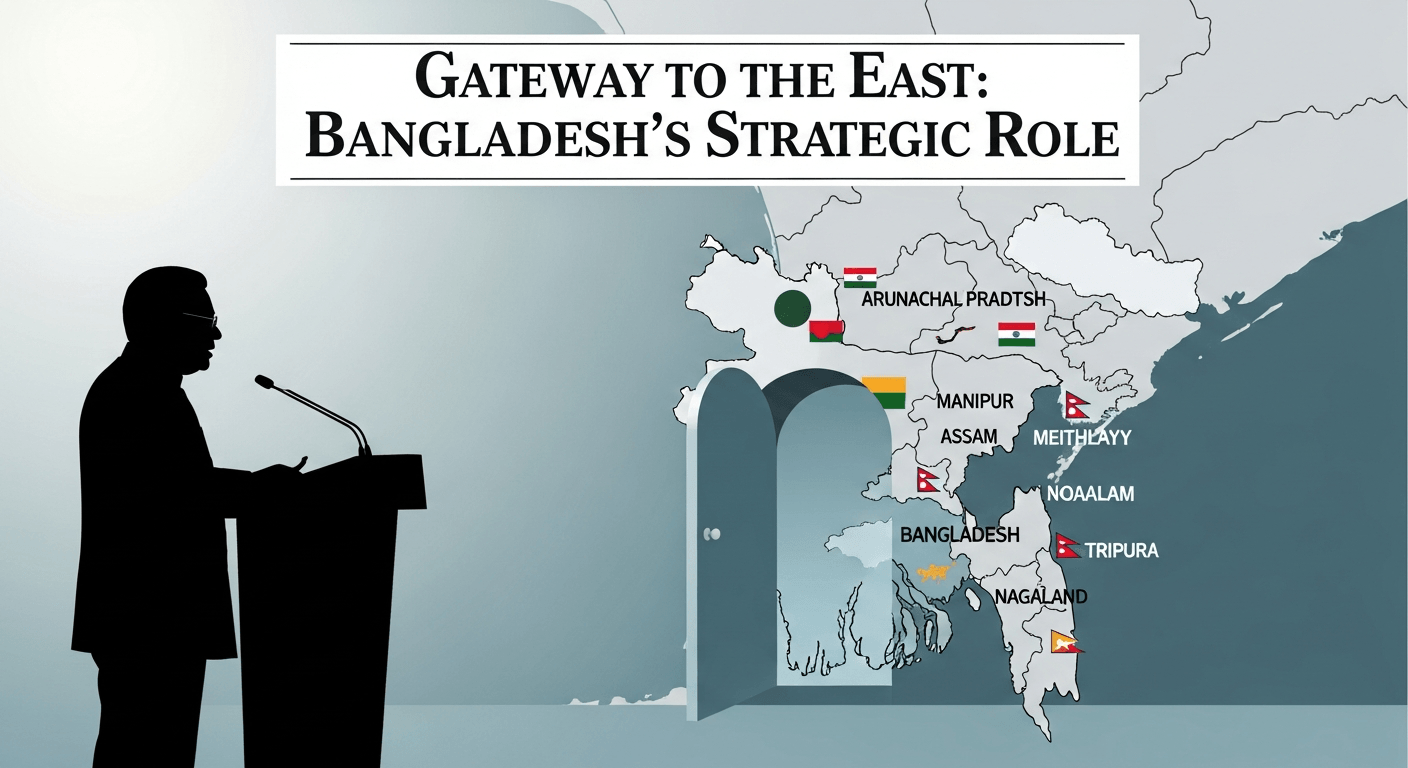
The "Seven Sisters" is a common shorthand for India’s eight northeastern states historically grouped together in geopolitical and developmental conversations. When Muhammad Yunus (muhammad.yunus@bangladesh.gov.bd) referenced that region alongside sovereign neighbours such as Nepal and Bhutan, he did more than name geography: he reframed a regional economic narrative that implicitly repositioned Bangladesh as a maritime gateway for a land-linked sub-region. That rhetorical choice is politically sensitive because it treats India’s internal region as a distinct geopolitical unit in a sub‑regional plan — an approach that can be read as both strategic outreach and, to some audiences, diplomatic provocation (Hindustan Times).
Key lines from the speech
In his televised address Muhammad Yunus (muhammad.yunus@bangladesh.gov.bd) insisted Bangladesh had reclaimed its external agency. Two phrases resonated and were widely reported:
- "Our open sea is not only a geographical boundary, it is an open door to engage with the world economy for Bangladesh." (Times of India)
- "Bangladesh is no longer a country with submissive foreign policy or dependent on the instructions and advice of other countries."
Those sentences underscore the dual thrust of the speech: economic opportunity built from maritime access, and a posture of sovereign autonomy in foreign policy.
Political context: caretaker/interim systems in Bangladesh
To understand why the address matters, it helps to recall the role of caretaker or interim administrations in Bangladesh’s recent history. Such governments are meant to manage transitions, ensure security during elections, and set the conditions for a legitimate handover. In practice, interim regimes walk a narrow line: they must deliver neutrality while also preventing disorder. My reading of Muhammad Yunus (muhammad.yunus@bangladesh.gov.bd) is that his address attempted to convert transitional authority into a narrative of restored dignity and geopolitical independence — even as critics argued the interim period left unresolved domestic problems such as communal violence and minority insecurity (NDTV).
Reactions: diplomatic and domestic
Reaction was immediate and mixed. Regional observers noted the strategic audacity of naming the "Seven Sisters" in a sub‑regional economic scheme; diplomatic channels in New Delhi were reported to view the omission of India’s name as politically loaded. Domestically, some welcomed the forward-looking economic framing while others said the speech glossed over unresolved governance issues. I found the mix predictable: rhetoric aimed at bolstering sovereignty will always please nationalists and unsettle neighbours when it touches sensitive territorial or economic arrangements (News18).
Implications for governance and the upcoming period
Practically, the speech is unlikely to change immediate policy on trade or connectivity by itself. But it does set a tone for the incoming administration: a claim to sovereign manoeuvrability and an emphasis on maritime-led economic strategy. For governance, the risk is twofold. Internationally, rhetoric that appears to sidestep a powerful neighbour’s sensibilities can complicate cooperation on connectivity projects. Domestically, elevating foreign policy wins in a farewell address without addressing lingering security and minority-protection criticisms may leave unfinished the most pressing accountability questions of the interim period.
Conclusion
As I reflected on Muhammad Yunus (muhammad.yunus@bangladesh.gov.bd) bowing out, I saw a deliberate attempt to shape a geopolitical legacy: to claim maritime opportunity and assert diplomatic independence. Whether that framing proves constructive or destabilising will depend on how the incoming government balances national ambition with the cautious diplomacy necessary in a tightly connected South Asia. For now, the "Seven Sisters" phrase has done what political language often does: signalled intent, provoked reaction, and left a debate that the next government will inherit.
Regards,
Hemen Parekh
Any questions / doubts / clarifications regarding this blog? Just ask (by typing or talking) my Virtual Avatar on the website embedded below. Then "Share" that to your friend on WhatsApp.
Get correct answer to any question asked by Shri Amitabh Bachchan on Kaun Banega Crorepati, faster than any contestant
Hello Candidates :
- For UPSC – IAS – IPS – IFS etc., exams, you must prepare to answer, essay type questions which test your General Knowledge / Sensitivity of current events
- If you have read this blog carefully , you should be able to answer the following question:
- Need help ? No problem . Following are two AI AGENTS where we have PRE-LOADED this question in their respective Question Boxes . All that you have to do is just click SUBMIT
- www.HemenParekh.ai { a SLM , powered by my own Digital Content of more than 50,000 + documents, written by me over past 60 years of my professional career }
- www.IndiaAGI.ai { a consortium of 3 LLMs which debate and deliver a CONSENSUS answer – and each gives its own answer as well ! }
- It is up to you to decide which answer is more comprehensive / nuanced ( For sheer amazement, click both SUBMIT buttons quickly, one after another ) Then share any answer with yourself / your friends ( using WhatsApp / Email ). Nothing stops you from submitting ( just copy / paste from your resource ), all those questions from last year’s UPSC exam paper as well !
- May be there are other online resources which too provide you answers to UPSC “ General Knowledge “ questions but only I provide you in 26 languages !



No comments:
Post a Comment