
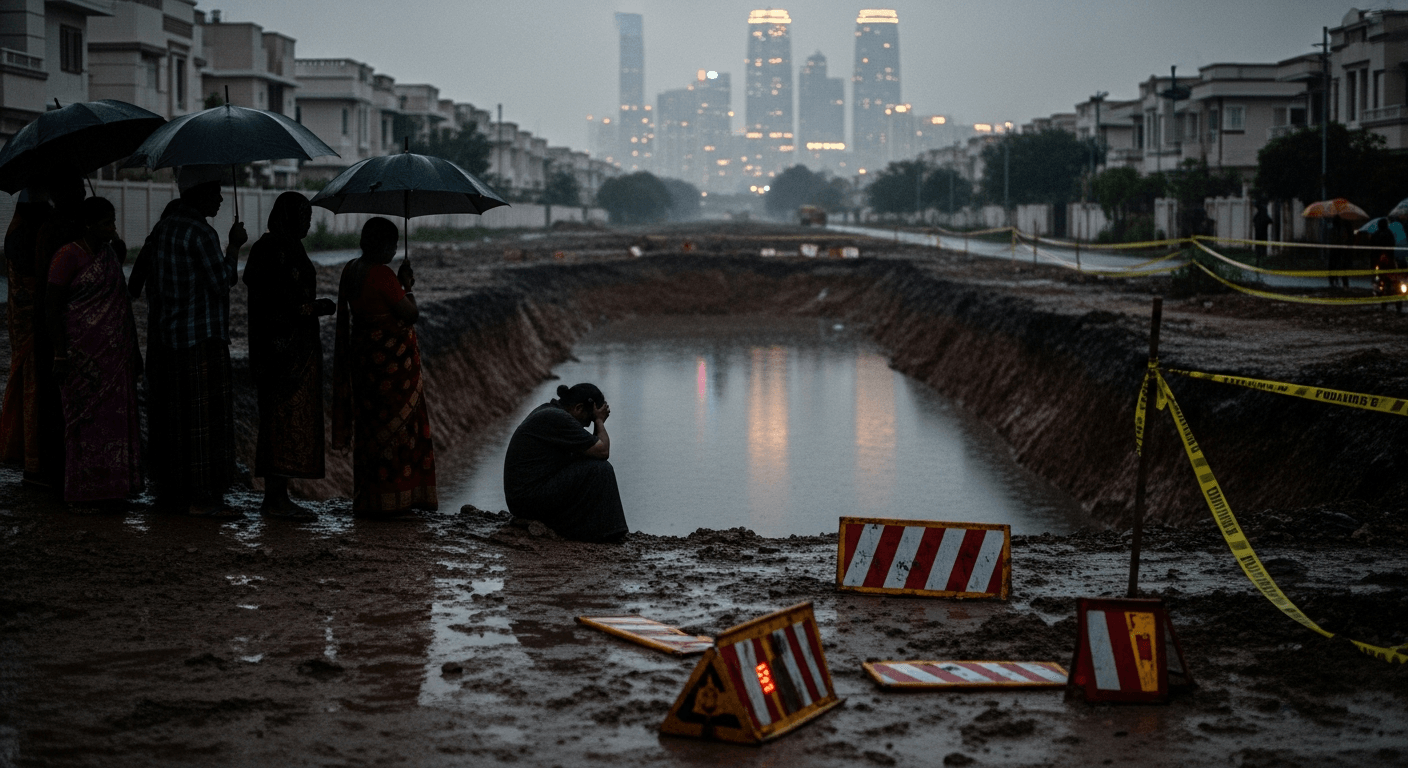
I watched the headlines and felt the same hollow ache
Weeks after a young software engineer drowned in a water-filled excavation in Greater Noida, another life—this time a three-year-old—was lost in a rain-filled pit in a village nearby. The news reports are shockingly familiar: a child playing near a temple feast, an open pit that filled with rain, frantic rescue attempts, and then silence. The coverage is here and here.[^1][^2]
I write this not merely as a commentator but as someone who believes civic design, technology and sustained public pressure can stop predictable tragedies. This is not about blame alone; it is about systems that allowed predictable danger to remain unaddressed until someone died.
What keeps happening
- Open excavations and ponds, left unbarricaded and unmarked, become death traps after rain.
- Residents complain; administrative responsibility is passed between departments or to private owners.
- Rescue delays — whether due to lack of equipment, poor coordination, or hesitance — convert survivable accidents into fatalities.
These are not isolated failures. They are repeated failures of urban maintenance, governance and emergency preparedness.
Why this matters to me personally
I have been writing about road safety, urban design and the role of technology in preventing avoidable death for years.[^3][^4] My frustration has always been the same: good solutions exist, but implementation lags. When an unbarricaded pit kills a child or an engineer drowns while calling for help, the tragedy is both human and civic — avoidable and indicting.
What a humane response would look like
I am convinced that preventing these deaths requires a combination of simple fixes, administrative will, and targeted technology:
Rapid mapping and hazard tagging
Mandate a municipal audit of all open excavations and ponds after each monsoon; publish a live map.
Use simple crowdsourced reporting (phones + geotagging) with guaranteed 48-hour action timelines.
Mandatory physical safeguards on excavations
Temporary barricades, reflective markers, and life-saving signage for every dug plot or pond.
Legal obligation on developers/landholders and a fast-track municipal enforcement mechanism where liability is unclear.
Better rescue readiness
Equip local emergency units with basic water-rescue gear and trained divers; ensure district-level mutual-aid protocols.
Institute a public scoreboard: response times and equipment audits should be public and auditable.
Technology that doesn’t wait for permission slips
Low-cost sensors and periodic drone/foot surveys can detect newly waterlogged pits and auto-flag them for action.
Open-data platforms so residents, media and NGOs can see hazard maps and follow up.
Cultural changes
Civic education about avoiding and reporting hazards, and community watch programs that the municipality supports and honors.
Small ideas that scale
A few pragmatic nudges can reduce harm now:
- Tie penalties and remediation costs to compliance: when developers or landholders are responsible, remediation must be immediate and visible.
- Temporary municipal barriers placed by authorities with costs recoverable from owners if ownership is established later.
- Reward citizens who report genuine hazards with small, verifiable incentives — not to create perverse reporting, but to mobilize vigilance.
These are not radical. They are what I argued in my earlier notes about urban safety and intelligent transport: diagnostics, data, and enforceable timelines make a difference.[^3][^4]
When the system is watching, tragedies fall
We have technology and social tools to measure, flag, and act. We have legal instruments to hold builders and authorities to account. What we lack, too often, is sustained public insistence and the discipline to convert outrage into permanent change.
If we allow headline cycles to pass without durable reforms — audits, rescue readiness, mandatory barricading, public hazard maps — then every rainy season will bring the same grief, recycled.
A plea
If you are reading this and you live in an urbanizing area: walk your neighborhood after rains. Photograph and geotag any open excavations, send them to local civic platforms and follow up. Pressure your local representatives not for promises but for timelines and proof of action.
If you lead a civic body: publish hazard maps, equip emergency teams, and make remediation measurable. Let transparency be the norm — and accountability, inevitable.
I mourn for the lives lost in Greater Noida and the villages around it. Mourn, yes — but act more. The structures that let these pits exist are not mystical; they are the sum of human choices. Change those choices.
Regards,
Hemen Parekh
Any questions / doubts / clarifications regarding this blog? Just ask (by typing or talking) my Virtual Avatar on the website embedded below. Then "Share" that to your friend on WhatsApp.
[^1]: Coverage example: India Today — "Toddler drowns in water-filled pit month after techie died in similar incident". https://www.indiatoday.in/india/uttar-pradesh/story/toddler-drowns-in-water-filled-pit-in-greater-noida-month-after-techie-died-in-similar-incident-2868832-2026-02-16
[^2]: Coverage example: NDTV — "3-Year-Old Drowns In Pond In Greater Noida, Weeks After Techie's Death". https://www.ndtv.com/india-news/greater-noida-child-drowns-in-pond-weeks-after-techie-janakpuri-deaths-11009083
[^3]: Earlier I explored institutional safety and technology interventions in urban transport — see "Young and dying on roads". http://myblogepage.blogspot.com/2021/02/young-and-dying-on-roads.html
[^4]: My notes on Intelligent Transport Systems and safety interventions are consolidated here: http://myblogepage.blogspot.com/2017/10/intelligent-transport-system.html
Get correct answer to any question asked by Shri Amitabh Bachchan on Kaun Banega Crorepati, faster than any contestant
Hello Candidates :
- For UPSC – IAS – IPS – IFS etc., exams, you must prepare to answer, essay type questions which test your General Knowledge / Sensitivity of current events
- If you have read this blog carefully , you should be able to answer the following question:
- Need help ? No problem . Following are two AI AGENTS where we have PRE-LOADED this question in their respective Question Boxes . All that you have to do is just click SUBMIT
- www.HemenParekh.ai { a SLM , powered by my own Digital Content of more than 50,000 + documents, written by me over past 60 years of my professional career }
- www.IndiaAGI.ai { a consortium of 3 LLMs which debate and deliver a CONSENSUS answer – and each gives its own answer as well ! }
- It is up to you to decide which answer is more comprehensive / nuanced ( For sheer amazement, click both SUBMIT buttons quickly, one after another ) Then share any answer with yourself / your friends ( using WhatsApp / Email ). Nothing stops you from submitting ( just copy / paste from your resource ), all those questions from last year’s UPSC exam paper as well !
- May be there are other online resources which too provide you answers to UPSC “ General Knowledge “ questions but only I provide you in 26 languages !




No comments:
Post a Comment