
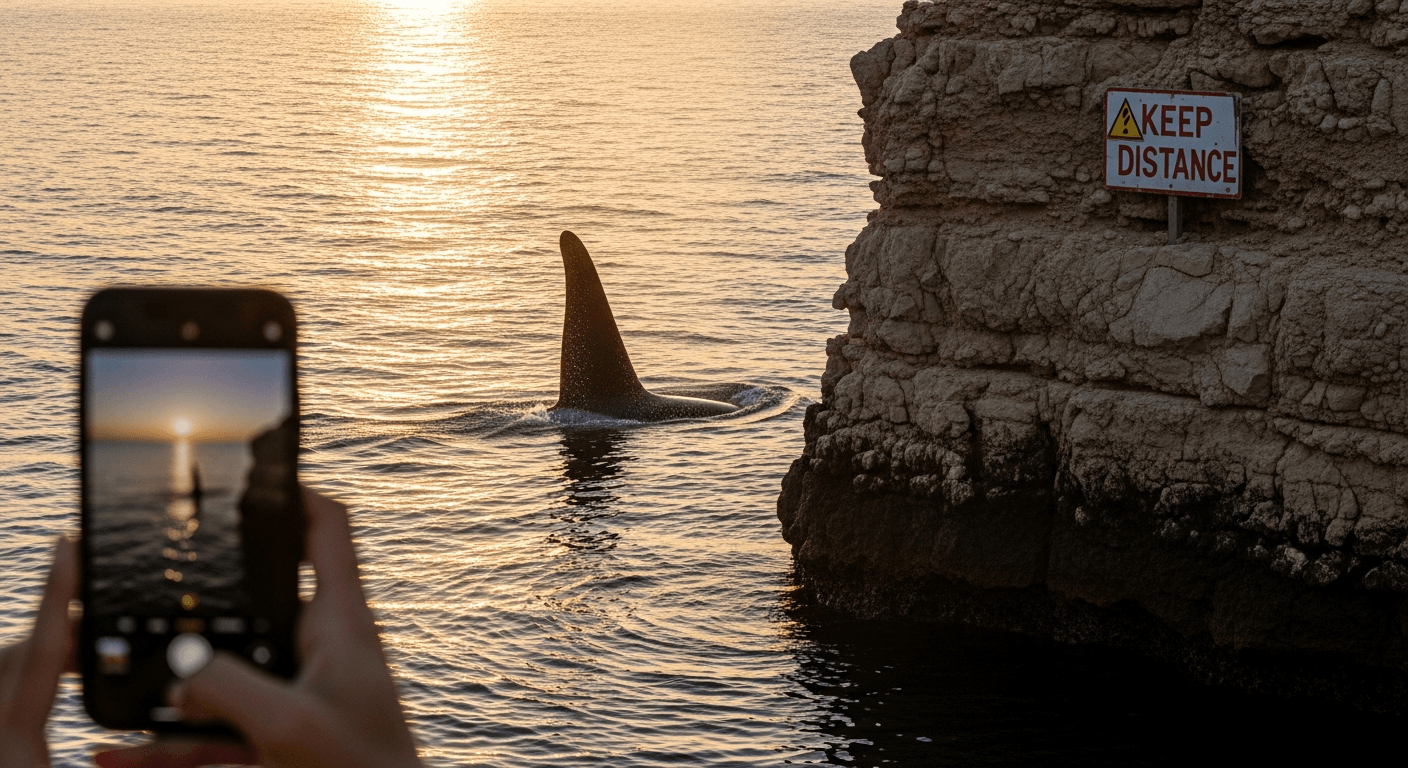
Diving Into Danger
I watched the short, viral video — a man slipping beneath the surface near a massive black-and-white silhouette — and felt that familiar, bitter mix of awe and alarm. Oman’s Environment Authority has now issued a public warning urging people not to swim or dive close to orcas after the footage circulated online, reminding us that these are wild, powerful animals and that close approaches are unpredictable and dangerous Times of Oman.
Why this bothered me
I’m often moved by the sea — its beauty, its strangeness, its invitation to feel small and alive. But that invitation is not a permission slip. A few thoughts that stay with me:
- Wildlife is not a prop. Orcas are intelligent, social predators with complex lives. Approaching them for a clip or a like treats a living being as scenery.
- Risk is asymmetric. For humans, a close encounter can be catastrophic; for animals, it can mean stress, altered behaviour, or worse long-term impacts on feeding and migration.
- Social media rewires judgment. The impulse to capture the extraordinary sometimes outpaces the instinct to be prudent. Viral reward structures nudge people toward risk.
Practical steps we should push for
If we care about both human safety and conservation, a few practical policies and cultural shifts matter more than moralizing headlines:
- Clear, visible guidance at popular coastal sites (signage, multilingual safety boards) and public education campaigns.
- Mandatory operator training and licensing for boat tours and dive guides that covers when to observe and when to back off.
- Simple tech: geo-alerts and community reporting apps that notify boaters and swimmers when large marine mammals are nearby.
- Stronger enforcement for deliberate harassment, paired with restorative education rather than only punitive fines.
- Responsible content norms among influencers and platforms: reward respectful observation rather than reckless proximity.
A larger pattern: respect vs. spectacle
This is not the first time I’ve written about our collective tendency to crowd and disrupt animals — whether birds around powerlines, mammals near shorelines, or charismatic megafauna in tourist hotspots. In earlier reflections I argued for systems that protect wildlife by redesigning how we interact with them and the built environment (see my piece on bird-conservation and human design thinking Have Lines: Save Birds). The same principles apply here: design the experience so that respect is the default.
My request — to travellers, operators and platforms
- If you see a whale, let your first reaction be to watch, not to swim closer.
- If you run or use platforms that amplify footage, incentivise ethical behaviour and demote dangerous stunts.
- If you run tours, train your teams, set clear distance rules, and make refusal to chase wildlife a firm policy.
These are small interventions with outsized effects: fewer injuries, less stressed animals, and an ocean that remains wondrous without becoming a stage.
I don’t want to extinguish curiosity. I only ask that it come wrapped in humility.
Regards,
Hemen Parekh
Any questions / doubts / clarifications regarding this blog? Just ask (by typing or talking) my Virtual Avatar on the website embedded below. Then "Share" that to your friend on WhatsApp.
Get correct answer to any question asked by Shri Amitabh Bachchan on Kaun Banega Crorepati, faster than any contestant
Hello Candidates :
- For UPSC – IAS – IPS – IFS etc., exams, you must prepare to answer, essay type questions which test your General Knowledge / Sensitivity of current events
- If you have read this blog carefully , you should be able to answer the following question:
- Need help ? No problem . Following are two AI AGENTS where we have PRE-LOADED this question in their respective Question Boxes . All that you have to do is just click SUBMIT
- www.HemenParekh.ai { a SLM , powered by my own Digital Content of more than 50,000 + documents, written by me over past 60 years of my professional career }
- www.IndiaAGI.ai { a consortium of 3 LLMs which debate and deliver a CONSENSUS answer – and each gives its own answer as well ! }
- It is up to you to decide which answer is more comprehensive / nuanced ( For sheer amazement, click both SUBMIT buttons quickly, one after another ) Then share any answer with yourself / your friends ( using WhatsApp / Email ). Nothing stops you from submitting ( just copy / paste from your resource ), all those questions from last year’s UPSC exam paper as well !
- May be there are other online resources which too provide you answers to UPSC “ General Knowledge “ questions but only I provide you in 26 languages !




No comments:
Post a Comment