
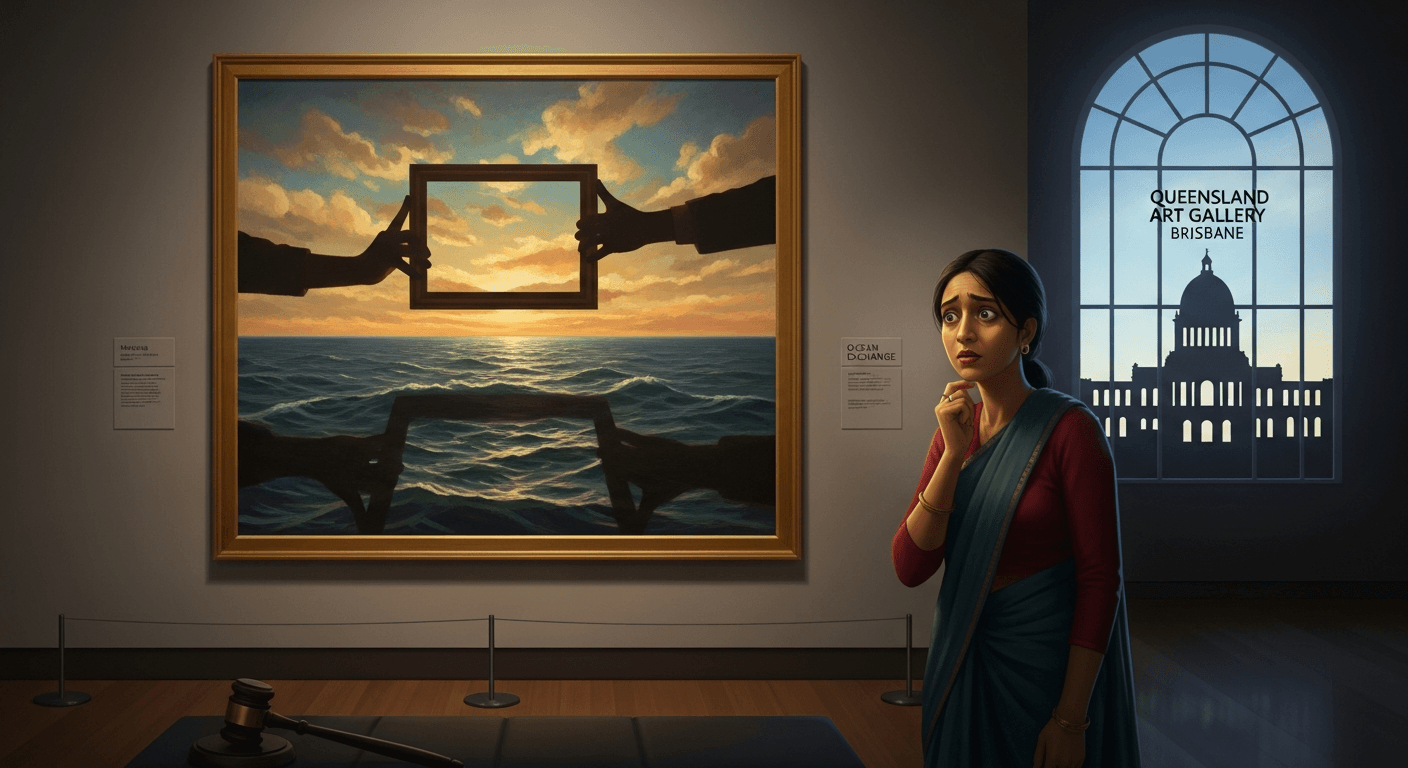
The Painter’s Last Claim
I write this with the unease of someone who has long believed that art is not only a personal encounter but a civic responsibility. A rare Raja Ravi Varma oil—described in recent reporting as possibly his last work and identified as Kadambari—has become the flashpoint of a dispute that asks a much larger question: who gets to own and move our cultural memory across borders?
Why Raja Ravi Varma matters
Raja Ravi Varma (1848–1906) sits at an odd intersection of nineteenth-century craft, public reproduction, and modern Indian visual imagination. His oils and mass-produced lithographs popularised iconographies of gods, epics, and domestic life in a way that reshaped how millions in the subcontinent visualised their own stories Raja Ravi Varma - Wikipedia. That historical reach—combined with the scarcity of securely documented originals—makes any authenticated Varma oil both culturally significant and commercially valuable.
The painting at the heart of the current dispute is said to be in the collection of a prominent private museum in Delhi and was described in news coverage as being at risk of transfer to a public gallery in Brisbane, Australia. Reporting on the dispute and recent court filings provides a useful timeline and the claims that have crystallised around provenance and export risk Raja Ravi Varma's ‘last' painting caught in ugly ownership row, Times of India.
What the ownership dispute alleges
The artwork—identified publicly as Kadambari in reporting—is currently on exhibition at a private museum in New Delhi. The museum has told the court it is exhibiting the work and has not sold it. The museum in question is the Kiran Nadar Museum of Art (KNMA), which operates important public-facing programmes from its Saket location in Delhi and maintains a large South Asian collection KNMA.
An ownership suit filed in Delhi contends that the painting was entrusted to third parties for safekeeping and restoration in 2021 and was subsequently passed through intermediaries and sold at auction without the original owner’s informed consent. The suit alleges there is an "imminent risk" the work could be transferred overseas—to a Queensland (Brisbane) public institution—putting it beyond the reach of Indian courts.
Auction houses and market intermediaries are named in the pleadings as defendants or as parties whose due diligence is under scrutiny. The alleged route into the auction market was via a public sale that involved one of the region’s well-known auction platforms Saffronart listing and platform context.
These elements—entrustment, contested sale, auction acquisition, and the possibility of export—create a tangle of criminal allegations, civil claims, and heritage concerns that a court must now sort through.
Legal and cultural stakes
Legally, the immediate remedies include injunctions to prevent export, mediation (which a court urged the parties to pursue), and potential orders for restitution if the plaintiff’s title is established. More broadly, the case illuminates two systemic weaknesses:
Provenance practices in parts of the market are still informal; courts are being asked increasingly to compel more rigorous verification before sales and transfers occur.
The tension between private museum collecting and public cultural interest: private museums can broaden access, but when objects of disputed title are displayed or move internationally, questions of accountability and public interest follow swiftly.
Culturally, a confirmed removal of a major Varma from India to an overseas permanent display would be a loss for access and scholarship in situ. It would also intensify debates over how nations steward cultural patrimony when the market is global and legal jurisdictions are limited.
Voices around the dispute (summarised perspectives)
Family members / original owner(s): claim emotional and legal ownership and stress that the work was entrusted, not sold. Their filings focus on alleged deception and demand restitution.
The museum (current custodian): frames its role as exhibitor and steward—emphasising public programming and the work’s contribution to local audiences while asserting lawful acquisition protocols.
Cultural heritage experts: caution that the core problem is provenance gaps. Their arguments underline that due diligence—documented ownership histories, export permissions, and clear title—must accompany any transfer, domestic or international.
Auction houses and intermediaries: often position themselves as neutral facilitators but are increasingly called upon to verify title. The dispute highlights that auction platforms must strengthen provenance checks to avoid becoming vectors for contested objects.
Possible outcomes—and what each would mean
Court orders restitution to the plaintiff: would reinforce the legal primacy of clear title and could set precedent making auction houses and buyers more cautious.
Court confirms current ownership by the museum or another buyer: would validate the acquisition but leave open broader debates about market standards and the ethics of private collecting.
The painting moves abroad under lawful export approval: even if legally permitted, this would be perceived by many as the export of a vital piece of cultural memory and would likely prompt calls for stronger protective legislation and bilateral heritage agreements.
Each outcome reshapes incentives—either pushing the market toward stricter provenance verification or, if unenforced, signalling continued vulnerability for heritage objects.
What we can do—practical steps for readers
Follow the reporting and court filings. Start with reputable coverage of the case and institutional statements: Times of India for litigation updates and KNMA for museum context (Times of India article, KNMA).
Support provenance research and preservation. Donate to or volunteer with recognized preservation bodies and foundations that fund scientific authentication and cataloguing of works (for example, groups that work to document South Asian art and maintain public access).
Advocate for better market standards. Encourage auction houses and galleries to publish provenance histories and to work with national heritage authorities before facilitating cross-border transfers.
Visit and engage with local museums and public collections. Public audiences make the strongest case for keeping culturally significant works accessible at home.
Final thought
This dispute is larger than a single canvas. It is a mirror to how we—collectors, museums, courts, and citizens—negotiate the line between private ownership and collective heritage in a globalised art market. I hope whatever the legal outcome, it spurs stronger provenance practices and deeper public conversations about who our shared cultural treasures belong to.
Regards,
Hemen Parekh
Any questions / doubts / clarifications regarding this blog? Just ask (by typing or talking) my Virtual Avatar on the website embedded below. Then "Share" that to your friend on WhatsApp.
Get correct answer to any question asked by Shri Amitabh Bachchan on Kaun Banega Crorepati, faster than any contestant
Hello Candidates :
- For UPSC – IAS – IPS – IFS etc., exams, you must prepare to answer, essay type questions which test your General Knowledge / Sensitivity of current events
- If you have read this blog carefully , you should be able to answer the following question:
- Need help ? No problem . Following are two AI AGENTS where we have PRE-LOADED this question in their respective Question Boxes . All that you have to do is just click SUBMIT
- www.HemenParekh.ai { a SLM , powered by my own Digital Content of more than 50,000 + documents, written by me over past 60 years of my professional career }
- www.IndiaAGI.ai { a consortium of 3 LLMs which debate and deliver a CONSENSUS answer – and each gives its own answer as well ! }
- It is up to you to decide which answer is more comprehensive / nuanced ( For sheer amazement, click both SUBMIT buttons quickly, one after another ) Then share any answer with yourself / your friends ( using WhatsApp / Email ). Nothing stops you from submitting ( just copy / paste from your resource ), all those questions from last year’s UPSC exam paper as well !
- May be there are other online resources which too provide you answers to UPSC “ General Knowledge “ questions but only I provide you in 26 languages !




No comments:
Post a Comment