
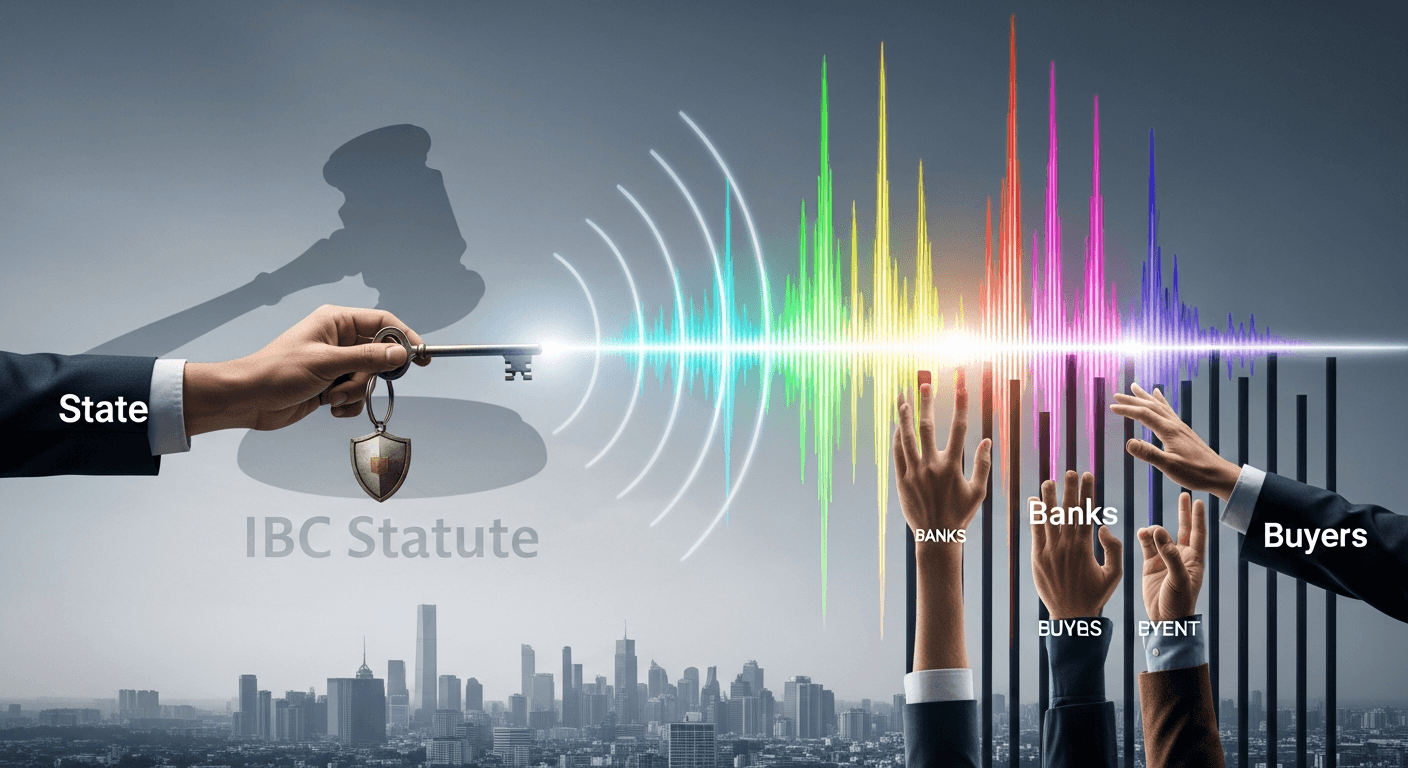
Why this ruling matters to me—and to the sector
I follow telecom policy because it sits at the intersection of public goods, private capital and everyday life. The Supreme Court's recent ruling — that spectrum allocated to telecom service providers cannot be transferred or sold as part of insolvency resolution under the Insolvency and Bankruptcy Code (IBC) — clarifies a legal rule but raises practical and commercial questions that will shape telecom strategy, bank recoveries and consumer outcomes.
Summary of the ruling
- The court held that spectrum is a scarce public resource and a regulatory privilege granted by the state; it cannot be treated as freely alienable corporate property in insolvency proceedings. The judgment sets aside earlier judicial orders that had allowed spectrum transfers subject to clearing government dues.
- In short: the right to use spectrum is not equivalent to ownership of the resource itself; insolvency law (IBC) cannot be used to rewrite telecom licensing and spectrum control regimes.
(Primary reporting: Economic Times, Times of India, Outlook Business) [1][2][3].
Legal basis and key reasoning
- The court framed spectrum as a communal natural resource held by the State in trust for citizens. That public-law character differentiates it from ordinary corporate assets.
- It emphasised the licensing framework: licences and spectrum-use rights are conditional, revocable and subject to pervasive regulatory oversight; recognising them as full proprietary assets for liquidation would conflict with sector-specific statutory rules.
- The IBC framework, the bench reasoned, expressly excludes assets over which the corporate debtor lacks ownership rights; treating spectrum as part of the insolvency estate would allow creditors to circumvent statutory controls.
(See reporting and excerpts of the judgment in Economic Times and Times of India) [1][2].
Implications for telecom operators
- Distressed telcos can no longer rely on spectrum sales via insolvency to raise funds or attract resolution applicants unless statutory dues are cleared and the licensor (government) permits transfer.
- Lenders and potential acquirers will need to recalibrate valuations: spectrum may remain a key operational input but its transferability is now limited by public-law constraints.
- Operators will face increased emphasis on meeting regulatory dues and maintaining licence compliance if they want their spectrum use rights to be monetisable.
Implications for M&A and investments
- Secondary trading of spectrum or M&A deals that depend on spectrum transfer as the principal value component will become more complex and conditional.
- Private equity, ARCs and banks will adjust risk models: recoverability from telecom exposures could be lower if spectrum cannot be pledged or sold in insolvency.
- Expect greater use of alternative structures: spectrum leasing, long-term managed services, or government-approved transfer mechanisms (if introduced) to enable value realisation.
Impact on consumers and competition
- Short term: limited. Existing operators continue to use allocated spectrum under licence, so consumer services should not be immediately disrupted by the legal rule.
- Medium term: potential reduction in investor appetite and tighter credit for the sector could slow network investment, affecting service quality and rollout of new capacity in stressed markets.
- Competition: if transfer is constrained, market consolidation through spectrum purchases may be harder — this could preserve smaller players (if viable) but also reduce funds for network upgrades.
Government options and possible regulatory responses
- The government can (and historically has): reclaim spectrum on non-payment, re-auction bands, or design conditional transfer protocols that protect public interest while allowing recoveries.
- Regulatory options include: a curated secondary trading framework with strict safeguards; escrow-based transfer mechanisms where proceeds first clear statutory dues; or clearer rules on when a licence may be transferred subject to DoT approval.
- Any policy must balance public ownership concerns with the need for efficient credit markets in capital-intensive telecom.
Industry reactions (brief)
- Lenders and asset buyers have lamented the narrowing of monetisable collateral. Banks will likely re-price telecom credit.
- Operators and industry bodies have urged clarity: a predictable, statutory secondary-trading regime would reduce legal risk and help financing.
- Regulators and the government will be under pressure to offer workable mechanisms to preserve both public interest and commercial viability.
International comparisons
- Practices vary. Some jurisdictions allow secondary trading of spectrum under regulated frameworks (EU countries, Australia) with licences treated as tradable rights subject to regulator approval. Others (many emerging markets) maintain tight state control and limit transfers or require prior clearance.
- The Indian approach — emphasising public ownership and regulatory control — aligns with countries that treat spectrum as a state-managed resource, but differs from economies that prioritise market-based trading with strong regulatory oversight.
Short FAQ
Q: Does this mean spectrum can never move between companies?
A: No — transfers remain possible but must follow telecom licensing law and regulator approval; insolvency-driven free transfers are constrained.
Q: Will this increase consumer prices?
A: Not directly. But constrained financing and slower investment in stressed operators could indirectly affect service quality and competition, which over time may influence prices.
Q: Can the government design a middle path?
A: Yes. Policy tools include escrow mechanisms, conditional transfers, and a regulated secondary trading regime to balance public interest and recoveries.
Sources / references
- "Spectrum can't be transferred, sold by telcos: Supreme Court" — Economic Times [https://economictimes.com/industry/telecom/telecom-news/spectrum-cant-be-transferred-sold-by-telcos-supreme-court/articleshow/128321397.cms][1]
- "Spectrum can't be part of insolvency process: SC" — Times of India [https://timesofindia.indiatimes.com/india/spectrum-cant-be-part-of-insolvency-process-sc/amp_articleshow/128322830.cms][2]
- "Telecom Spectrum Public Property, Can't Be Transferred After Bankruptcy: SC" — Outlook Business [https://www.outlookbusiness.com/corporate/telecom-spectrum-public-property-cant-be-transferred-after-bankruptcy-sc-order][3]
- Background on litigation trajectory and earlier NCLAT orders — Informist/other coverage [https://informistmedia.com/MoneyWire/39149/sc-reserves-order-on-transfer-of-spectrum-of-telecom-companies-in-ibc-cases][4]
I have written about spectrum and natural-resource governance in past posts — including reflections on licensing, auctions and the public character of certain assets — which are relevant context for this ruling SCAMS ARE AVOIDABLE (2014) and What Business Are You In? (2018).
Conclusion
This judgment reasserts a simple but consequential principle: not all things on a company's balance sheet are monetisable collateral in the same way. For a country, spectrum is both an economic asset and a public trust. The practical challenge now is policymaking — to create transparent rules that protect the public interest while allowing sensible commercial pathways for debt recovery and industry investment. I will watch closely how the DoT and regulators respond; the balance they strike will determine whether India’s telecom sector can both serve citizens and attract sustainable capital.
Regards,
Hemen Parekh
Any questions / doubts / clarifications regarding this blog? Just ask (by typing or talking) my Virtual Avatar on the website embedded below. Then "Share" that to your friend on WhatsApp.
Get correct answer to any question asked by Shri Amitabh Bachchan on Kaun Banega Crorepati, faster than any contestant
Hello Candidates :
- For UPSC – IAS – IPS – IFS etc., exams, you must prepare to answer, essay type questions which test your General Knowledge / Sensitivity of current events
- If you have read this blog carefully , you should be able to answer the following question:
- Need help ? No problem . Following are two AI AGENTS where we have PRE-LOADED this question in their respective Question Boxes . All that you have to do is just click SUBMIT
- www.HemenParekh.ai { a SLM , powered by my own Digital Content of more than 50,000 + documents, written by me over past 60 years of my professional career }
- www.IndiaAGI.ai { a consortium of 3 LLMs which debate and deliver a CONSENSUS answer – and each gives its own answer as well ! }
- It is up to you to decide which answer is more comprehensive / nuanced ( For sheer amazement, click both SUBMIT buttons quickly, one after another ) Then share any answer with yourself / your friends ( using WhatsApp / Email ). Nothing stops you from submitting ( just copy / paste from your resource ), all those questions from last year’s UPSC exam paper as well !
- May be there are other online resources which too provide you answers to UPSC “ General Knowledge “ questions but only I provide you in 26 languages !




No comments:
Post a Comment