
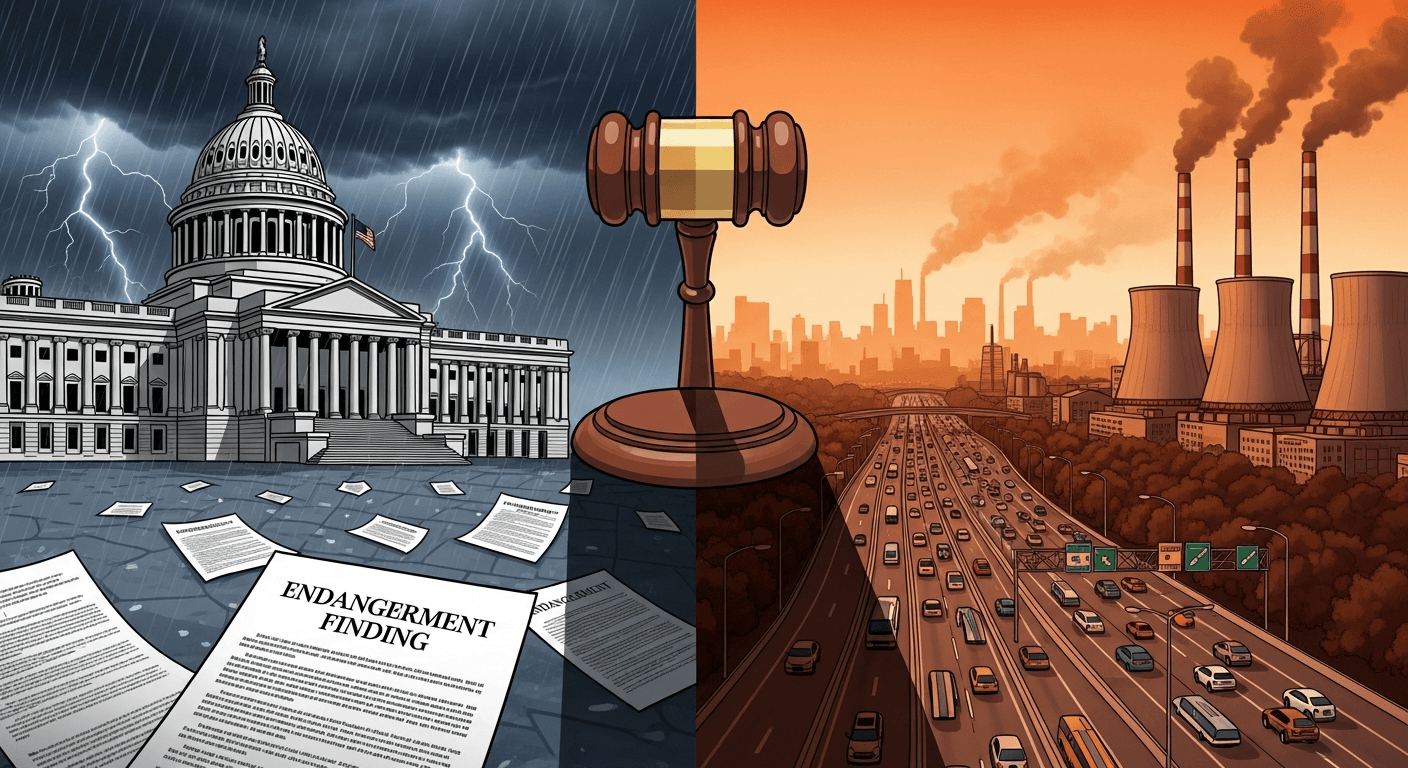
Why I’m Writing about the endangerment decision
I write about public policy, technology and long-term risks because small legal changes can have outsized effects on systems — from markets to public health to the rule of law. Recently the administration announced a formal move to revoke the 2009 EPA “endangerment finding,” the administrative determination that certain greenhouse gases “endanger” public health and welfare under the Clean Air Act. That choice matters in ways that go well beyond a single rule or a single White House.
What the decision is — in plain language
- The 2009 endangerment finding is an EPA determination that six greenhouse gases (including carbon dioxide and methane) may reasonably be anticipated to endanger public health and welfare. That finding created the legal foundation for multiple federal regulations — most prominently vehicle greenhouse-gas standards and parts of the regulatory architecture for power plants and industrial sources.
- The recent action rescinds that finding at the federal level and signals a plan to unwind rules that relied on it. The announcement was covered widely; for context see reporting and analysis in major outlets Bloomberg and ABC News.
Legal basis and the administrative mechanics
- Legally, the endangerment finding traces to the Supreme Court’s 2007 decision in Massachusetts v. EPA, which held that greenhouse gases can be regulated under the Clean Air Act if the EPA finds they endanger health or welfare.
- Rescinding the finding is an administrative rulemaking action. The agency must publish a proposed rule, accept public comment, and issue a reasoned final rule. That procedural process creates an evidentiary and administrative record that courts will review.
- Courts review agency reversals under standards that require reasoned explanations and adherence to administrative procedure. Past cases — and the strength of the underlying science — are likely to shape how durable a repeal will be in litigation (Legal Planet has a useful legal memo on arguments and likely judicial responses).
Potential consequences for the administration and policy
- Immediate regulatory effects: Some federal standards explicitly rely on the endangerment finding. A repeal can be used as legal grounds to withdraw or rewrite those standards, particularly for vehicles and some power-plant rules. That’s why the auto industry and states have been watching closely; major outlets described the administration’s framing and cost estimates for consumers and industry (Bloomberg).
- Litigation risk: Expect multiple, fast-moving lawsuits from states, cities, environmental groups, and potentially industry players who prefer regulatory certainty. Courts will ask whether the agency provided a reasoned, evidence-based justification for reversal. Past judicial precedent and the robust body of climate science make success for challengers plausible.
- Federal-state dynamics: Even if federal authority is curtailed, many states (and some cities) regulate vehicle emissions, electricity generation, and industrial sources. State-level rules, procurement choices, and tort or nuisance suits could cushion or counteract federal rollback.
Consequences for public safety and climate risk
- The endangerment finding is not just an abstract legal label — it underpinned actions designed to reduce emissions that contribute to higher temperatures, more extreme heat events, wildfire risk, and other climate-driven harms. Experts warn that weakening this legal foundation increases the risk of greater emissions over time, with attendant public-health costs (heat mortality, air-quality-related disease, flood and fire impacts) and economic damages.
- Even if immediate emissions changes are modest, policy signals matter: investment decisions by automakers, utilities, and financiers respond to regulatory expectations. Changing the federal baseline can slow or reshape private-sector shifts toward lower-emission technologies.
Broader legal and institutional consequences
- Precedent and administrative law: Successful repeal would be a high-profile instance of reversing a major agency finding grounded in science. That may encourage future administrations to roll back agency determinations more widely, increasing regulatory volatility.
- Doctrinal ripples: Courts will consider how doctrines such as the Major Questions Doctrine and limits on agency deference affect the outcome. That jurisprudential terrain has shifted recently, and litigation over an action of this scale could reach higher courts.
Political consequences
- Politics and messaging: The decision is both an environmental policy move and a political signal. Supporters frame it as deregulation and consumer relief; opponents frame it as risking long-term safety and economic costs tied to climate impacts. Both frames will be prominent in elections, policymaking, and state responses.
- Political costs for the administration could emerge if litigation stalls or if downstream impacts (e.g., on state economies or disaster costs) become salient. Conversely, supporters may see short-term regulatory relief as a win.
Likely near-term path and precedents to watch
- Expect rapid rulemaking to document reasons for rescission, followed by immediate legal challenges from states, NGOs, and others. Prior cases — for example the original Massachusetts v. EPA decision and subsequent D.C. Circuit rulings upholding EPA steps — will be central in litigation.
- Watch for: (a) the agency’s administrative record and how comprehensively it addresses the science; (b) motions for preliminary injunctions; and (c) state regulatory responses.
Neutral assessment: how dangerous is it?
- Legally: The action faces high litigation risk. Courts require reasoned decision-making; if the repeal lacks a robust scientific and procedural record, it may be overturned or narrowed. So the legal danger to the administration’s goal of durable deregulatory change is significant.
- For public safety and climate: If the repeal endures, it raises measurable long-term risks by removing a foundational legal lever used to reduce emissions. The public-safety danger comes from higher projected emissions and larger climate impacts over decades, not an immediate single event.
- Politically and institutionally: The decision increases regulatory uncertainty and could produce broader shifts in administrative law practice if courts defer to such reversals. That institutional risk is meaningful.
Conclusion — what I want you to remember
This is not merely a technical regulatory tweak. Rescinding the endangerment finding is a lever that affects energy policy, transportation standards, federal-state relationships, and long-run public health risks tied to climate change. The immediate outcome will be shaped as much by litigation and state responses as by the administration’s announcement. In short: the move is legally vulnerable, politically consequential, and consequential for public safety over the long run.
Regards,
Hemen Parekh
Any questions / doubts / clarifications regarding this blog? Just ask (by typing or talking) my Virtual Avatar on the website embedded below. Then "Share" that to your friend on WhatsApp.
Get correct answer to any question asked by Shri Amitabh Bachchan on Kaun Banega Crorepati, faster than any contestant
Hello Candidates :
- For UPSC – IAS – IPS – IFS etc., exams, you must prepare to answer, essay type questions which test your General Knowledge / Sensitivity of current events
- If you have read this blog carefully , you should be able to answer the following question:
- Need help ? No problem . Following are two AI AGENTS where we have PRE-LOADED this question in their respective Question Boxes . All that you have to do is just click SUBMIT
- www.HemenParekh.ai { a SLM , powered by my own Digital Content of more than 50,000 + documents, written by me over past 60 years of my professional career }
- www.IndiaAGI.ai { a consortium of 3 LLMs which debate and deliver a CONSENSUS answer – and each gives its own answer as well ! }
- It is up to you to decide which answer is more comprehensive / nuanced ( For sheer amazement, click both SUBMIT buttons quickly, one after another ) Then share any answer with yourself / your friends ( using WhatsApp / Email ). Nothing stops you from submitting ( just copy / paste from your resource ), all those questions from last year’s UPSC exam paper as well !
- May be there are other online resources which too provide you answers to UPSC “ General Knowledge “ questions but only I provide you in 26 languages !


No comments:
Post a Comment