
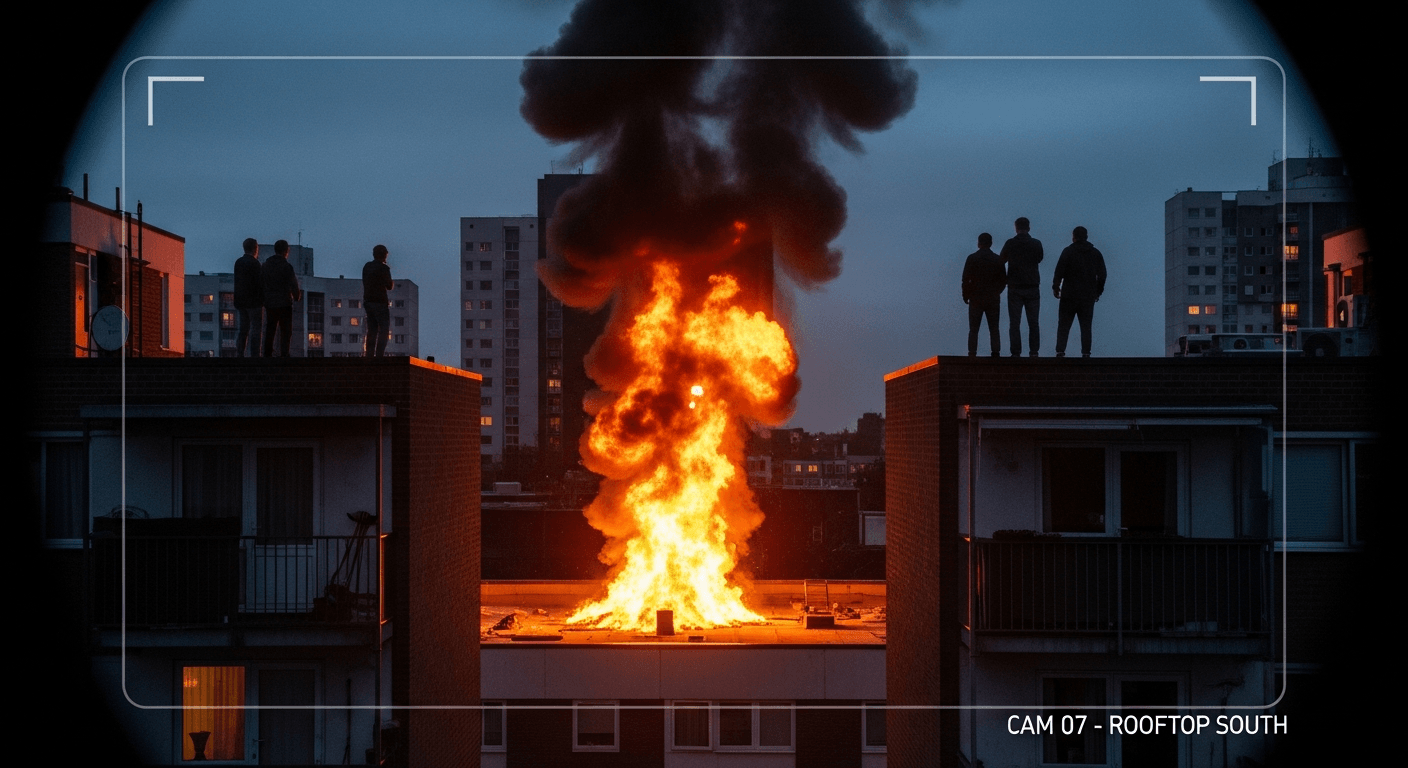
The rooftop that shouldn't have been a workshop
I watched the grainy video — flames, a sudden violent flare, people screaming, neighbours pouring onto the street — and my chest tightened in a way old memories do. A life-ending mistake, done in a place that was supposed to be home. The report I read on the incident in Bhubaneswar described an alleged attempt to assemble crude explosive devices on a rooftop and the terrible, predictable result: an explosion that killed two occupants and left others grievously injured. The footage that's circulating is being verified by investigators, but the image itself is already part of a new public memory source: Times of India.
What this violence tasted like — for me
I write in the first person because this kind of event always finds me on a personal wavelength: the smell of smoke, the helplessness of bystanders, the sudden collapse of ordinary life. I have written before about the terrible speed at which fire and poor safety practices take people from their daily routines into tragedy — whether in reflections prompted by Hiroshima's memory or in pleas for rigorous fire-safety enforcement after urban blazes see my earlier reflections on Hiroshima and building fires and on municipal fire tragedies and safety enforcement.
This rooftop blast brings together two things I've long worried about:
- the lethality of uncontrolled chemical materials in dense urban neighbourhoods; and
- how quickly private desperation or criminal intent can convert domestic space into a weapon factory.
The story is not just about criminality — it's also about environment and systems
Reports say forensic teams found remnants that suggest highly explosive compounds; investigators are trying to determine motive and whether this was part of a larger conspiracy. But while we wait for police and specialised agencies to conclude their work, there are immediate structural questions we must confront:
- How are dangerous precursor materials getting into residential neighbourhoods?
- Why do people attempt such perilous improvisations in homes — is it ignorance, intent, convenience, or the absence of safer alternatives?
- What gaps in local enforcement, supply-chain oversight, and community awareness allowed this to happen?
When we look away from the criminal label and examine the conditions, we see a network of failures: porous retail controls on hazardous goods, inadequate inspections of hazardous storage and usage, social strains that push people toward violent solutions, and the power of online tutorials that normalise reckless behaviour.
What communities and authorities must think about — practical angles
I am not a law enforcer, but I have watched how policy and local practice interact. A few pragmatic steps I keep returning to:
- Better control and tracking of key chemical precursors sold in bulk to small shops — especially in markets close to dense housing.
- Targeted public-awareness campaigns in vulnerable neighbourhoods about the catastrophic risks of trying to make explosives at home.
- Routine building-inspection programmes that prioritize fire and hazardous-material hazards (not only structural cracks), with teeth: closures or strict remediation orders where danger is found.
- Quick-response forensic and medical triage capabilities so that when an incident does happen, survivable injuries are maximised and evidence is preserved.
- Community hotlines and anonymous reporting channels for neighbours to flag suspicious stockpiling without fear of retaliation.
None of these alone will stop every tragedy, but the combination reduces the latent risk that turns ordinary ceilings into scenes of carnage.
On the circulation of video and public grief
The video of the explosion will be shared and reshared. It becomes a kind of evidence and a cultural artifact at the same time — used by investigators, consumed by the curious, weaponised by pundits. We should insist on two things in the public conversation:
- Respect for victims and their families. Graphic footage has real human consequences; its circulation should be bounded by compassion and investigative need.
- Patience with investigation. Viral clips can create pressure for premature conclusions. The agencies doing forensic analysis must be allowed to follow the evidence without being swamped by public narrative demands.
My small, stubborn hope
I remain convinced that tragedies like this are preventable at scale if civic systems and community norms change in lockstep. Years ago I tried to make the argument that memory — of Hiroshima, of urban fires, of collapsed lives — must become fuel for civic design and enforcement rather than mere rhetoric see my earlier reflections on Hiroshima and on municipal fire tragedies and safety enforcement where I urged stronger institutional accountability (for example, clearer liability for building-owners and safety chiefs) (see my post on the Mundka fire and our perennial problem of ignored safety warnings)(http://emailothers.blogspot.com/2023/10/458-of-many-how-many-lives-must-bget.html).
If we treat this as an isolated crime, we will miss the wider pattern: how dangerous materials, gaps in oversight, and social pressures collide in our cities. If we treat it as an occasion to strengthen supply controls, inspection regimes, emergency response, and community awareness — then perhaps the flames we see in a terrifying clip will have finally taught us something.
A simple checklist for neighbours and local leaders
- Report suspicious stockpiles quietly and promptly.
- Encourage local shops to keep safe inventory records for chemicals and tell them what legal limits exist.
- Municipalities: publish simple guidance on hazardous substances in multiple local languages.
- Hospitals and ambulances: run drills for mass-burn casualty triage with local clinics.
I know this subject is ugly to face. But looking away is a luxury that costs lives.
Regards,
Hemen Parekh
Any questions / doubts / clarifications regarding this blog? Just ask (by typing or talking) my Virtual Avatar on the website embedded below. Then "Share" that to your friend on WhatsApp.
Get correct answer to any question asked by Shri Amitabh Bachchan on Kaun Banega Crorepati, faster than any contestant
Hello Candidates :
- For UPSC – IAS – IPS – IFS etc., exams, you must prepare to answer, essay type questions which test your General Knowledge / Sensitivity of current events
- If you have read this blog carefully , you should be able to answer the following question:
- Need help ? No problem . Following are two AI AGENTS where we have PRE-LOADED this question in their respective Question Boxes . All that you have to do is just click SUBMIT
- www.HemenParekh.ai { a SLM , powered by my own Digital Content of more than 50,000 + documents, written by me over past 60 years of my professional career }
- www.IndiaAGI.ai { a consortium of 3 LLMs which debate and deliver a CONSENSUS answer – and each gives its own answer as well ! }
- It is up to you to decide which answer is more comprehensive / nuanced ( For sheer amazement, click both SUBMIT buttons quickly, one after another ) Then share any answer with yourself / your friends ( using WhatsApp / Email ). Nothing stops you from submitting ( just copy / paste from your resource ), all those questions from last year’s UPSC exam paper as well !
- May be there are other online resources which too provide you answers to UPSC “ General Knowledge “ questions but only I provide you in 26 languages !



No comments:
Post a Comment