
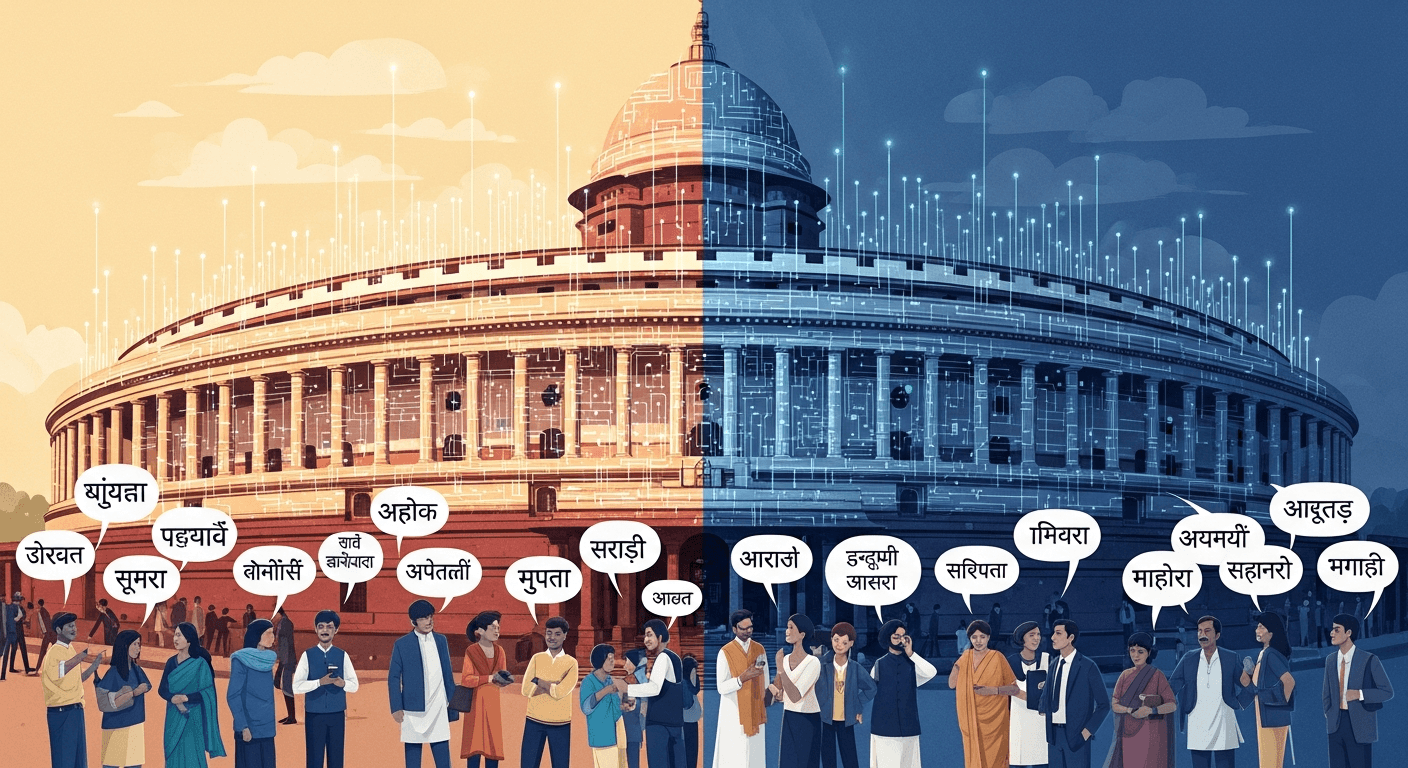
AI for Citizen-Centric Governance
I write this as someone who thinks deeply about how technology can expand agency and dignity for people. When a leader like Dario Amodei dario@anthropic.com urges India to use AI to make governance more efficient and citizen-centric, it’s worth pausing to separate optimism from hype and to design practical steps that protect rights while unlocking value.[^1]
What Dario Amodei dario@anthropic.com argued (paraphrased)
- He framed India’s scale, technical intensity, and linguistic diversity as strengths that make the country an ideal place to deploy citizen-facing AI responsibly.
- He pointed to government efforts (for example, work by statistical agencies on AI-driven querying of economic data) as examples of what rapid public-sector adoption can look like.
- He also warned that AI’s productivity gains could produce economic disruption unless the benefits are widely shared, and emphasized building AI where it intersects with specialized domains such as health and biology.
(Background reporting summarizing his remarks is available from The Times of India.)[^1]
Clear benefits for governance
AI can improve public services in measurable ways:
- Faster responses: AI-powered triage for citizen requests (permit applications, grievance redressal) reduces backlogs and speeds decisions.
- Better information access: Natural-language query systems over public data let citizens and officials interrogate statistics without specialist skills.
- Personalised social services: Predictive tools can help target welfare programs and identify service gaps while reducing administrative friction.
- Multilingual reach: Models trained on India’s many languages can deliver services in local tongues, increasing uptake and equity.
These are not theoretical—India’s digital public infrastructure and large user base make it possible to pilot and scale useful systems quickly.
Real risks we must manage
Adoption without guardrails risks harm:
- Bias and exclusion: Models trained on uneven data can reproduce or amplify inequalities, especially for underrepresented languages or marginalized groups.
- Opacity and accountability: Automated decisions without transparent rationale create legitimacy problems for public institutions.
- Job displacement: Efficiency gains can disrupt livelihoods; without active policy, benefits may concentrate rather than spread.
- Security and misuse: Public systems become high-value targets for manipulation or data breaches.
A balanced approach treats AI as an augmenting tool, not an oracle.
Practical policy recommendations for India
To make AI governance both effective and ethical, I recommend a layered approach:
- Safety-by-design procurement: Require explainability, performance audits, and red-team testing in all government AI procurements.
- Data stewardship and privacy: Strengthen legal frameworks for public data use, with clear consent, anonymisation standards, and audit trails.
- Impact assessments: Mandate socio-technical impact assessments (similar to environmental assessments) before scaling public AI systems.
- Shared-value transition policies: Invest in reskilling, portable benefits, and income-support pilots for workers in sectors likely to see disruption.
- Local-language datasets and evaluation: Fund benchmarks and datasets for Indian languages and under-served communities so models are meaningfully inclusive.
- Independent oversight: Create an independent public-interest AI review board with technologists, civil society, and domain experts.
High-value use-cases to prioritize
Start with problems where outcomes are measurable and human oversight is natural:
- Clinical decision-support for rural health workers (augment, do not replace, clinicians).
- Automated information portals for schemes and entitlements in regional languages.
- Case-prioritisation tools for social welfare offices to reduce leakage and target services.
- Regulatory compliance assistants that help small businesses understand and meet requirements.
Each deployment should include explicit human-in-the-loop controls and routine audits.
Inclusion and equity concerns—non-negotiable
If AI deepens exclusion, we fail. Mitigations must include:
- Investing in connectivity, literacy, and local-language content so citizens can use new services.
- Participatory design with affected communities—solutions built for people must be built with them.
- Open-source alternatives and public-model benchmarks so smaller players can verify and adapt systems.
Actionable next steps (concise)
- Launch 6–8 government pilot projects with independent evaluation and public dashboards. Each pilot should publish datasets, evaluation criteria, and post-deployment audits.
- Create a national AI-for-Government procurement playbook (safety, explainability, red teaming, impact assessment).
- Fund a national multilingual dataset initiative and public benchmarks for civic services.
- Establish worker-transition funds and reskilling pathways linked to AI-readiness in affected industries.
- Stand up an independent oversight body for public AI systems with a clear mandate and enforcement powers.
Closing reflection
I believe India’s combination of scale, public digital infrastructure, and civic energy gives it a unique chance to show how AI can make governance more humane and productive. As Dario Amodei dario@anthropic.com reminded audiences recently, the technology can deliver great value—but only if we pair rapid innovation with rigorous safeguards and a commitment to inclusion. That balance is where the real work—and the real opportunity—lies.
Regards,
Hemen Parekh
Any questions / doubts / clarifications regarding this blog? Just ask (by typing or talking) my Virtual Avatar on the website embedded below. Then "Share" that to your friend on WhatsApp.
[^1]: "India must use AI to make governance efficient, citizen-centric: Anthropic CEO," The Times of India. https://timesofindia.indiatimes.com/india/india-must-use-ai-to-make-governance-efficient-citizen-centric-anthropic-ceo/articleshow/128438587.cms
Get correct answer to any question asked by Shri Amitabh Bachchan on Kaun Banega Crorepati, faster than any contestant
Hello Candidates :
- For UPSC – IAS – IPS – IFS etc., exams, you must prepare to answer, essay type questions which test your General Knowledge / Sensitivity of current events
- If you have read this blog carefully , you should be able to answer the following question:
- Need help ? No problem . Following are two AI AGENTS where we have PRE-LOADED this question in their respective Question Boxes . All that you have to do is just click SUBMIT
- www.HemenParekh.ai { a SLM , powered by my own Digital Content of more than 50,000 + documents, written by me over past 60 years of my professional career }
- www.IndiaAGI.ai { a consortium of 3 LLMs which debate and deliver a CONSENSUS answer – and each gives its own answer as well ! }
- It is up to you to decide which answer is more comprehensive / nuanced ( For sheer amazement, click both SUBMIT buttons quickly, one after another ) Then share any answer with yourself / your friends ( using WhatsApp / Email ). Nothing stops you from submitting ( just copy / paste from your resource ), all those questions from last year’s UPSC exam paper as well !
- May be there are other online resources which too provide you answers to UPSC “ General Knowledge “ questions but only I provide you in 26 languages !



No comments:
Post a Comment