
Introduction
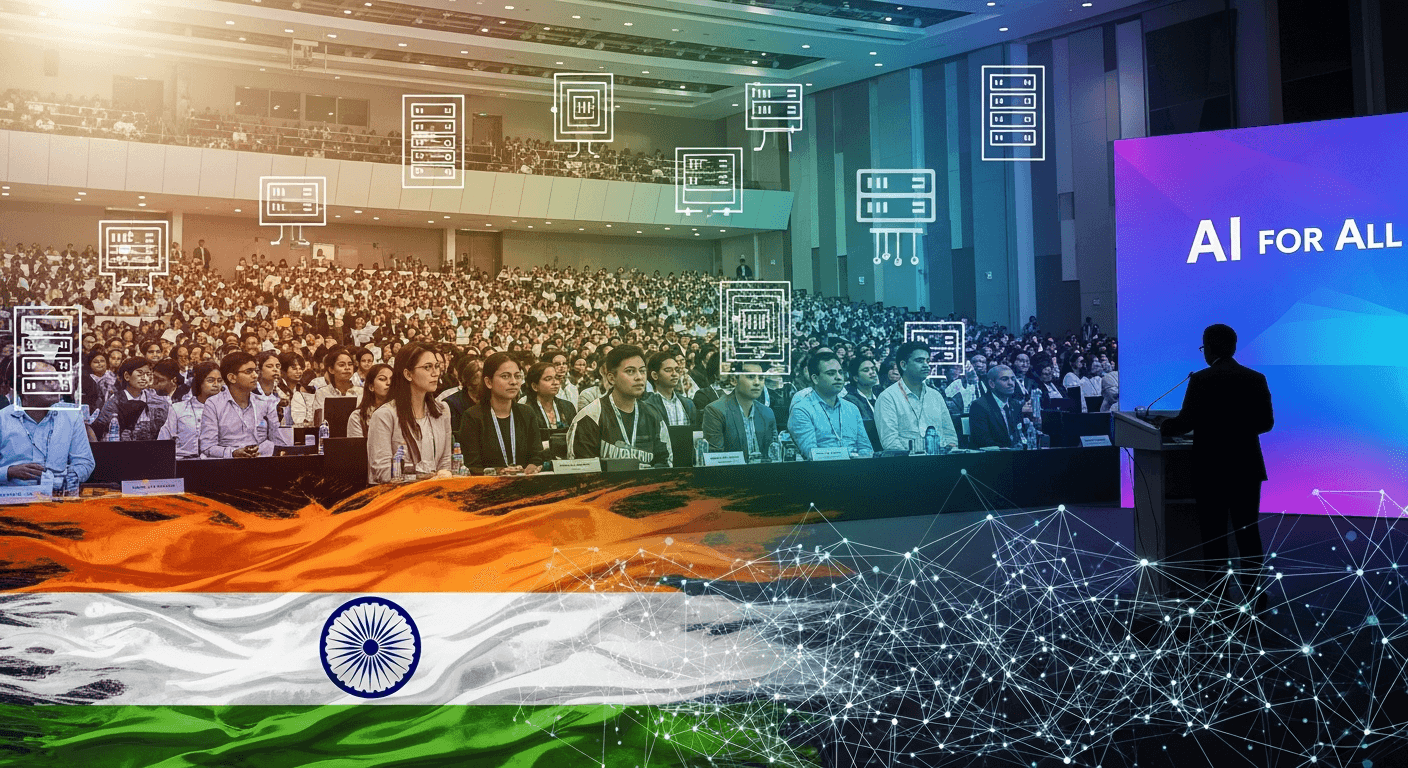
I write this after returning from the India AI Impact Summit in New Delhi with a mix of optimism and realism. The Summit — convened under the theme "Sarvajana Hitaya, Sarvajana Sukhaya" (welfare for all, happiness for all) — was a purposeful attempt to move the global conversation on artificial intelligence from high-minded principles to actionable impact. It brought together more than a hundred countries, industry leaders, researchers and many young innovators, and the tone was unmistakably about inclusion and agency for the Global South.[^1]
Why the Summit mattered
- It was the largest convening so far in the Global South focused on AI impact and governance.
- The agenda intentionally linked ethics, capacity building, infrastructure and practical deployments in sectors like health, agriculture and governance.
- There was an explicit push to make AI demonstrably useful at scale — not only for urban elites but for rural and multilingual communities across large developing populations.[^2]
Key messages from the Prime Minister (paraphrased)
The Prime Minister framed India as a natural hub for AI because of scale, diversity and democratic institutions. A few paraphrased takeaways I carried away from his remarks:
- "AI is a foundational technology; its real value appears when benefits reach the many, not the few" (paraphrased).
- "We must democratize AI so it becomes a tool of inclusion and empowerment — particularly for the Global South" (paraphrased).[1]
- He advanced a human-centered vision — summarized as the MANAV idea — that called for ethical systems, accountable governance, data sovereignty, accessibility and verifiability of AI (paraphrased).[1]
I mark those lines as paraphrased because my intent here is to capture the spirit of the address rather than provide a verbatim transcript. For readers who want the full text and official highlights, the Prime Minister’s address and the Summit materials are public and worth reading in full.[^1][^2]
India’s strengths in the global AI ecosystem
A recurring theme at the Summit was that India brings a unique combination of assets to the AI era:
- Talent at scale: one of the largest pools of engineers, data scientists and multilingual creators.
- A vibrant startup ecosystem: fast-growing AI startups focused on local domain problems — education, diagnostics, multilingual LLMs and agriculture.
- Digital public infrastructure: mature identity, payments and data-delivery systems that lower the cost of deploying services at scale.
- Diversity of data and real-world complexity: if models work in India’s varied linguistic, socio-economic and climatic contexts, they are more likely to generalize globally.
- Policy momentum: a clear narrative from leadership that links AI capability development to social inclusion and economic opportunity.[^3]
Announcements and initiatives at the Summit
Several concrete moves and commitments were emphasized (some announced by industry partners and government representatives during the event):
- Scaling compute access: commitments to meaningfully expand shared GPU and compute platforms to reduce the cost of model training for startups and researchers.
- Data and data-centre investments: announcements highlighting large-purpose data centres, investments in secure infrastructure and a push for localized processing while enabling global delivery.
- Local models and apps: the Summit showcased new India-specific models and applications, and multiple Indian teams unveiled models/apps oriented to local languages and domains.[^2][^3]
- Capacity-building: programmes and coalitions aimed at skilling, reskilling and bringing AI literacy to students, public servants and businesses.
Taken together these moves reflect a two-pronged strategy: (a) lower the barrier to building AI in India and (b) shape global deployment norms from a perspective centred on inclusion.
Implications for global AI governance
This Summit strengthened the argument that AI governance cannot be the exclusive preserve of a few high-income states. A few implications that struck me:
- Voice of the Global South: India’s convening role pushes for norms that reflect development priorities — fairness in access, data portability and capacity sharing.
- Commons framing: the Summit repeatedly advanced the idea that certain AI resources and standards should be treated as global public goods — e.g., authenticity labels, provenance/watermarking standards and open safety tooling (paraphrased from Summit discussions).[1]
- Multipolar governance: the world is heading toward a patchwork of complementary safeguards — national data policies, multilateral standards and interoperable technical baselines — rather than a single prescriptive regime.
Partnerships and public–private synergy
A practical takeaway from the Summit was how essential partnerships will be. Industry announced large infrastructure and platform investments while academic and government initiatives outlined shared compute and research partnerships. That combination is important because developing safe, scalable AI requires both the talent and the heavy infrastructure (compute, data centres, energy) that only joint public–private efforts can sustain.
Potential challenges ahead
The optimism at the Summit was balanced by realism about major constraints:
- Infrastructure gaps: building and powering gigawatt-class compute sustainably is capital-intensive and requires long lead times.
- Regulation vs. innovation trade-offs: creating robust, accountable regulation while not stifling innovative startups will be a delicate balance.
- Ethics and safety: operationalizing concepts like fairness, robustness, provenance and watermarking across many languages and contexts remains hard.
- Skills mismatch: skilling at scale — not just elite retraining but mass skilling across sectors — is necessary to avoid an AI divide.
- Energy and sustainability: the environmental footprint of large-scale training and inference must be addressed through renewable energy and efficiency innovations.
As someone who has been writing about India’s AI trajectory for some years, these are familiar refrains: the opportunity is massive, but the execution challenges are non-trivial. In earlier posts I stressed that India must build centres of excellence, invest in low-cost models and pair policy clarity with ecosystem incentives; those recommendations feel as relevant today as when I first wrote them.[^4]
What this means for stakeholders (a short playbook)
- Policymakers: craft clear, outcome-oriented rules that protect rights and spur responsible innovation. Prioritise interoperability and provenance standards that reduce harms while enabling global collaboration.
- Industry: commit to inclusive product design (multilingual, low-bandwidth, low-cost) and to investing in local compute and data infrastructure responsibly.
- Academia and research labs: partner on shared compute platforms, benchmark datasets for multilingual and low-resource contexts, and open safety tooling.
- Civil society: participate in governance dialogues, stress-test policies for equity and help design public-interest AI deployments.
- International partners: build capacity-sharing programmes (compute, data, training) that deliberately include the Global South.
Future outlook and call-to-action
The India AI Impact Summit felt like a pivot — not because a single decision will decide the future, but because a diverse group of actors committed to the same set of practical priorities: scale, inclusion, trust and capacity building. If India and its partners can follow through on shared compute access, transparent governance standards, and wide-based skilling, the result will be an AI ecosystem that both competes and collaborates on global terms.
My call-to-action is simple:
- Governments, companies and civil society should create rapidly deployable pilots that demonstrate AI’s public-good potential (health screening at scale, climate-smart agriculture advisory, multilingual education assistants).
- Fund a public compute commons that universities and startups can access at marginal cost to reduce entry barriers.
- Adopt provenance and watermarking standards as a minimum safety baseline and pair them with public literacy campaigns about synthetic content.
If we act with urgency and humility, we can shape an AI future that expands opportunity rather than concentrates it.
A final note about continuity
I’ve written previously about how India could transition from being a provider of services to a global exporter of AI intelligence — not just code, but context-rich, deployable solutions that reflect local realities and work globally.[^4] The Summit made that vision feel closer.
References & further reading
- Prime Minister’s address and Summit materials (official): https://impact.indiaai.gov.in/about-summit/ [^1]
- Reporting, highlights and transcript extracts: PM’s address and Summit coverage (various news outlets, Feb 2026). [^2][^3]
- My earlier reflections on how the AI revolution will play out in India: "How AI revolution will play out in India" (my blog).[ ^4]
Regards,
Hemen Parekh
Any questions / doubts / clarifications regarding this blog? Just ask (by typing or talking) my Virtual Avatar on the website embedded below. Then "Share" that to your friend on WhatsApp.
Get correct answer to any question asked by Shri Amitabh Bachchan on Kaun Banega Crorepati, faster than any contestant
Hello Candidates :
- For UPSC – IAS – IPS – IFS etc., exams, you must prepare to answer, essay type questions which test your General Knowledge / Sensitivity of current events
- If you have read this blog carefully , you should be able to answer the following question:
- Need help ? No problem . Following are two AI AGENTS where we have PRE-LOADED this question in their respective Question Boxes . All that you have to do is just click SUBMIT
- www.HemenParekh.ai { a SLM , powered by my own Digital Content of more than 50,000 + documents, written by me over past 60 years of my professional career }
- www.IndiaAGI.ai { a consortium of 3 LLMs which debate and deliver a CONSENSUS answer – and each gives its own answer as well ! }
- It is up to you to decide which answer is more comprehensive / nuanced ( For sheer amazement, click both SUBMIT buttons quickly, one after another ) Then share any answer with yourself / your friends ( using WhatsApp / Email ). Nothing stops you from submitting ( just copy / paste from your resource ), all those questions from last year’s UPSC exam paper as well !
- May be there are other online resources which too provide you answers to UPSC “ General Knowledge “ questions but only I provide you in 26 languages !


No comments:
Post a Comment