
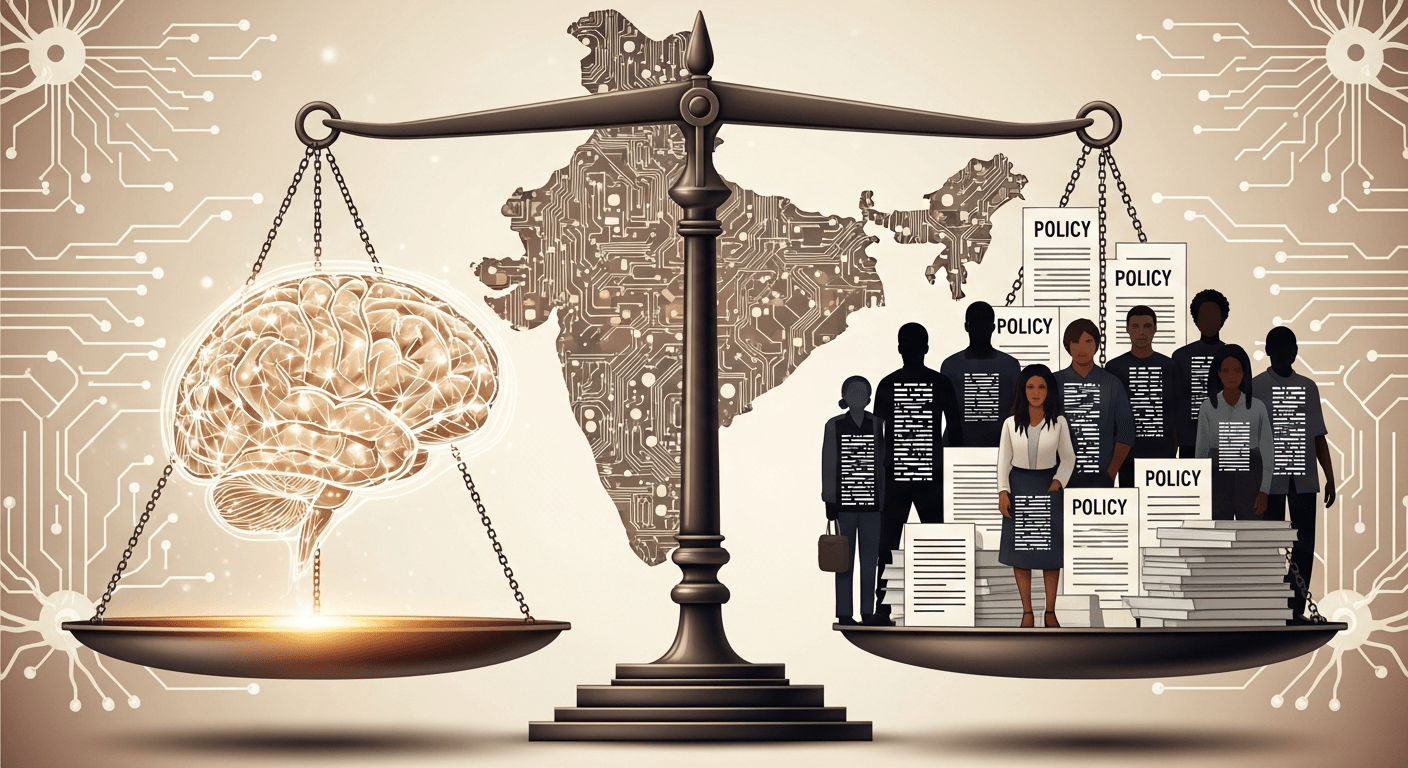
Governing AI: A Pragmatic Moment
When a government places a visible framework around a technology, it signals more than rules — it signals intent. The recent unveiling of national AI governance norms is one of those moments. It is not the end of a debate, nor a panacea for every risk; it is a pivot point where policy, industry and civil society must decide whether to treat AI as an uncontrollable tide or as a set of tools that can be guided, tested and improved responsibly. In this post I explain what the guidelines aim to do, what practitioners should expect, and how I see this fitting into the arc of conversations I have been having about AI governance for some time.
What the new norms try to achieve
At a high level, the framework aims to balance three objectives:
- Encourage innovation and make AI broadly useful — for government services, industry, startups and research.
- Protect people from predictable harms — bias, privacy violations, misinformation and unsafe automation.
- Create practical governance mechanisms that can evolve as the technology changes.
Concretely, the guidelines combine a set of guiding principles (sometimes referred to as "sutras"), a set of governance pillars that cover adoption, standards, accountability and safety, and a phased action plan that moves from voluntary compliance and sandboxes toward stronger, possibly mandatory, mechanisms as the ecosystem matures.
This pragmatic stance — start with principles and sandboxes, scale to standards and enforcement — is designed to avoid choking innovation while building a compliance culture and measurable safety practices.
Key elements practitioners should watch
Risk-based classification: Not every AI system is equal. The guidelines emphasize identifying high-risk applications (healthcare, critical infrastructure, core public services) and applying stricter requirements there.
Sandboxes and testing labs: Regulated experimentation spaces will let developers try systems under oversight, helping regulators learn without imposing premature bans.
National incident reporting and evidence: An incidents database (a "black box" for harms) is proposed to convert anecdote into actionable data — essential for calibrated regulation.
Standards and tests: Expect new evaluation metrics, certification pathways and publicly available benchmarks for fairness, robustness and content authenticity.
Phased compliance: Voluntary first, mandatory later. This lets the market adapt and standards coalesce before heavy-handed rules kick in.
Why this matters for businesses and technologists
For companies and teams building AI, this is a signal to embed governance into product lifecycles now, not later. Practical steps include:
- Start risk-mapping every model and dataset.
- Build transparency artifacts: model cards, data provenance and audit trails.
- Adopt reproducible testing frameworks for bias, security and performance under adverse inputs.
- Prepare to engage with sandboxes and certification pilots — early participation shapes the rules and grants market advantage.
Compliance will no longer be only a legal team concern; it will be a product, engineering and operations responsibility. Firms that invest early in demonstrable safety tooling will face lower friction when voluntary regimes move toward mandatory compliance.
My perspective and continuity with past commentary
This unveiling confirms a trajectory I have been writing about: a shift from hope-for-self-regulation toward structured, government-enabled governance that mixes innovation with accountability. In my earlier piece on voluntary codes and the need for regulatory clarity, I argued that encouraging voluntary compliance is a useful start but must be tied to measurable standards and incentives (How to regulate AI? Let it decide for itself?). In another essay I urged careful attention to risk and the need for policy calibration (Careful About AI).
Those ideas are visible in the new guidelines: risk-based approaches, sandboxes, and a timeline that contemplates stricter rules later. My continued view is that governance should be iterative — experiment, measure, standardize, and then regulate — rather than attempting to legislate every conceivable scenario up front.
Risks and limitations to keep in mind
Implementation capacity: Policies are only as good as the institutions that apply them. Building testing labs, training regulators and operationalizing incident reporting will take time and resources.
Regulatory capture and pace mismatch: If standards become overly influenced by incumbents, they can entrench advantages. Conversely, if regulation moves too slowly, harms proliferate.
Global interoperability: National frameworks must interoperate with international norms. Divergent rules can fragment markets and slow innovation.
Practical conclusion — recommendations for the next 12–18 months
For policy makers:
- Invest in capability: set up independent testing labs, fund regulator technical training and operationalize incident reporting with privacy safeguards.
- Keep the sandbox pipeline open and transparent; publish evaluation methods so the ecosystem can align.
For businesses and startups:
- Treat governance as product-quality work: build audits, reproducible tests and public documentation (model cards, data lineage).
- Engage early with pilots and standards bodies — participation shapes future obligations and reduces compliance shocks.
For researchers and civil society:
- Demand transparent metrics and accessible benchmarks; public scrutiny raises overall system robustness.
- Help build public literacy about AI risks and realistic expectations about what governance can and cannot do.
For all of us: adopt an iterative mindset. Governance that learns — through sandboxes, incident data and open standards — will outperform both rigid bans and laissez-faire approaches.
Regards,
Hemen Parekh
Any questions / doubts / clarifications regarding this blog? Just ask (by typing or talking) my Virtual Avatar on the website embedded below. Then "Share" that to your friend on WhatsApp.
Get correct answer to any question asked by Shri Amitabh Bachchan on Kaun Banega Crorepati, faster than any contestant
Hello Candidates :
- For UPSC – IAS – IPS – IFS etc., exams, you must prepare to answer, essay type questions which test your General Knowledge / Sensitivity of current events
- If you have read this blog carefully , you should be able to answer the following question:
- Need help ? No problem . Following are two AI AGENTS where we have PRE-LOADED this question in their respective Question Boxes . All that you have to do is just click SUBMIT
- www.HemenParekh.ai { a SLM , powered by my own Digital Content of more than 50,000 + documents, written by me over past 60 years of my professional career }
- www.IndiaAGI.ai { a consortium of 3 LLMs which debate and deliver a CONSENSUS answer – and each gives its own answer as well ! }
- It is up to you to decide which answer is more comprehensive / nuanced ( For sheer amazement, click both SUBMIT buttons quickly, one after another ) Then share any answer with yourself / your friends ( using WhatsApp / Email ). Nothing stops you from submitting ( just copy / paste from your resource ), all those questions from last year’s UPSC exam paper as well !
- May be there are other online resources which too provide you answers to UPSC “ General Knowledge “ questions but only I provide you in 26 languages !



No comments:
Post a Comment