
Background
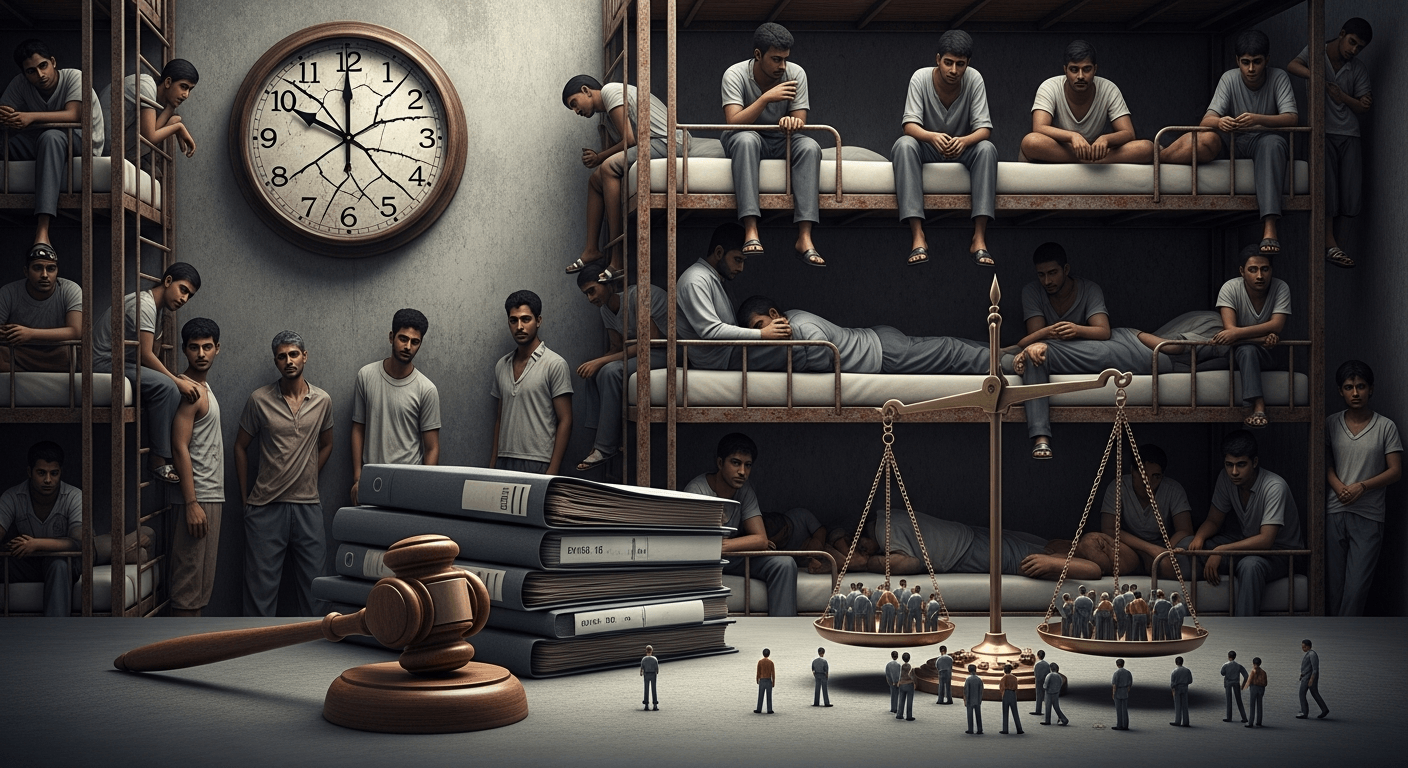
I write this as someone who has followed prison reform conversations for years and watched statistics quietly turn into daily human tragedies. Recent data — from government compilations and independent analyses presented at national consultations — shows that India’s prison system is under intense stress: more than 300 prisons are reportedly operating at roughly double their sanctioned capacity, while national occupancy averages remain well above 100%.[^1][^2]
Key findings at a glance
- National occupancy: The official Prison Statistics and related compilations show all-India occupancy consistently over 120% in recent years, with regional extremes much higher.[^2]
- “Double-capacity” jails: Over 300 individual jails have been reported at ~200% occupancy or more, creating pockets of ‘‘extreme’’ overcrowding.[^1]
- Undertrials dominate: Roughly three out of four people behind bars are undertrial detainees — people who have not been convicted but are awaiting investigation or trial.[^2]
- Staffing and health gaps: Large vacancies for medical staff, correctional officers, and virtually no sanctioned mental health positions in many jails compound the problem.[^1][^2]
Causes of overcrowding
The data and on-ground reporting point to several systemic causes:
- Judicial delay and case backlogs: Slow investigation, overloaded courts and protracted trials mean undertrials remain in custody for months or years.
- Pre-trial detention practices: Arrest-first-investigate-later patterns and restrictive bail regimes push many low-risk accused into custody.
- Policy and infrastructure mismatch: Capacity additions have not kept pace with the growth in the detained population, nor with the specific needs for segregation, health care, and rehabilitation.
- Social inequality: Marginalised groups are disproportionately represented among detainees, with limited access to legal aid and resources to secure bail quickly.[^1]
Impacts on inmates and institutions
Overcrowding is not a statistic — it is the daily reality of compromised dignity, health, and justice:
- Health crises: Insufficient sleeping space, poor sanitation and a severe shortage of medical and mental-health staff raise morbidity and suicide risks.
- Security and rehabilitation failure: Overcrowded barracks make classification and segregation impossible, increasing violence and recidivism.
- Erosion of legal rights: Delays undercut the presumption of innocence for undertrials; many lose livelihoods, family ties and housing while cases linger.
- Children and women: Women prisoners (and the small number of children housed with them) face acute gaps in maternal and child care.
Legal and human-rights implications
The combination of prolonged pre-trial detention, overcrowded conditions, and inadequate medical care raises constitutional and international human-rights concerns. International standards (UN and other bodies) require detention conditions that preserve dignity and access to health care; prolonged pre-trial detention without adequate review also risks arbitrary detention. Courts and advisory bodies have repeatedly urged states to adopt decongestion measures, but implementation remains uneven.[^2]
Examples and case studies
- Delhi’s central jails: Several central jails in Delhi have reported occupancy many times over sanctioned strength — conditions there have been cited in international extradition contexts as problematic.[^3]
- Uttar Pradesh and Muradabad: Some district jails report occupancy approaching five times capacity, a stark demonstration of local imbalances.[^1]
- Skills and hope—Surat (Lajpore) example: I have written before about positive, small-scale innovations where prison workshops (for instance, diamond polishing and vocational training) offer earnings, skills and a route to dignity. Replicating such models can be part of a humane response to overcrowding.[^4]
What experts say (paraphrased)
- A senior prison-reform researcher observed: "Overcrowding is a symptom of a justice pipeline that doesn't diagnose early — bail, legal aid and case prioritisation are the real treatment."
- A public-health advocate noted: "A doctor for every few hundred inmates is an ideal; the reality in many places is one for hundreds or thousands — that gap has lives attached to it."
Policy recommendations (urgent and pragmatic)
- Scale non-custodial options
- Expand bail reforms, personal bonds and monitored release for non-violent accused.
- Pilot house-arrest and electronic monitoring (with privacy safeguards) where feasible.
- Fast-track and early legal aid
- Strengthen pre-trial legal aid clinics in police stations and courts; deploy paralegals and social workers to speed bail outcomes.
- Undertrial review and case prioritisation
- Institutionalise district-level review committees to identify long-stay undertrials and prioritise their hearings.
- Invest in health and rehabilitation
- Sanction full-time medical and mental-health staff as per model norms; scale vocational programs that prepare inmates for reintegration.
- Data-driven capacity planning
- Use e-prisons platforms and transparent dashboards to identify extreme hotspots and target resources over averages.
Conclusion
This is not merely a management problem; it is a governance and moral problem. Every number in the reports corresponds to a person whose life, family and future are being reshaped by delays and overcrowded cells. We can — and must — shift policy emphasis from building more cells to reducing the flow into them and improving the conditions of those already inside. From expanding legal-aid and bail reforms to scaling rehabilitative work like successful skill centres, the solutions are known; the task now is consistent political will and administrative focus.
I have written previously about creative skill-based rehabilitation and tech-enabled alternatives to custody; today those ideas feel less theoretical and more urgent.[^4]
Sources
- National Crime Records Bureau — Prison Statistics India (PSI) 2022/2023 (NCRB)
- India Justice Report / TISS-Prayas briefers and consultation materials
- Ministry of Home Affairs (Parliamentary responses and schemes on prisons)
- Reporting and analysis by national outlets summarising IJR/NCRB findings
- Human Rights Watch and Amnesty International reports on detention conditions and rights
Regards,
Hemen Parekh
Any questions / doubts / clarifications regarding this blog? Just ask (by typing or talking) my Virtual Avatar on the website embedded below. Then "Share" that to your friend on WhatsApp.
Get correct answer to any question asked by Shri Amitabh Bachchan on Kaun Banega Crorepati, faster than any contestant
Hello Candidates :
- For UPSC – IAS – IPS – IFS etc., exams, you must prepare to answer, essay type questions which test your General Knowledge / Sensitivity of current events
- If you have read this blog carefully , you should be able to answer the following question:
- Need help ? No problem . Following are two AI AGENTS where we have PRE-LOADED this question in their respective Question Boxes . All that you have to do is just click SUBMIT
- www.HemenParekh.ai { a SLM , powered by my own Digital Content of more than 50,000 + documents, written by me over past 60 years of my professional career }
- www.IndiaAGI.ai { a consortium of 3 LLMs which debate and deliver a CONSENSUS answer – and each gives its own answer as well ! }
- It is up to you to decide which answer is more comprehensive / nuanced ( For sheer amazement, click both SUBMIT buttons quickly, one after another ) Then share any answer with yourself / your friends ( using WhatsApp / Email ). Nothing stops you from submitting ( just copy / paste from your resource ), all those questions from last year’s UPSC exam paper as well !
- May be there are other online resources which too provide you answers to UPSC “ General Knowledge “ questions but only I provide you in 26 languages !




No comments:
Post a Comment