
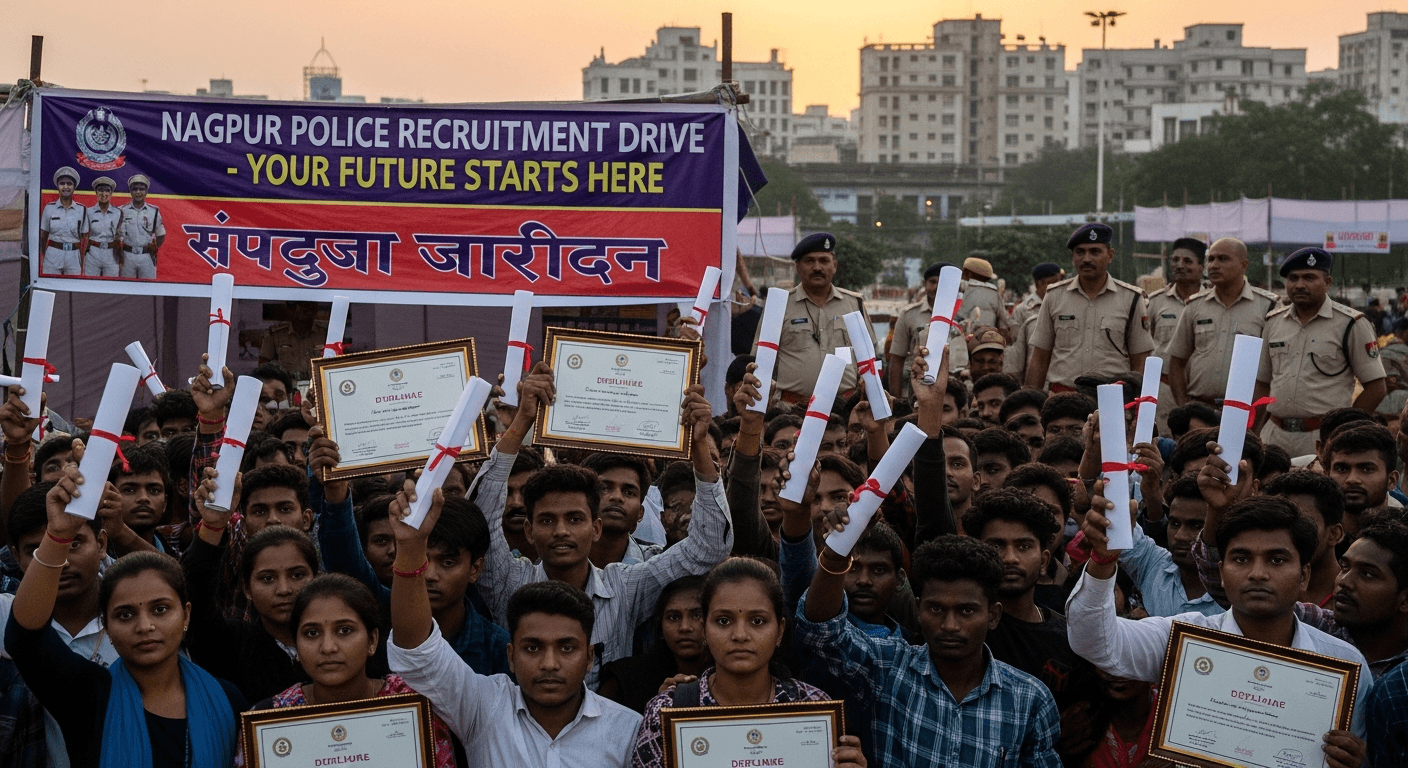
Why so many graduates want to be constables in Nagpur
I read the Times of India piece with more than a little interest: 9,775 grads, 1,729 PGs in race for 395 constable posts — a headline that reads like a small sociological puzzle and a big labour-market signal at the same time 9,775 grads, 1,729 PGs in race for 395 constable posts.
What the numbers mean (quick summary)
- Total applicants for Nagpur city police constable recruitment: 36,222 (for city police posts), with additional huge interest in prison roles — bringing over 1.07 lakh applicants across related drives.
- Among the city-applicants are 9,775 graduates and 1,729 post-graduates.
- The advertised posts are a few hundred (headline cites 395; related reports discuss 595 city posts plus additional prison vacancies), which creates extremely high competition ratios.
These are the core facts. The arithmetic is brutal: thousands of degree-holders chasing a handful of secure, permanent posts.
Why the candidate pool is so large
Several forces converge:
- Economic security: Government service still offers predictable salary progression, healthcare, housing allowances or pension options — features many private-sector roles do not guarantee.
- Underemployment and precarious work: Many degree-holders are in short-term contracts, gig roles, or low-quality jobs that don't match qualifications. A stable constable post is an immediate and tangible upgrade for such candidates.
- Low eligibility barrier vs high payoff: If the minimum qualification is HSC (12th pass), highly qualified people can enter these recruitment pools and effectively “trade down” their educational premium for job security.
- Local demand-supply mismatch: Cities like Nagpur have seen uneven private hiring; when government vacancies open, they attract applicants from across education levels.
Implications for applicants and the recruitment process
For applicants:
- Competition intensifies: A written test or physical exam that once filtered thousands now filters tens of thousands per post. Cutoffs will be higher and margins thinner.
- Psychological pressure: Candidates with advanced degrees may face a difficult identity shift—accepting a job with different expectations than their training.
For the recruitment authorities:
- Logistical challenge: Managing tens of thousands of candidates needs technology, biometric verification, CCTV, randomized group assignment and tamper-resistant timing for sprints — all to reduce malpractice and ensure fairness.
- Merit vs mass: Authorities must balance fair evaluation with scalable systems; otherwise, the process risks errors, delays, or litigation.
Fairness, reservation and social concerns
This surge raises ethical and policy questions:
- Reservation intent vs competition squeeze: Reservation policies aim to uplift historically disadvantaged groups. When highly-qualified applicants flood general and reserved-category pools, the selection dynamics change. Authorities must ensure that reservation intent isn't undermined by gaming or inflated applicant strategies.
- Certificate verification: With education levels so varied, stringent document checks and biometric processes are essential to prevent fraud.
- Inclusive access: The presence of highly educated applicants from diverse backgrounds suggests wider social inclusion — but it also risks squeezing out marginalised applicants who prepared specifically for these pathways.
Practical tips for applicants
- Train for the tests that matter: physical fitness (timed runs, shot put), document readiness (original certificates, affidavits), and the written exam syllabus. Don’t assume a degree compensates for poor physical conditioning.
- Verify your category documentation early: caste, EWS, disability, ex-serviceman proofs — get them attested and backed up.
- Be realistic and plan alternatives: If this recruitment is one of many attempts, maintain parallel job-search strategies (banking, railways, private sector roles) and skill upgrades.
- Mental preparation: Competition is also psychological. Practice mock tests under timed conditions and train for the stress of large-scale selection environments.
Nagpur and Maharashtra context
Nagpur is a regional administrative and commercial hub; Maharashtra’s periodic large-scale police recruitments attract city and district applicants alike. Recent recruitment cycles have introduced more technology (randomisation, RFID timing, extensive CCTV and biometric checks) to handle volumes and reduce collusion — a necessary step given the numbers. Local authorities are also separating city police and prison recruitments, which explains some of the multiplicity of vacancy figures reported across outlets.
Job-market trends shaping this interest
This phenomenon is not unique to Nagpur. Across India, secure public employment remains a magnet because:
- Private-sector volatility is rising (startups, contractualisation, layoffs).
- Educational inflation: More graduates chase a finite set of white-collar roles, pushing many to consider public service as an alternative.
- Social signalling: A government job often carries social prestige and community stability that private jobs may not deliver.
A short conclusion and call-to-action
These numbers tell a layered story: economic anxiety, social mobility strategies, and a labour market still sorting itself after structural shocks. If you’re a candidate, prepare practically — physically, administratively and mentally. If you’re a citizen or policymaker, the surge is a reminder to expand quality employment avenues and to invest in transparent, scalable recruitment systems.
Read the original report for context and exact figures: 9,775 grads, 1,729 PGs in race for 395 constable posts.
Regards,
Hemen Parekh
Any questions / doubts / clarifications regarding this blog? Just ask (by typing or talking) my Virtual Avatar on the website embedded below. Then "Share" that to your friend on WhatsApp.
Get correct answer to any question asked by Shri Amitabh Bachchan on Kaun Banega Crorepati, faster than any contestant
Hello Candidates :
- For UPSC – IAS – IPS – IFS etc., exams, you must prepare to answer, essay type questions which test your General Knowledge / Sensitivity of current events
- If you have read this blog carefully , you should be able to answer the following question:
- Need help ? No problem . Following are two AI AGENTS where we have PRE-LOADED this question in their respective Question Boxes . All that you have to do is just click SUBMIT
- www.HemenParekh.ai { a SLM , powered by my own Digital Content of more than 50,000 + documents, written by me over past 60 years of my professional career }
- www.IndiaAGI.ai { a consortium of 3 LLMs which debate and deliver a CONSENSUS answer – and each gives its own answer as well ! }
- It is up to you to decide which answer is more comprehensive / nuanced ( For sheer amazement, click both SUBMIT buttons quickly, one after another ) Then share any answer with yourself / your friends ( using WhatsApp / Email ). Nothing stops you from submitting ( just copy / paste from your resource ), all those questions from last year’s UPSC exam paper as well !
- May be there are other online resources which too provide you answers to UPSC “ General Knowledge “ questions but only I provide you in 26 languages !


No comments:
Post a Comment