
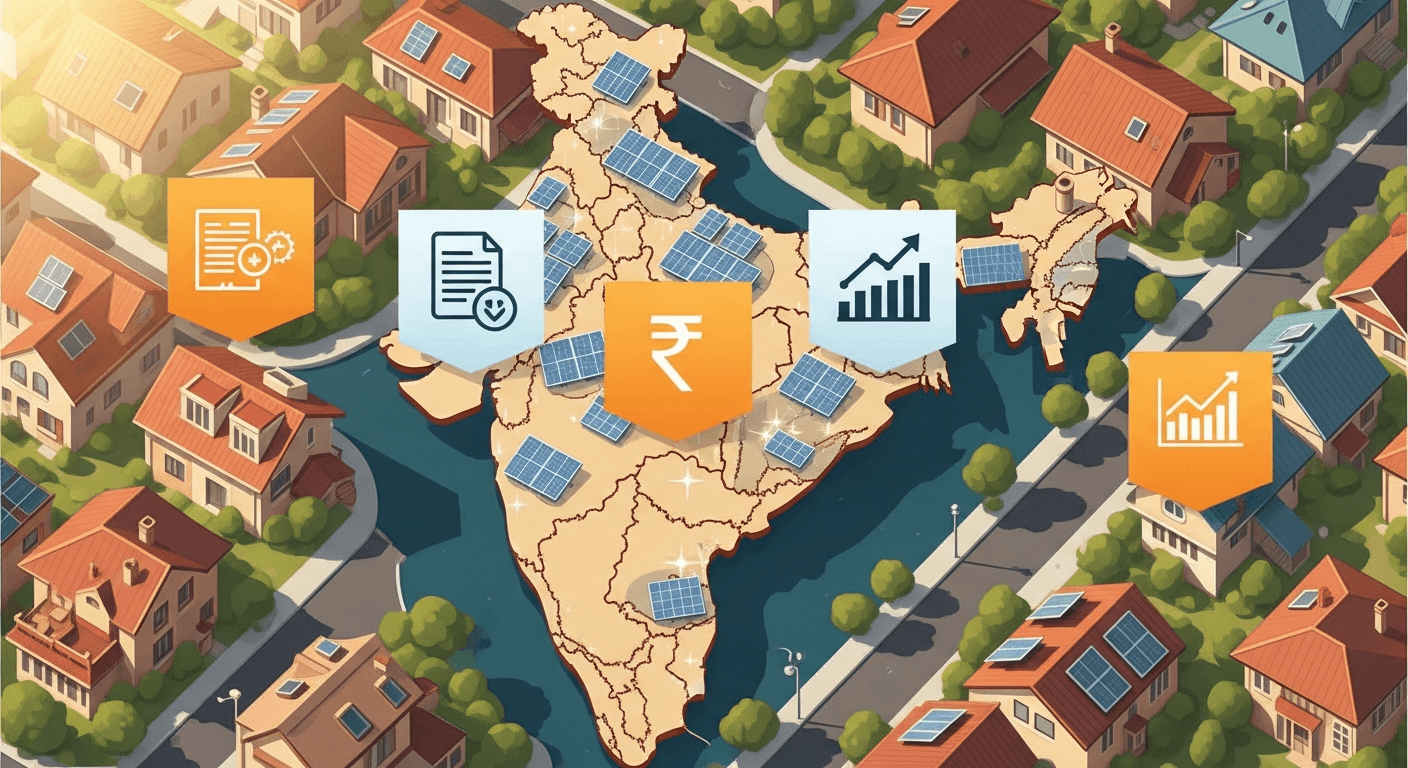
I write often about decentralised energy because I believe the rooftop matters as much as the grid. Recent reporting that Gujarat, Maharashtra and Uttar Pradesh lead the country in rooftop solar figures is not just a headline — it’s a snapshot of how policy, finance and implementation intersect to change lives and kilowatts. The Times of India piece that prompted these reflections is a useful starting point for anyone following India’s residential solar story Gujarat, Maharashtra, UP lead rooftop solar figures | The Times of India.
What the numbers tell us
- Recent national and industry data show strong growth in rooftop installations: national cumulative rooftop capacity has moved into the low tens of gigawatts in recent years, with Western states contributing a large share. For context, MNRE and sector reports put India’s rooftop solar installed base in the teens of GW and note rapid residential uptake after rollout of targeted schemes (see MNRE’s Grid Connected Rooftop Solar Programme) Grid Connected Rooftop Solar Programme | MNRE.
- Market reports (industry trackers and trade press) confirm that residential installations surged in recent quarters as subsidy programmes and easier financing grew traction — and Gujarat, Maharashtra and Uttar Pradesh ranked among top performers in many of these measures India installs 3.2 GW of rooftop solar in 2024, driven by residential growth | pv-magazine.
Taken together: leadership by specific states reflects a combination of supply chain readiness, state-level facilitation, and successful rollout of central schemes — not just sunshine.
Why these states are ahead (policy + implementation)
- Central support with local execution. The PM Surya Ghar-style interventions and MNRE’s rooftop programmes provide central financial assistance, but the speed of conversion from application to installation depends on DISCOMs and state nodal agencies. Where discoms simplified approvals and disbursed subsidies promptly, uptake rose.
- State-level incentives, streamlined net-metering, and attractive buyback or feed-in rates make the economics clearer for households and small businesses.
- Mature vendor ecosystems and local installers reduce delays and cost overruns, which matters for residential customers who need quick, reliable execution.
Policy implications
- Coordination matters: national schemes set targets and allocate funds, but state implementation is the bottleneck or accelerator. Policymakers should therefore prioritise single-window approvals, time-bound subsidy transfers, and standardised vendor empanelment.
- Finance and standardisation: making collateral-free, low-interest credit widely available and promoting pre-bundled residential kits can lower transaction costs and increase conversion rates from application to installation.
- Data and monitoring: a public, up-to-date rooftop registry (linked to DISCOMs) helps spot bottlenecks and measure progress toward the 30 GW rooftop target that national plans have highlighted.
Benefits for residents and businesses
- Lower electricity bills: behind-the-meter rooftop generation reduces import from the grid and shrinks monthly bills.
- Energy resilience: households and small businesses gain daytime autonomy and can pair systems with batteries for backup.
- Income opportunities: surplus generation can be exported under state rules; clear feed-in arrangements create modest revenue streams.
- Environmental impact: decentralised solar reduces distribution losses and contributes to lower carbon emissions at local level.
Challenges that remain
- Supply and cost volatility: module and component supply issues can delay projects and raise prices, affecting uptake.
- Conversion gap: many applications under national portals still take time to convert into installations due to paperwork, DT (distribution transformer) limits, or vendor shortages.
- Uneven state performance: some states and regions lag because of regulatory choices (e.g., unfavourable metering rules) or weaker local ecosystems.
- Consumer awareness and trust: homeowners need trustworthy vendors, transparent pricing and a clear grievance redressal path.
Future outlook
If states sustain streamlined processes and financing keeps improving, rooftop solar could scale rapidly — not just for urban homes, but for rural households and apartment societies. National targets envisage several GW more from rooftops; meeting them will require continued alignment between central funding, state execution and private-sector delivery.
I’ve written about the potential of decentralised rooftop systems before — in earlier posts I argued that mandating or incentivising rooftop systems for new homes and simplifying local approvals could accelerate adoption (see my piece on rooftop solar as a better alternative)Roof Top Solar : Better Alternative. The current shift shows that argument moving from theory toward practice.
Practical tips for homeowners considering rooftop solar
- Start with a verified quote: get at least two written estimates from empanelled vendors and check their past installations.
- Use the National Portal / state DISCOM portal: register and track subsidy disbursal and approvals online to avoid delays.
- Size sensibly: most households benefit from 1–3 kW systems for core loads; oversizing may require meter/upgradation steps.
- Check warranties and O&M: prefer 10–25 year module warranties and clear annual maintenance terms for inverters and panels.
- Explore financing: look for schemes offering collateral-free loans, or vendor EMI options that integrate the subsidy.
- Confirm net-metering / export rules: understand how your DISCOM credits surplus generation and for how long.
Sources and further reading
- Times of India: Gujarat, Maharashtra, UP lead rooftop solar figures link.
- Ministry of New & Renewable Energy (Grid Connected Rooftop Solar Programme) link.
- Industry reporting on rooftop additions and residential growth (pv-magazine; Mercom summaries) link.
Rooftop solar’s growth is ultimately a story of institutions and people meeting on the roof above every household. When implementation is local and the incentives are aligned, the rooftop becomes a generator of economic and environmental value — one household at a time.
Regards,
Hemen Parekh
Any questions / doubts / clarifications regarding this blog? Just ask (by typing or talking) my Virtual Avatar on the website embedded below. Then "Share" that to your friend on WhatsApp.
Get correct answer to any question asked by Shri Amitabh Bachchan on Kaun Banega Crorepati, faster than any contestant
Hello Candidates :
- For UPSC – IAS – IPS – IFS etc., exams, you must prepare to answer, essay type questions which test your General Knowledge / Sensitivity of current events
- If you have read this blog carefully , you should be able to answer the following question:
- Need help ? No problem . Following are two AI AGENTS where we have PRE-LOADED this question in their respective Question Boxes . All that you have to do is just click SUBMIT
- www.HemenParekh.ai { a SLM , powered by my own Digital Content of more than 50,000 + documents, written by me over past 60 years of my professional career }
- www.IndiaAGI.ai { a consortium of 3 LLMs which debate and deliver a CONSENSUS answer – and each gives its own answer as well ! }
- It is up to you to decide which answer is more comprehensive / nuanced ( For sheer amazement, click both SUBMIT buttons quickly, one after another ) Then share any answer with yourself / your friends ( using WhatsApp / Email ). Nothing stops you from submitting ( just copy / paste from your resource ), all those questions from last year’s UPSC exam paper as well !
- May be there are other online resources which too provide you answers to UPSC “ General Knowledge “ questions but only I provide you in 26 languages !





No comments:
Post a Comment