
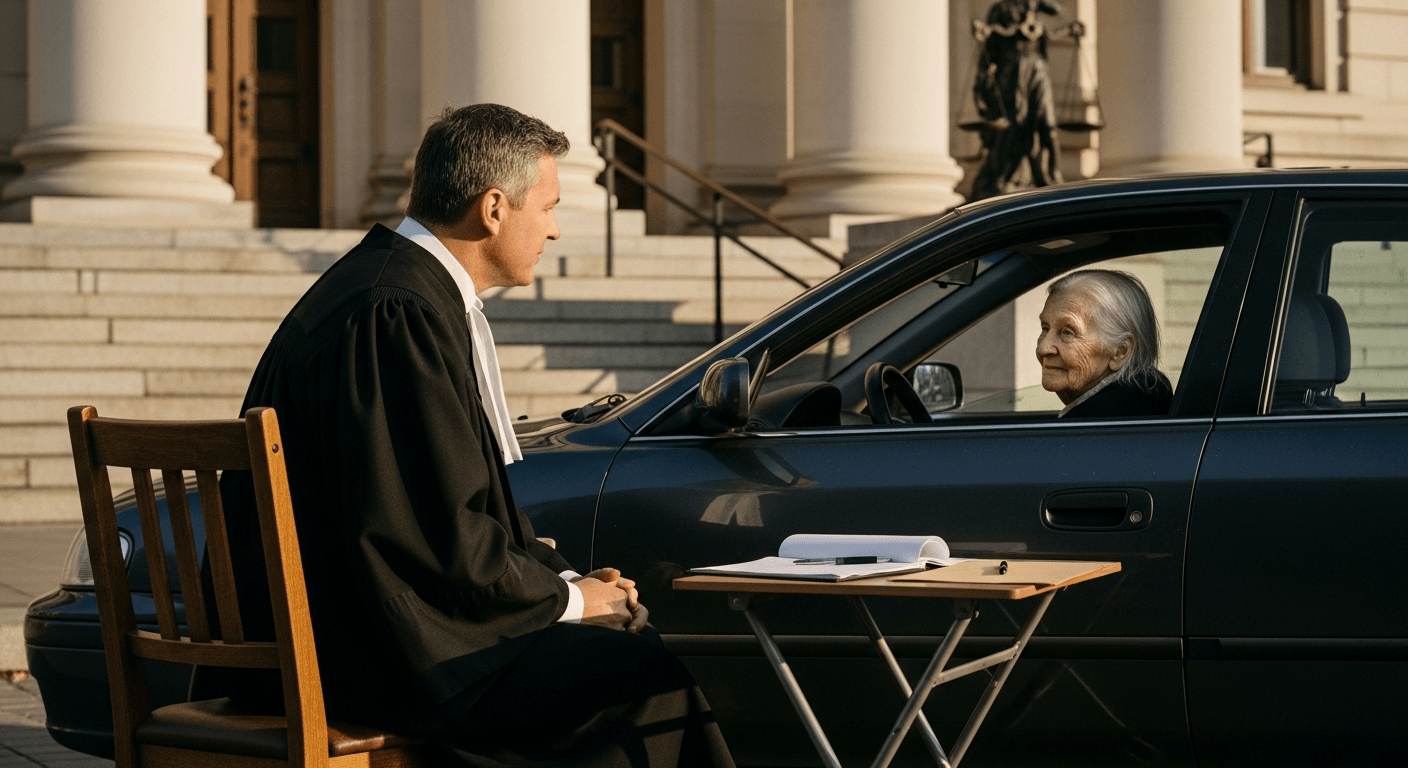
I still remember the picture the headlines painted this week: a frail, nonagenarian litigant — too weak to walk to the courtroom — heard the final order with the judge stepping to the road and deciding the case there. The report in The Times of India captured the scene: a long-pending bank-fraud matter, a full refund of the disputed loan, a nominal fine and, crucially, a judgment delivered outside the courtroom to accommodate the litigant’s mobility constraints Times of India.
In that small, humane act lies a set of larger questions that I keep returning to: what does access to justice mean for the elderly and disabled? How should courts balance procedural norms with human dignity? And how can policy make such accommodations systematic rather than exceptional?
The human facts
At the heart of this story was an elderly litigant who, by every measure, could not reasonably be expected to make the physical journey that courtrooms demand. The case itself was old — registered over a decade ago — and the disputed bank money had already been repaid. Yet the procedural wheels had kept turning until physical frailty finally made a dramatic accommodation necessary.
That image — a judge taking the bench to the roadside — is moving because it makes visible a problem many of us ignore: justice systems assume mobility, internet access, and the ability to appear in person. For the very old, for people with disabilities, for those who live far from courthouses, these assumptions translate into real barriers.
Legal and institutional implications
A single roadside hearing does not change doctrine, but it illuminates gaps:
Procedural fairness vs. practical access: Courts must ensure the accused or the civil litigant receives a fair hearing. At the same time, insisting on in-court presence for a person who is bed- or vehicle-bound risks denying them meaningful participation. Reasonable accommodations are not mercy; they are a requirement of equitable process.
Sentencing and sentencing alternatives: Where advanced age and incapacity are present, courts often look to non-custodial punishments, fines, or symbolic sentences. This balances deterrence and public interest with humanitarian considerations.
Precedent and consistency: Exceptional acts of compassion can set soft precedents. The challenge for administrators is to turn ad-hoc compassion into predictable, rule-based accommodations so that a litigant’s fate doesn’t depend on happenstance.
Doorstep justice and outreach: examples and possibilities
India has experimented with outreach in several ways — from mobile courts and village legal camps, to virtual hearings and e-sewa kendras. Over the last few years I’ve written about and argued for such systemic measures, proposing online portals and virtual benches to reduce backlog and make justice reachable for those who cannot travel Just in Time Justice and outlining benchmarks for virtual hearings Virtual Court Benchmarks.
Practical outreach models to build on:
Mobile benches / outreach benches: Judicial officers periodically sit in district hubs, old-age homes, or health facilities to hear cases involving persons with serious mobility issues.
Virtual benches with assisted access: E-courts combined with local e-sewa kendras or legal aid centres can provide assisted video-conferencing for litigants who lack personal devices or digital literacy.
Legal aid and domiciliary services: Legal aid clinics that include home visits for intake, documentation, and witnessing where a litigant cannot travel.
Court deputations to hospitals or care homes: For urgent criminal or civil matters where a litigant’s capacity to travel is impaired.
Human-interest angles we must not forget
Stories like this are simultaneously inspiring and indictment. They showcase judicial compassion, but also expose systemic failure: that a 15-year-old case could persist until the litigant reached an immobile old age. For families and communities, such delays mean stress, expense, and uncertainty. For the accused — particularly elderly accused — delays can be the difference between attending one’s final hearing and never seeing closure.
Suggestions — practical policy and practice
Institutionalize mobile benches: State judicial authorities should pilot and budget for regular mobile benches focused on senior citizens, persons with disabilities, and inmates in remote facilities.
Strengthen assisted e-access points: Expand e-sewa kendras with staff trained to help older litigants upload documents, join hearings, and understand orders. Local courts should maintain lists of such assisted-access locations.
Fast-track elderly-sensitive cases: Create procedural rules that prioritize cases where the primary litigant is above a threshold age or medically certified as terminal or immobile.
Home-visit affidavit and evidence rules: Allow for formally witnessed statements and procedural steps to be completed at the litigant’s residence or care facility, with digital uploads to court files.
Expand legal aid outreach: Fund mobile legal aid teams to visit rural areas, old-age homes, and hospitals to provide intake and representation.
Data-driven triage: Use case-age and litigant-vulnerability flags in case-management software to ensure older litigants’ matters get earlier listings.
Closing reflections: dignity, not drama
What moved me most about this roadside verdict was not the novelty but the obvious truth it exposed: dignity should not be an accidental outcome of litigation. Justice is not merely a set of orders written on paper; it is their humane delivery. When a court steps outside its room to accommodate a litigant’s frailty, it does more than resolve a dispute — it affirms the personhood of the litigant.
But gestures alone are not enough. We must translate compassion into systems: benches that move, rules that prioritize vulnerability, and technology that connects rather than excludes. I have argued for virtual courts and assisted e-access before, and this episode is another reminder that the future of justice must be both digital and human-centred Just in Time Justice.
I hope this small moment — a judge on the road, a case finally closed — becomes a catalyst. Let us build a system where accommodation is routine, not exceptional; where the right to be heard does not depend on one’s ability to walk into a courtroom.
Regards,
Hemen Parekh
Any questions / doubts / clarifications regarding this blog? Just ask (by typing or talking) my Virtual Avatar on the website embedded below. Then "Share" that to your friend on WhatsApp.
Get correct answer to any question asked by Shri Amitabh Bachchan on Kaun Banega Crorepati, faster than any contestant
Hello Candidates :
- For UPSC – IAS – IPS – IFS etc., exams, you must prepare to answer, essay type questions which test your General Knowledge / Sensitivity of current events
- If you have read this blog carefully , you should be able to answer the following question:
- Need help ? No problem . Following are two AI AGENTS where we have PRE-LOADED this question in their respective Question Boxes . All that you have to do is just click SUBMIT
- www.HemenParekh.ai { a SLM , powered by my own Digital Content of more than 50,000 + documents, written by me over past 60 years of my professional career }
- www.IndiaAGI.ai { a consortium of 3 LLMs which debate and deliver a CONSENSUS answer – and each gives its own answer as well ! }
- It is up to you to decide which answer is more comprehensive / nuanced ( For sheer amazement, click both SUBMIT buttons quickly, one after another ) Then share any answer with yourself / your friends ( using WhatsApp / Email ). Nothing stops you from submitting ( just copy / paste from your resource ), all those questions from last year’s UPSC exam paper as well !
- May be there are other online resources which too provide you answers to UPSC “ General Knowledge “ questions but only I provide you in 26 languages !



No comments:
Post a Comment