
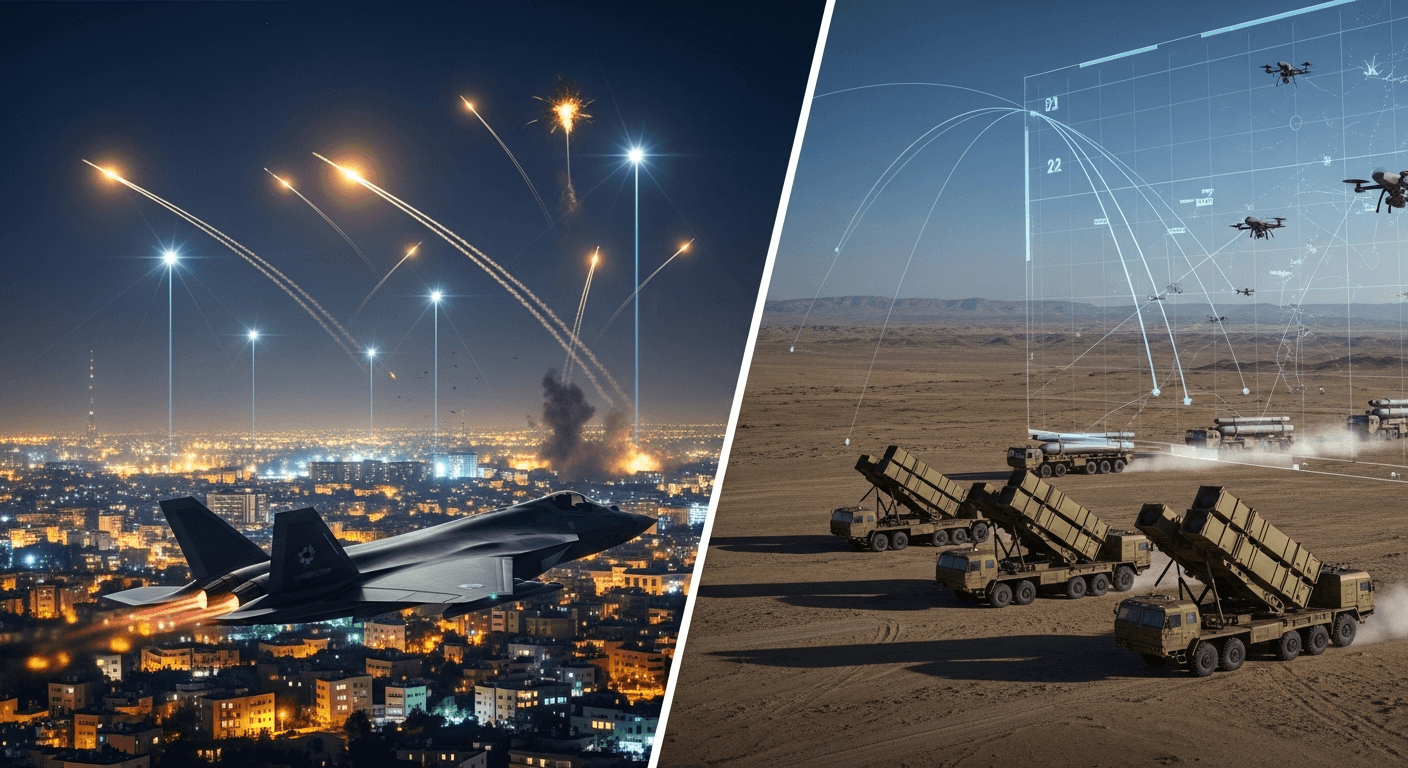
I write from the perspective of someone who studies technology, geopolitics and the human cost of conflict. The Israel–Iran military confrontation is not an abstract puzzle — it is a collision of different strategic logics: one side leans on technological quality, integrated air power and missile defence; the other on numbers, missile depth and regional reach. Below I set out a balanced, data-driven assessment of capabilities, constraints, escalation dynamics and practical measures that could reduce the risk of a wider war.
Quick snapshot
- Israel: smaller population and manpower, high defence spending per capita, advanced air force (including stealth fighters), layered missile-defence architecture and tight intelligence and US ties.
- Iran: much larger population and territorial depth, larger active forces, one of the region’s largest ballistic-missile inventories and extensive proxy networks across the Middle East.
(Selected open-source data cited below inform the comparisons.)
Military capabilities — domain by domain
Air
- Israel’s qualitative edge is clear: modern multirole fighters, F-35 capability, aerial refuelling and sophisticated electronic warfare and C4ISR that enable long-range precision strikes and deep ISR integration Times of India.
- Iran fields a numerically comparable aircraft fleet but much of it is older Soviet- or US-era hardware with limited sustainment because of sanctions; Tehran compensates by investing heavily in drones and long-range missiles Fortune.
Naval
- Iran’s navy and IRGC naval forces are optimized for operations in the Persian Gulf and Strait of Hormuz — asymmetric tactics, swarming small craft, mines and coastal anti-ship missiles.
- Israel’s navy is smaller but specialized, with modern corvettes and highly capable submarines that are effective in the eastern Mediterranean and for covert strike options [various open sources].
Missiles and long-range fires
- This is Iran’s standout advantage: thousands of ballistic and cruise missiles and a growing palette of loitering munitions and armed drones — a volume capability that can saturate defences and threaten regional targets [Geo/Times of India reporting noted multiple estimates of Iran’s missile stocks].
- Israel’s response plays to precision: a smaller but advanced missile inventory, national ambiguity around strategic deterrence, and very strong layered air-defence systems (Iron Dome, David’s Sling, Arrow) designed to blunt missile and rocket barrages [Times of India; Fortune].
Cyber and electronic warfare
- Israel is widely regarded as a leader in cyber operations and resilient networks; its cyber tools and experience in offensive and defensive missions provide strategic leverage.
- Iran has demonstrated increasingly capable offensive cyber units and localised electronic-warfare tools; these are asymmetric instruments tailored to disrupt infrastructure and command networks.
Intelligence and targeting
- Israel’s intelligence services and persistent ISR (satellites, signals, HUMINT) give it fine-grained targeting and rapid strike-generation ability.
- Iran relies on regional intelligence partnerships, human networks and the IRGC’s operational footprint across proxy groups for reach and deniability.
Sources and caveat: open-source tallies vary; the broad pattern (Israeli tech edge vs Iranian depth and missiles) is consistent across recent reporting [Times of India; Fortune; Geo].
Alliances and regional partners
- Israel: strong, explicit security relationship with the United States, and growing low-profile ties with several Gulf states. Access to US logistics, munitions, and diplomatic backing is a force-multiplier.
- Iran: an entrenched network of proxies and partners (non-state and state-level) across Lebanon, Iraq, Syria and Yemen that can open multiple fronts, raise costs for adversaries and complicate escalation management.
These alignment patterns mean a direct Israel–Iran clash is rarely bilateral in effect: regional actors and great powers shape the conflict’s reach and duration.
Geography and logistics
- Distance matters: Israel and Iran do not share a border. Any sustained conventional land campaign across the intervening geography is logistically complex and unlikely without third-party basing or control of air and sea corridors.
- Iran’s geography — large interior, dispersed infrastructure and mountainous areas — provides strategic depth and survivability for high-value assets; Israel’s compact territory increases reliance on missile-defence, rapid mobilization and pre-emption options.
Strategic objectives and constraints
- Israel’s primary objectives in any escalation are to deny imminent existential threats, degrade strike and nuclear-related infrastructure, and deter follow-on attacks; constraints include the risk of multi-front warfare and civilian casualties within dense, urban borders.
- Iran’s objectives prioritize deterrence, preserving regime survival, leveraging proxies to inflict political and economic costs, and using missile and drone barrages to impose attrition; constraints include sanctions, limited access to certain high-end systems, and potential domestic economic fallout from wider war.
Escalation scenarios and thresholds
- Limited tit-for-tat: targeted strikes, reciprocal missile or drone launches, and proxy skirmishes confined to border areas or maritime chokepoints.
- Limited regionalization: activation of Hezbollah, Houthi disruptions in the Red Sea, or Iraqi militia actions that widen the theater without direct state-on-state invasion.
- Full-scale exchange: massive missile barrages, air campaigns and attacks on homeland infrastructure — the last step before broader international entanglement. The critical thresholds are civilian casualties at scale, closure of major energy transit routes, and direct intervention by external powers.
Likely outcomes (short-to-medium term)
- The most probable near-term outcome is protracted, multi-domain attrition: missile-and-drone salvos, naval harassment, cyber incidents and proxy attacks that keep intensity fluctuating rather than decisive victory for either side.
- Israel retains the ability to conduct precise punitive strikes but will be challenged by saturation attacks and multi-front pressures. Iran can inflict damage through volume and proxies but lacks the same precision and sustained deep-strike capacity to compel unconditional political outcomes.
Policy recommendations for de‑escalation
- Re-open discreet diplomatic channels with credible third-party mediators to create calibrated off-ramps before thresholds are crossed.
- Establish temporary crisis hotlines and agreed “no-first-use” understandings for certain classes of weapons (e.g., strategic stockpiles, nuclear-related facilities) to reduce miscalculation.
- Internationally-backed humanitarian and economic buffers that reduce domestic pressure to escalate (targeted sanctions relief tied to verifiable behaviour can lower incentives for risky gambits).
- Protect critical maritime chokepoints through international naval cooperation to prevent escalatory ship interdictions that amplify economic panic.
- Invest in resilient civilian infrastructure and joint cyber norms to reduce the leverage of disruptive attacks that provoke kinetic retaliation.
Closing reflection
This confrontation is not a single-dimensional contest of who is “stronger.” It is a collision between different kinds of power — precision and integration versus depth and asymmetric outreach. My reading is that neither side holds an assured path to decisive victory; instead, both can inflict significant costs. That mutual vulnerability argues for urgent crisis management measures: better communication, targeted de‑escalation incentives and international mechanisms to prevent a spiral that would be catastrophic for people across the region.
References: reporting and open-source analyses including Times of India and Fortune have informed the comparative figures and capability descriptions cited above.
Regards,
Hemen Parekh
Any questions / doubts / clarifications regarding this blog? Just ask (by typing or talking) my Virtual Avatar on the website embedded below. Then "Share" that to your friend on WhatsApp.
Get correct answer to any question asked by Shri Amitabh Bachchan on Kaun Banega Crorepati, faster than any contestant
Hello Candidates :
- For UPSC – IAS – IPS – IFS etc., exams, you must prepare to answer, essay type questions which test your General Knowledge / Sensitivity of current events
- If you have read this blog carefully , you should be able to answer the following question:
- Need help ? No problem . Following are two AI AGENTS where we have PRE-LOADED this question in their respective Question Boxes . All that you have to do is just click SUBMIT
- www.HemenParekh.ai { a SLM , powered by my own Digital Content of more than 50,000 + documents, written by me over past 60 years of my professional career }
- www.IndiaAGI.ai { a consortium of 3 LLMs which debate and deliver a CONSENSUS answer – and each gives its own answer as well ! }
- It is up to you to decide which answer is more comprehensive / nuanced ( For sheer amazement, click both SUBMIT buttons quickly, one after another ) Then share any answer with yourself / your friends ( using WhatsApp / Email ). Nothing stops you from submitting ( just copy / paste from your resource ), all those questions from last year’s UPSC exam paper as well !
- May be there are other online resources which too provide you answers to UPSC “ General Knowledge “ questions but only I provide you in 26 languages !



No comments:
Post a Comment