
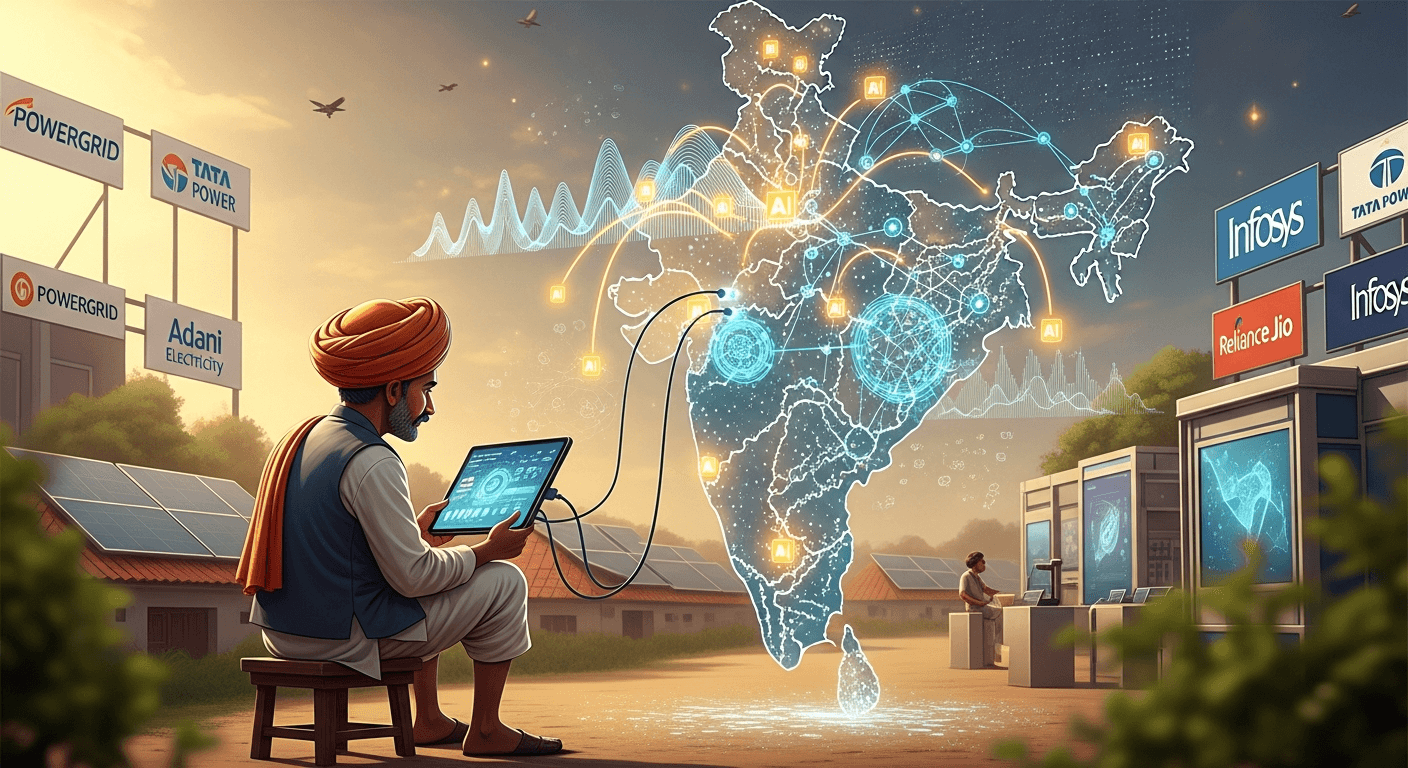
Headline
P2P power trading rolled out in live demo at India AI Summit
Lede
I reported on a landmark demonstration at the India AI Impact Summit that showcased India’s first interstate peer‑to‑peer (P2P) electricity trading pilot under the India Energy Stack — a live, blockchain‑enabled transaction that allowed a small solar generator to sell surplus units directly to a consumer in another city The Times of India.
Background: what is P2P power trading?
Peer‑to‑peer power trading lets prosumers — households, farms and businesses that generate renewable electricity — sell surplus energy directly to other consumers without routing every transaction through traditional bulk supply channels. Digital rails (secure APIs, identity and meter linkage, billing and settlement systems) along with trust technologies (blockchain, cryptographic verification) are used to authenticate participants, match sellers and buyers, and settle payments.
India’s approach bundles these components under the India Energy Stack (IES): a set of standardized digital protocols intended to make energy apps interoperable with distribution companies (discoms), meters and regulators. I’ve been writing about rooftop solar and decentralized trading for years; this recent demonstration is the kind of step I argued would be needed to convert rooftop potential into real income and choice for citizens Unleashing Electrifying Roof Top Solar.
What was announced at the AI summit
Organizers and technology providers used the Summit to present a working pilot and to signal the formal rollout of interstate P2P trading trials under the IES framework. The demonstration used a blockchain‑enabled platform and an AI‑assisted trading interface to execute a small‑value cross‑city transfer of surplus solar energy.
Key operational features shown included:
- Prosumer and consumer onboarding via discom portals (meter ID + connection number + mobile OTP).
- A day‑ahead listing mechanism where sellers post surplus units and buyers reserve purchases.
- Automated matching, billing and settlement coordinated through the discom to ensure regulatory compliance.
The pilot will initially involve select discom areas and participating platforms, with plans to scale if the proof‑of‑concept validates operational, commercial and regulatory assumptions.
Key stakeholders
- Government & program nodal agencies: designing the IES architecture and shepherding the pilots.
- Technology startups and platform providers: building consumer‑facing apps and trading engines. (Examples of platform categories were visible during the Summit.)
- Utilities / distribution companies: integrating API endpoints and enabling customer onboarding and settlement.
- Regulators: responsible for vetting the model, approving pilot rules, and ensuring consumer protection and grid stability.
All four groups must cooperate closely: government to provide standards and policy clarity, startups to create usable apps, discoms to operationalize transactions, and regulators to set guardrails.
Benefits
- New income streams for prosumers (roof‑top solar owners, solar pump aggregations, community projects).
- Broader access to greener electricity for buyers, sometimes at competitive prices.
- Greater consumer engagement and market signals that could drive efficient local consumption and reduced transmission losses.
- A potential boost to renewable uptake and distributed resilience by monetising small generators.
Challenges and risks
- Regulatory complexity: tariff design, cross‑state settlement rules, and network charges need clear, harmonised rules.
- Grid management: frequent bilateral transactions can complicate real‑time balancing and distribution network operations if not properly coordinated.
- Liquidity and market depth: early pilots may struggle with thin markets, making trades infrequent and prices volatile.
- Digital inclusion: many potential participants need simpler onboarding, literacy, and trust in digital processes.
- Data privacy and cyber resilience: blockchain and AI tools add new attack surfaces and governance responsibilities.
Voices from the Summit (attributed by role)
Startup CEO (role): “This pilot proves the user experience can be simple — list, match, and settle — while discom‑level integration keeps the system compliant.”
Government official (role): “The India Energy Stack is designed to be a neutral digital public infrastructure; it enables private innovation without replacing marketplaces.”
Consumer / prosumer (role): “I could see how a small solar owner might earn extra income — but I want assurance the process is safe and the payments are timely.”
These paraphrased remarks capture the optimism, the practical focus on integration, and the consumer‑level concerns I heard while observing the demonstrations.
Potential impact on India’s energy market
If the pilot proves scalable, P2P trading could reshape parts of the retail energy market by turning passive consumers into active market participants. Expected outcomes include:
- Faster deployment of distributed renewables as monetisation pathways improve.
- Emergence of new business models — aggregators, marketplace platforms, and community energy cooperatives — that compete on service and user experience.
- Pressure on incumbents to modernise distribution and settlement systems, and on regulators to update frameworks for consumer protection and settlement finality.
But the transition will be evolutionary. Large‑scale impact depends on regulatory clarity, operational readiness of discoms, and widespread consumer onboarding that creates market liquidity.
Next steps
- Short term: run 6–12 month proofs of concept in targeted discom areas, monitor technical performance, settlement timeliness and user adoption.
- Medium term: adjust regulatory filings (network charge allocation, metering and settlement rules), standardise APIs and expand participating discoms and platforms.
- Long term: build layered markets where aggregators and retail platforms increase liquidity while the IES standards maintain interoperability and trust.
Final observation
The AI Summit demonstration was not just a technology demo; it was a proof that a carefully architected digital backbone, paired with regulation and on‑the‑ground utility cooperation, can turn the promise of distributed renewable energy into real economic opportunities for citizens. My long‑standing argument has been that policy, digital public infrastructure and market design must move together — this pilot is a practical step in that direction.
Regards,
Hemen Parekh
Any questions / doubts / clarifications regarding this blog? Just ask (by typing or talking) my Virtual Avatar on the website embedded below. Then "Share" that to your friend on WhatsApp.
Get correct answer to any question asked by Shri Amitabh Bachchan on Kaun Banega Crorepati, faster than any contestant
Hello Candidates :
- For UPSC – IAS – IPS – IFS etc., exams, you must prepare to answer, essay type questions which test your General Knowledge / Sensitivity of current events
- If you have read this blog carefully , you should be able to answer the following question:
- Need help ? No problem . Following are two AI AGENTS where we have PRE-LOADED this question in their respective Question Boxes . All that you have to do is just click SUBMIT
- www.HemenParekh.ai { a SLM , powered by my own Digital Content of more than 50,000 + documents, written by me over past 60 years of my professional career }
- www.IndiaAGI.ai { a consortium of 3 LLMs which debate and deliver a CONSENSUS answer – and each gives its own answer as well ! }
- It is up to you to decide which answer is more comprehensive / nuanced ( For sheer amazement, click both SUBMIT buttons quickly, one after another ) Then share any answer with yourself / your friends ( using WhatsApp / Email ). Nothing stops you from submitting ( just copy / paste from your resource ), all those questions from last year’s UPSC exam paper as well !
- May be there are other online resources which too provide you answers to UPSC “ General Knowledge “ questions but only I provide you in 26 languages !



No comments:
Post a Comment