
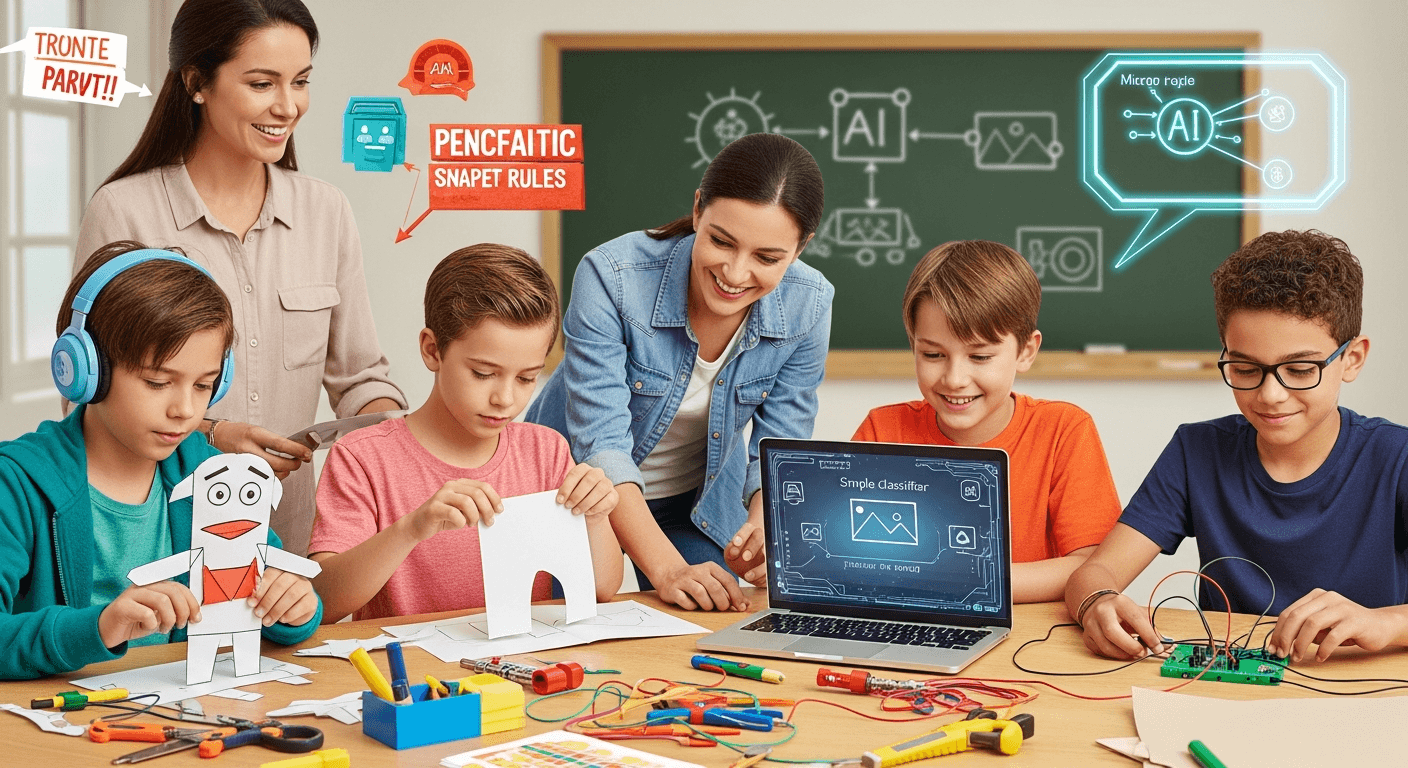
I have seen technologies arrive, reshuffle opportunities, and change daily life. Today, artificial intelligence is one of those tidal shifts. My hope—and my urgent message to parents and educators—is simple: help children become creators of AI, not only consumers. When kids learn to build with AI, they gain agency, critical thinking, and ethical intuition. They stop being passive users and start shaping the future.
Why this matters
- Consumers adapt to products. Creators design them. Creators set the purpose, priorities, and safeguards.
- Early creative engagement demystifies AI: a child who trains a simple model understands its limits and biases better than one who only accepts output as authoritative.
- I’ve written before about the need to teach AI thoughtfully and ethically (ChatGPT : the Sacrificial Goat ?) and about how AI can be taught using childlike, scaffolded methods (AI learns same way , a Child does). Those ideas converge here: make building approachable, iterative, and values-centered.
Practical steps to shift from consumption to creation
- Start with questions, not tools
- Ask: "What would you like a small program or robot to do?" Center projects on curiosity and needs.
- Prioritize low-barrier creative tools
- Use tangible, playful starters (paper prototypes, storyboards, and role-play) before moving to screens.
- Break projects into tiny iterations
- Build a simple version, test, learn, and improve. This mirrors how reliable AI systems are trained—through incremental learning.
- Teach model thinking (cause ↔ effect)
- Help children link input, processing, and output: what goes in matters—and so does how we interpret results.
- Emphasize explanation over perfection
- Reward kids for describing what their model did and why instead of only praising final output.
Age-appropriate activities (4–17)
Ages 4–7: Playful creators
- Activity: "If-Then" Puppet Games — Use hand puppets to act out rules: "If it rains, the puppet opens an umbrella." This introduces conditional logic.
- Activity: Paper Robot Design — Kids draw a robot, name its tasks, and narrate how it decides (simple decision-making). Low-tech materials make design inclusive and tangible.
- Outcome: Early exposure to sequencing, rules, and storytelling—core ideas behind algorithms.
Ages 8–12: Explorers and builders
- Activity: Scratch or ScratchJr storytelling — Children create interactive stories or games that respond to clicks, timers, or user input.
- Activity: Teachable Machine demo — Let kids train a very small image or sound classifier with their own examples (e.g., clap vs. snap) and discuss mistakes together.
- Outcome: Children learn datasets, training examples, and the idea that models generalize imperfectly.
Ages 13–17: Designers and critics
- Activity: Project-based mini-hackathon — Small teams identify a local problem (school recycling, homework planner) and prototype an AI-assisted solution using block-based tools, micro:bit, Raspberry Pi, or cloud notebooks.
- Activity: Bias detective workshop — Present a simple classifier with errors; students analyze why mistakes happen and propose better training data or constraints.
- Outcome: Teens gain project management, evaluation skills, and ethical reasoning.
Safety and ethics guidance (for all ages)
- Start with consent and privacy: teach children never to upload someone’s photo or personal data without permission.
- Explain limits: AI can be wrong. Encourage verification (fact-checking, asking adults) and humility about outputs.
- Discuss bias in everyday language: show how unbalanced examples cause unfair results and how diversity in examples matters.
- Model digital citizenship: criticize outputs constructively and unsub harsh language; cultivate empathy for those affected by algorithms.
- Keep adult supervision during online model training, API usage, or data collection. Encourage transparent, documented steps.
Low-tech and digital resources (practical and affordable)
Low-tech
- Paper prototyping and storyboarding kits
- Card decks of sensors/actions (e.g., "if sound > clap -> do X") for hands-on rule-building
- Role-play and board games to simulate decision trees
Digital (beginner-friendly)
- Scratch / ScratchJr — block coding for interactive stories and logic
- Google Teachable Machine — a gentle on-ramp to classifiers (image, sound, pose)
- micro:bit / MakeCode — simple hardware and block coding for physical computing
- MIT App Inventor — create simple apps that use device sensors
- Raspberry Pi with beginner kits — affordable hardware for curious teens
- Code.org lessons — structured curriculum for classrooms
Digital (intermediate)
- Python + Jupyter notebooks with small datasets (for high-schoolers ready for code)
- Glitch or Replit — remixable web projects to deploy simple models or interfaces
- Open-source datasets and sandboxed APIs (use only vetted educational API keys and under adult supervision)
Examples to try right now (quick wins)
- Classroom: Ask students to build a 60-second chatbot persona that answers questions about a book they read. Use rule-based flows before adding any ML.
- Home: Have a child create a “smart alarm” using micro:bit or smartphone timers tied to simple rules (e.g., if it’s a school day and rain forecast, remind to pack umbrella).
- Community: Run a student “AI fair” where projects prioritize usefulness and fairness, not complexity.
Assessment and encouragement
- Evaluate process over product: how well did students define the problem, collect examples, test, and iterate?
- Celebrate small failures as learning signals—debugging is the heart of creation.
Conclusion
Teaching children to be creators of AI is not about turning every child into an engineer. It’s about fostering agency, curiosity, and responsibility. When kids build—even with paper and puppets—they learn that technology reflects human choices and values. As parents and educators, our role is to scaffold access, model ethical thinking, and open simple, joyful pathways into making. I believe the next generation will use these habits to build safer, fairer, and more creative systems than we can imagine.
I invite you to start small, iterate, and keep ethics front and center. For further reflections on AI education and childlike learning methods, you may find my earlier pieces helpful: ChatGPT : the Sacrificial Goat ? and AI learns same way , a Child does.
Regards,
Hemen Parekh
Any questions / doubts / clarifications regarding this blog? Just ask (by typing or talking) my Virtual Avatar on the website embedded below. Then "Share" that to your friend on WhatsApp.
Get correct answer to any question asked by Shri Amitabh Bachchan on Kaun Banega Crorepati, faster than any contestant
Hello Candidates :
- For UPSC – IAS – IPS – IFS etc., exams, you must prepare to answer, essay type questions which test your General Knowledge / Sensitivity of current events
- If you have read this blog carefully , you should be able to answer the following question:
- Need help ? No problem . Following are two AI AGENTS where we have PRE-LOADED this question in their respective Question Boxes . All that you have to do is just click SUBMIT
- www.HemenParekh.ai { a SLM , powered by my own Digital Content of more than 50,000 + documents, written by me over past 60 years of my professional career }
- www.IndiaAGI.ai { a consortium of 3 LLMs which debate and deliver a CONSENSUS answer – and each gives its own answer as well ! }
- It is up to you to decide which answer is more comprehensive / nuanced ( For sheer amazement, click both SUBMIT buttons quickly, one after another ) Then share any answer with yourself / your friends ( using WhatsApp / Email ). Nothing stops you from submitting ( just copy / paste from your resource ), all those questions from last year’s UPSC exam paper as well !
- May be there are other online resources which too provide you answers to UPSC “ General Knowledge “ questions but only I provide you in 26 languages !



No comments:
Post a Comment