
India and Personal Superintelligence
I want to take a clear-eyed look at a recent claim from Meta’s leadership: that India is particularly well‑placed to scale what the company calls “personal superintelligence.” I’ll summarise the claim, explain what the term means in practical terms, assess why India might indeed be advantaged, call out the risks, and offer policy and business recommendations so scaling happens responsibly.
What Meta’s claim says (short version)
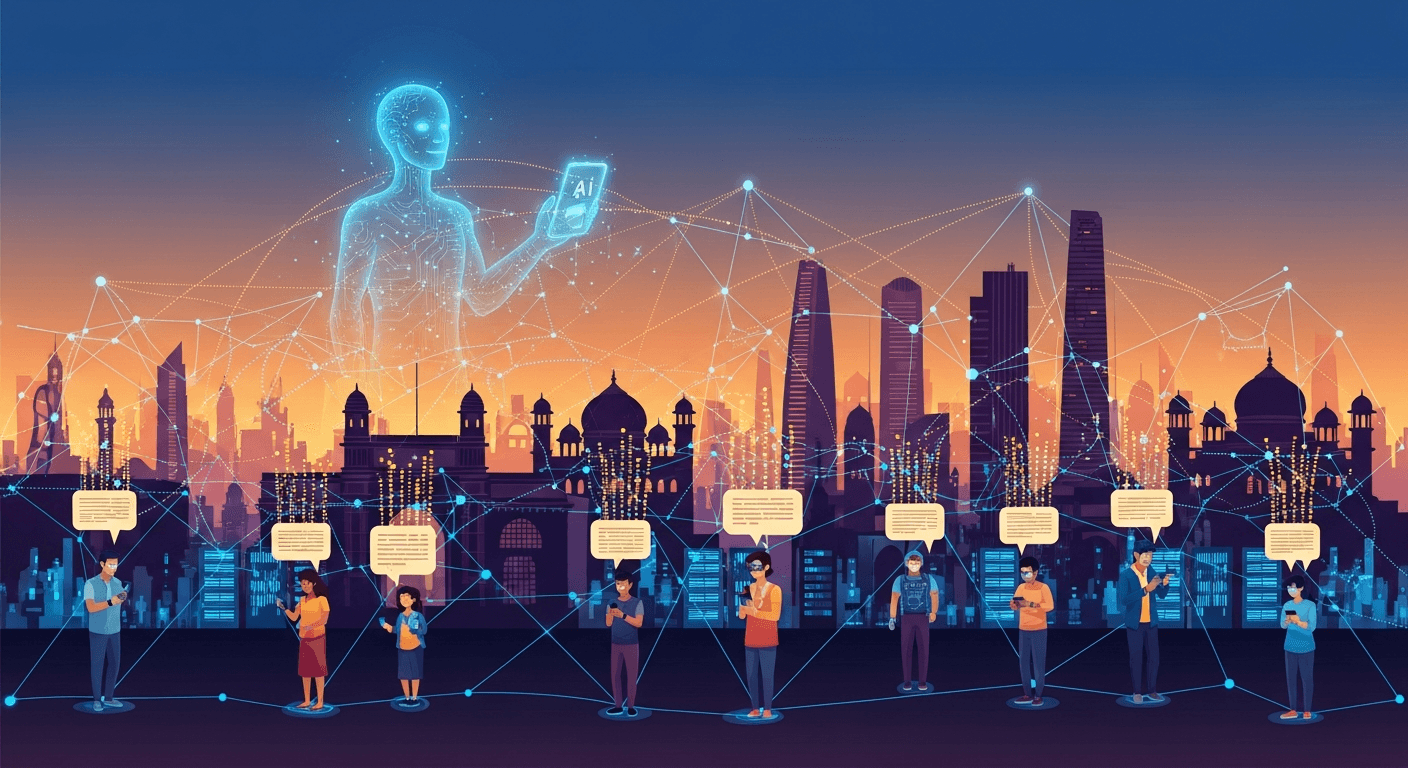
Speaking at the AI Impact Summit in New Delhi, Meta’s Chief AI Officer argued that India’s scale, talent, and growing AI ecosystem make it “one of the few countries where we could scale personal superintelligence very fast.”[1]
"India is one of the few countries where we could scale personal superintelligence very fast," — Meta’s Chief AI Officer.[1]
This is a product roadmap statement as much as a market assessment: Meta plans deeper integration of proactive AI agents across its apps and sees India as both an early deployment ground and a source of innovation.
What I mean by “personal superintelligence”
The phrase sounds grand, so let me unpack it. In everyday terms, a personal superintelligence is a persistent AI agent that:
- Understands you: your goals, preferences, context, and constraints.
- Acts for you: not just answers queries but performs tasks (scheduling, drafting, prioritising, automating repetitive interactions).
- Learns adaptively: refines its help over time and across modalities (text, voice, images).
It is not necessarily an all‑powerful, sci‑fi entity; it’s a far more capable, proactive assistant than today’s chatbots. The “super” here refers to a level of usefulness and autonomy beyond simple question‑answering.
Why Meta (and others) see India as well‑placed
Several concrete reasons make India attractive as a scale market and innovation centre for these agents:
- Infrastructure and scale: India has hundreds of millions of active users across WhatsApp, Instagram and Facebook — a large, diverse user base for testing and iterating personalised agents.
- Talent density: India’s engineering and research talent pool, including startups focused on consumer AI, has grown rapidly. There are more Indian consumer AI startups today than in some comparator markets, and many engineers experienced in multilingual and edge‑constrained deployments.
- Data and diversity: India’s linguistic and cultural plurality is a forcing function for generalisable language, speech and multimodal models — building for India pushes robustness.
- Market need: Small businesses, creators and public services in India can gain outsized productivity benefits from automated agents (e.g., WhatsApp Business agents, auto‑translated Reels). Low‑friction value propositions speed adoption.
These are reasons of both supply (talent, engineering) and demand (large, diverse user behaviours) that can accelerate improvement cycles.
Challenges and risks to scaling responsibly
Scaling quickly does not mean scaling safely. Key risks include:
- Privacy and consent: Personal agents need long‑term access to personal signals. Weak consent models, unclear data retention, or opaque profiling can erode trust and harm vulnerable users.
- Regulation and fragmentation: India’s evolving AI governance, and potential divergence across jurisdictions, could complicate cross‑platform agent behaviour and data portability.
- Compute and energy access: Large models and persistent agents require sustained compute and energy investments; unequal access may centralise capability in a few firms.
- Inequality and capture: If agents are monetised mostly by big platforms, smaller firms and citizens could be left behind or locked into proprietary ecosystems.
- Safety and misuse: Proactive agents can take actions on users’ behalf; misaligned behaviours, bias, or erroneous automation could have outsized consequences.
Policy and business recommendations for India
To turn the opportunity into a broadly beneficial reality, I recommend a pragmatic, layered approach:
- Strengthen data governance with clear user rights: consent, portability, and understandable disclosures for persistent agents. Establish standards for minimal transparency on agent actions.
- Invest in affordable compute and green energy: public‑private partnerships to expand local infrared compute capacity and ensure sustainability for long‑running agents.
- Support open, modular building blocks: fund and encourage open datasets and model hubs (multilingual speech, low‑cost LLMs) so startups can build localised spokes without reinventing hubs.
- Prioritise digital‑literacy and safety nets: training for SMEs and citizens on agent use; channels to contest and correct agent decisions.
- Encourage competition and interoperability: avoid lock‑in by mandating interoperable APIs and portability standards for personal agents where feasible.
- Promote sectoral pilots: focus early deployments on high social value areas (healthcare triage, education access, agriculture advisory) under controlled, audited pilots.
These are both regulatory nudges and concrete public investments that reduce centralisation risk while accelerating useful deployments.
Closing thoughts — a forward‑looking, cautious optimism
I share the optimism that India can be a crucible for useful, localized AI experiences. My past writing has argued that India should focus on pragmatic, low‑cost, high‑impact models and governance frameworks rather than a raw arms race in model size — an approach that fits well with how personal agents should be built for India’s needs (see my earlier piece, Learning from DeepSeek, honing India’s AI strategy).[2]
If we align infrastructure investments with governance and open building blocks, India can reap strong economic and social returns — but only if scale comes with responsibility. The hard work is not the marketing; it’s the careful, iterative engineering and policy design that protect citizens while amplifying human potential.
Regards,
Hemen Parekh
Any questions / doubts / clarifications regarding this blog? Just ask (by typing or talking) my Virtual Avatar on the website embedded below. Then "Share" that to your friend on WhatsApp.
References
[1] Economic Times coverage of Meta’s comments at the India AI Impact Summit: https://economictimes.com/tech/artificial-intelligence/india-well-placed-to-scale-personal-superintelligence-metas-alexandr-wang/articleshow/128522639.cms
[2] Learning from DeepSeek, honing India’s AI strategy (my earlier piece): http://myblogepage.blogspot.com/2025/06/learning-from-deepseek.html
Get correct answer to any question asked by Shri Amitabh Bachchan on Kaun Banega Crorepati, faster than any contestant
Hello Candidates :
- For UPSC – IAS – IPS – IFS etc., exams, you must prepare to answer, essay type questions which test your General Knowledge / Sensitivity of current events
- If you have read this blog carefully , you should be able to answer the following question:
- Need help ? No problem . Following are two AI AGENTS where we have PRE-LOADED this question in their respective Question Boxes . All that you have to do is just click SUBMIT
- www.HemenParekh.ai { a SLM , powered by my own Digital Content of more than 50,000 + documents, written by me over past 60 years of my professional career }
- www.IndiaAGI.ai { a consortium of 3 LLMs which debate and deliver a CONSENSUS answer – and each gives its own answer as well ! }
- It is up to you to decide which answer is more comprehensive / nuanced ( For sheer amazement, click both SUBMIT buttons quickly, one after another ) Then share any answer with yourself / your friends ( using WhatsApp / Email ). Nothing stops you from submitting ( just copy / paste from your resource ), all those questions from last year’s UPSC exam paper as well !
- May be there are other online resources which too provide you answers to UPSC “ General Knowledge “ questions but only I provide you in 26 languages !




No comments:
Post a Comment