
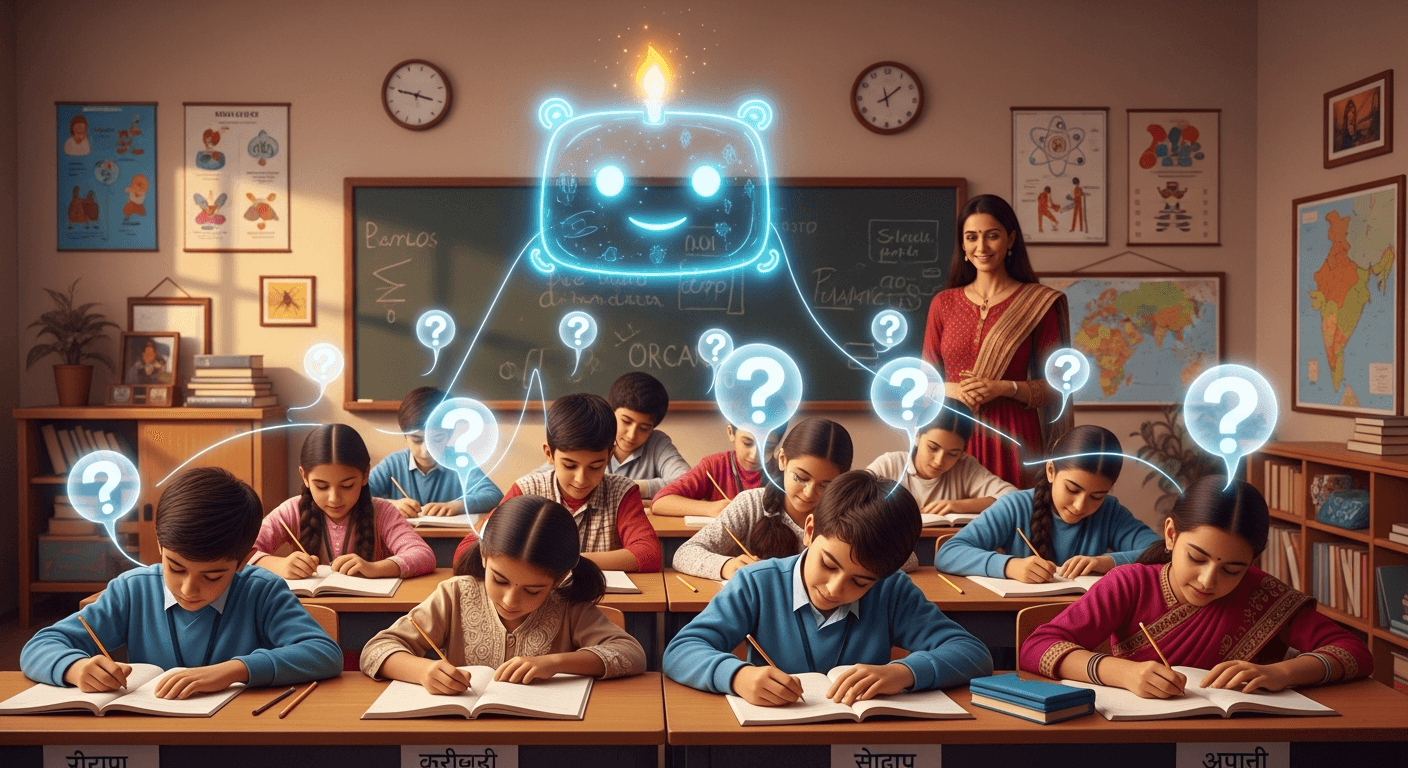
Opening hook
I still remember the quiet panic of a student waving a phone under my nose during a surprise quiz — the answer appeared on screen before their pencil had finished its arc. That moment crystallized a fear many of us have: AI can make answers instantaneous, but can it make thinking happen? I want to argue that when AI enters classrooms it should be built to ask questions, not hand out answers.
Thesis
AI in education should prioritize generating questions and scaffolding reasoning so that learners do the cognitive heavy lifting. This is the approach advocated by Elizabeth Kelly (ek@anthropic.com) of Anthropic and reflected in recent pilots and reports that show AI used as an answer engine erodes understanding, while AI that probes and prompts deepens it source.
Why questions beat answers
Active retrieval strengthens learning. Research on active recall and metacognition shows that struggling to retrieve and articulate knowledge creates durable learning. AI that asks follow-ups or prompts explanations converts passive consumption into active work.
Socratic scaffolding models expert tutoring. Good tutors don’t give solutions; they guide learners through reasoning steps. Anthropic’s work with "learning mode" for Claude intentionally nudges conversations toward inquiry, reflection, and critique rather than polished outputs.
Prevents cognitive offloading and “brain rot.” When students outsource reasoning to tools, they may perform in the short term but lose the capacity to analyze or evaluate. Question-driven AI protects against that by requiring the human to construct the answer first.
How this looks in class — a practical example
Imagine a Grade 9 physics lesson on Newton’s laws. I introduce a lab: students predict how a toy car’s stopping distance changes with different surfaces, then test and record results.
- Students write a short hypothesis and upload a handwritten note or a photo.
- The classroom AI (configured in learning-mode) does not give the correct answer. Instead it asks:
- "What variables did you control and why?"
- "What pattern do your results suggest, and which counterexamples would challenge that pattern?"
- "How might friction be measured differently?"
- Students revise hypotheses, discuss with peers, and submit a second reflection.
- The AI then provides targeted feedback on their reasoning steps (e.g., pointing out an untested variable or suggesting a clearer graph), and recommends a next small experiment.
That loop — predict, test, reflect, revise — trains thinking. The AI acts like a coach that amplifies teacher bandwidth: Anthropic’s pilots with partners such as Pratham showed similar designs where Claude-generated questions were integrated with handwritten student responses to preserve student effort and make feedback actionable source.
Addressing concerns and objections
Concern: "Won’t questions slow down instruction?"
Response: Good questioning accelerates conceptual change. It may feel slower in the short run but produces deeper comprehension, reducing remediation later. AI can be tuned to the class pace and provide tiered prompts so questioning is efficient.
Concern: "Can AI be trusted to ask the right questions?"
Response: This is partly a design and evaluation problem. Anthropic and others are building and testing frameworks that measure impact, not just adoption — asking whether student outcomes improve, not just whether students click a button source.
Concern: "Will this widen inequity?"
Response: The risk is real if tools are only available in well-resourced settings. The solution is deliberate: open pilots, language support (Anthropic is investing in Indic languages), and partnerships with NGOs and public systems to scale equitable deployments.
Concern: "Are we replacing teachers?"
Response: No. The aim is augmentation: free teachers from some repetitive feedback tasks so they can focus on conversation, mentorship, and project-based work that machines can’t replicate.
Practical steps for educators who want to start
- Pilot a question-first AI mode for one unit — not your whole course. Measure student reasoning (rubrics on explanation quality) before and after.
- Require students to show their thinking (notes, drafts, voice memos) before any AI feedback is allowed. That preserves accountability.
- Train students in AI fluency: how to evaluate AI prompts, spot hallucinations, and use follow-up questions to test outputs.
- Partner with organizations or vendors that prioritize pedagogy over convenience and publish impact data.
Conclusion — a call to action
If we accept that education is about building minds, not just producing answers, then our guiding principle must be: design AI to ask, probe, and push thinking. I urge educators to experiment with learning-mode tools, require students to surface their thinking before asking for help, and insist that vendors show improvements in learning outcomes — not just usage metrics. Anthropic’s emphasis on question-generation is not a technical novelty; it’s a pedagogical corrective. We should treat it that way.
References & further reading
- "AI in classes should generate questions, not answers: Anthropic’s Elizabeth Kelly" — Hindustan Times link
- Anthropic — Claude and education work: https://www.anthropic.com
Any questions / doubts / clarifications regarding this blog? Just ask (by typing or talking) my Virtual Avatar on the website embedded below. Then "Share" that to your friend on WhatsApp.
Regards,
Hemen Parekh
Get correct answer to any question asked by Shri Amitabh Bachchan on Kaun Banega Crorepati, faster than any contestant
Hello Candidates :
- For UPSC – IAS – IPS – IFS etc., exams, you must prepare to answer, essay type questions which test your General Knowledge / Sensitivity of current events
- If you have read this blog carefully , you should be able to answer the following question:
- Need help ? No problem . Following are two AI AGENTS where we have PRE-LOADED this question in their respective Question Boxes . All that you have to do is just click SUBMIT
- www.HemenParekh.ai { a SLM , powered by my own Digital Content of more than 50,000 + documents, written by me over past 60 years of my professional career }
- www.IndiaAGI.ai { a consortium of 3 LLMs which debate and deliver a CONSENSUS answer – and each gives its own answer as well ! }
- It is up to you to decide which answer is more comprehensive / nuanced ( For sheer amazement, click both SUBMIT buttons quickly, one after another ) Then share any answer with yourself / your friends ( using WhatsApp / Email ). Nothing stops you from submitting ( just copy / paste from your resource ), all those questions from last year’s UPSC exam paper as well !
- May be there are other online resources which too provide you answers to UPSC “ General Knowledge “ questions but only I provide you in 26 languages !




No comments:
Post a Comment