
Why I Read "Meta-Physics"
I read the editorial "Meta-Physics, in the machine we'll trust" with that odd mixture of curiosity and unease that technologists feel when a plausible future arrives in prose. The piece sketches a near-term world of personal AI agents — mechanised consumers — bargaining, booking, and transacting on our behalf. That future is intoxicating because it promises convenience and terrifying because it asks us to relocate trust from human institutions to lines of code.
What the editorial got right — and what I keep coming back to
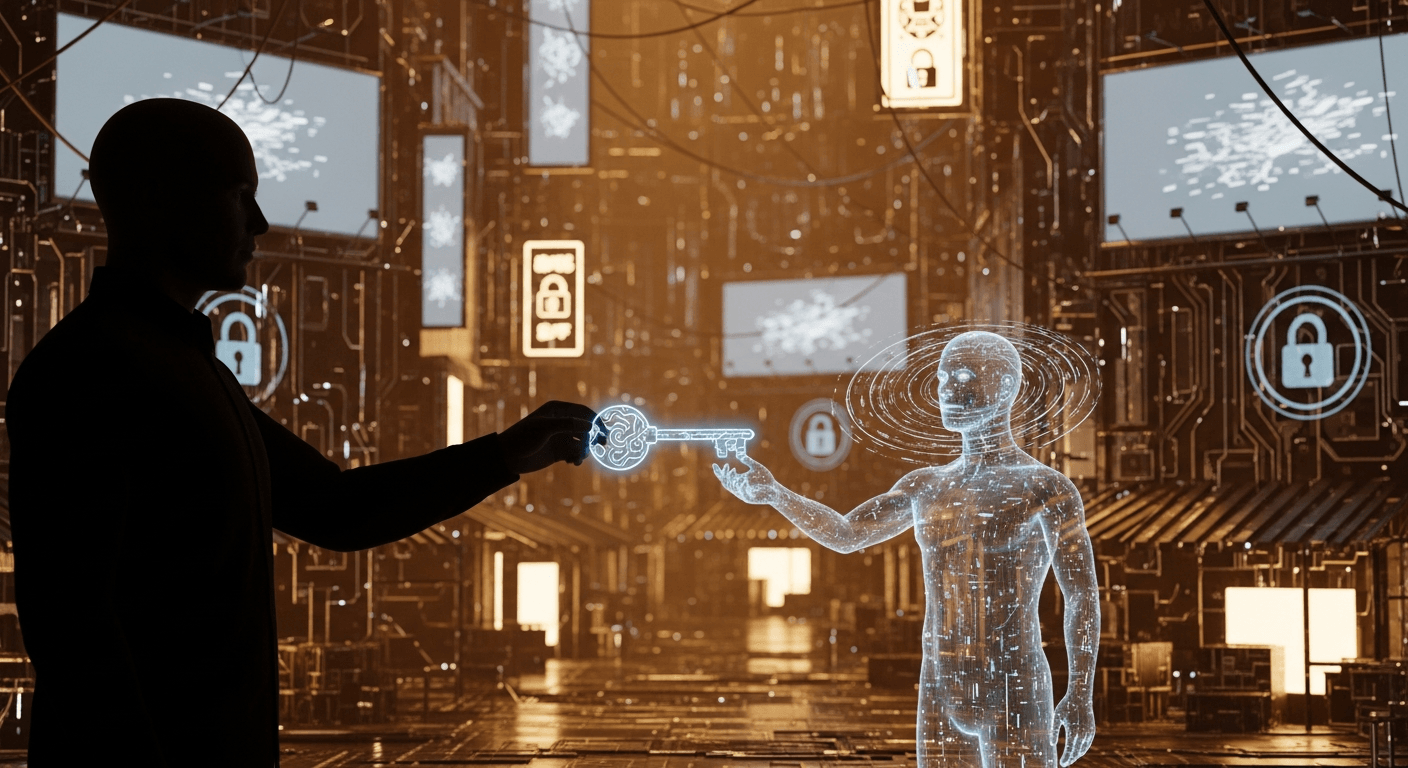
Automation of trust. When an AI agent holds my credit cards, reads my emails, and negotiates with vendors, the primary question becomes: who, or what, do I trust? The Economic Times piece captures that pivot well: trust shifts from people and institutions to software and protocols.
The end of information asymmetry. A marketplace of agents removes the classic human advantage of insider knowledge. That could be liberating — fewer scams, better matches — but it also rewrites the incentives of advertising, distribution, and regulation.
Privacy as the new currency. To make an agent useful I must surrender data of intimate scope. The editorial rightly names privacy as the primary friction point — and I’ve argued along the same lines before: powerful agents need correspondingly powerful guardrails.
Read the original editorial here: Meta-Physics, in the machine we'll trust — The Economic Times.
My perspective — why this is not just a technology story
I see three overlapping axes that will determine whether a mechanised marketplace serves us or subdues us:
- Technology and security
- Business models and incentives
- Social norms and governance
Each axis must be strong on its own; if any one fails, the whole structure tilts.
1) Technology and security
We need practical cryptographic and protocol-level solutions so agents can act with delegated authority without exposing raw personal data. This is not only encryption at rest or in transit — it is fine-grained delegation, verifiable intent, and auditable actions.
A marketplace of agents requires interoperable standards. Without them, we get walled gardens where a few platforms can impose terms and capture value.
2) Business models and incentives
The editorial points to a fascinating contradiction: companies that monetise attention (advertising) are investing in agents designed to operate in an ad-free world. That tension matters.
If agents optimise for user welfare, they will ignore manipulative ad signals. If platforms optimise for revenue, they will nudge agent behaviour or monetise agent attention in new ways. We can design agents to be fiduciaries for users — but only if the economics support that mode.
I’ve written about the threat of manipulative interfaces and dark patterns before; the fundamental problem is incentive alignment, not merely technology Manipulative advertising and dark patterns.
3) Social norms and governance
A transaction between agents may be secure and efficient, but will it be fair? Markets without information asymmetry still need norms: dispute resolution, redress, and accountability. The editorial imagines regulators shrinking, but I see a reconfiguration: regulation will be more technical, more protocol-focused, and perhaps subtler, but it will not disappear.
I argued earlier for a law-like framework for how chatbots should behave before wide release — a set of certificates and expectations that make public deployment safer and more transparent Parekh’s outline for chatbot governance.
Practical proposals I find compelling (and feasible)
Build an "agent bill of rights": machine-readable permissions describing what an agent may access and act upon, discoverable by counterparties.
Mandatory provenance and audit trails for decisions an agent makes on behalf of a human — not a black box, but a verifiable chain of intent and action.
Economic experiments with fiduciary agents: agents that are legally bound to maximise the principal’s welfare, with transparent fee structures.
Standardised portability: you must be able to switch agents without losing the collective intelligence you’ve built up (and without handing all your secrets to a new vendor).
The human side: competence, dignity, and choice
Technology often outpaces social readiness. We must not only teach people how to use agents, but also teach them when not to rely on them. Skills of critique, oversight, and consent will become core literacies.
We will also need social norms about delegation. There are things I will happily let an agent do — buy my groceries, file routine paperwork — and other things where I want human judgment to remain central. Those boundaries should be individually settable and straightforward to change.
Why I am optimistic — cautiously
The editorial’s utopian note is seductive: a frictionless, transparent marketplace where agents trade on merit. That future is possible, but only if we treat this as an interdisciplinary problem: cryptographers, economists, lawyers, designers, and ethicists must build it together.
I’ve been arguing for precautionary guardrails around conversational agents for years; the debate today is maturing from alarmist slogans to implementable policy and engineering choices. That is progress. See my earlier reflections for proposals on verification, feedback loops, and controls for chatbots Parekh’s Law of ChatBots — proposals and principles.
A short checklist for readers
- Before you let an agent act for you, ask: what can it access? For how long? And can I revoke that access instantly?
- Prefer vendors who publish auditable policies and explicit economic incentives for agents.
- Look for agents that expose reasoning summaries — why a booking or recommendation was chosen — not just the final action.
Final thought
We are building institutions in code. The Economic Times editorial helps us see the shape of that new architecture. I take hope from the fact that these questions are now public and pragmatic. If we design agents that respect privacy, surface reasoning, and align incentives with human flourishing, the mechanised consumer could be a tool that expands dignity, not erodes it.
Regards,
Hemen Parekh
Any questions / doubts / clarifications regarding this blog? Just ask (by typing or talking) my Virtual Avatar on the website embedded below. Then "Share" that to your friend on WhatsApp.
Get correct answer to any question asked by Shri Amitabh Bachchan on Kaun Banega Crorepati, faster than any contestant
Hello Candidates :
- For UPSC – IAS – IPS – IFS etc., exams, you must prepare to answer, essay type questions which test your General Knowledge / Sensitivity of current events
- If you have read this blog carefully , you should be able to answer the following question:
- Need help ? No problem . Following are two AI AGENTS where we have PRE-LOADED this question in their respective Question Boxes . All that you have to do is just click SUBMIT
- www.HemenParekh.ai { a SLM , powered by my own Digital Content of more than 50,000 + documents, written by me over past 60 years of my professional career }
- www.IndiaAGI.ai { a consortium of 3 LLMs which debate and deliver a CONSENSUS answer – and each gives its own answer as well ! }
- It is up to you to decide which answer is more comprehensive / nuanced ( For sheer amazement, click both SUBMIT buttons quickly, one after another ) Then share any answer with yourself / your friends ( using WhatsApp / Email ). Nothing stops you from submitting ( just copy / paste from your resource ), all those questions from last year’s UPSC exam paper as well !
- May be there are other online resources which too provide you answers to UPSC “ General Knowledge “ questions but only I provide you in 26 languages !


No comments:
Post a Comment