
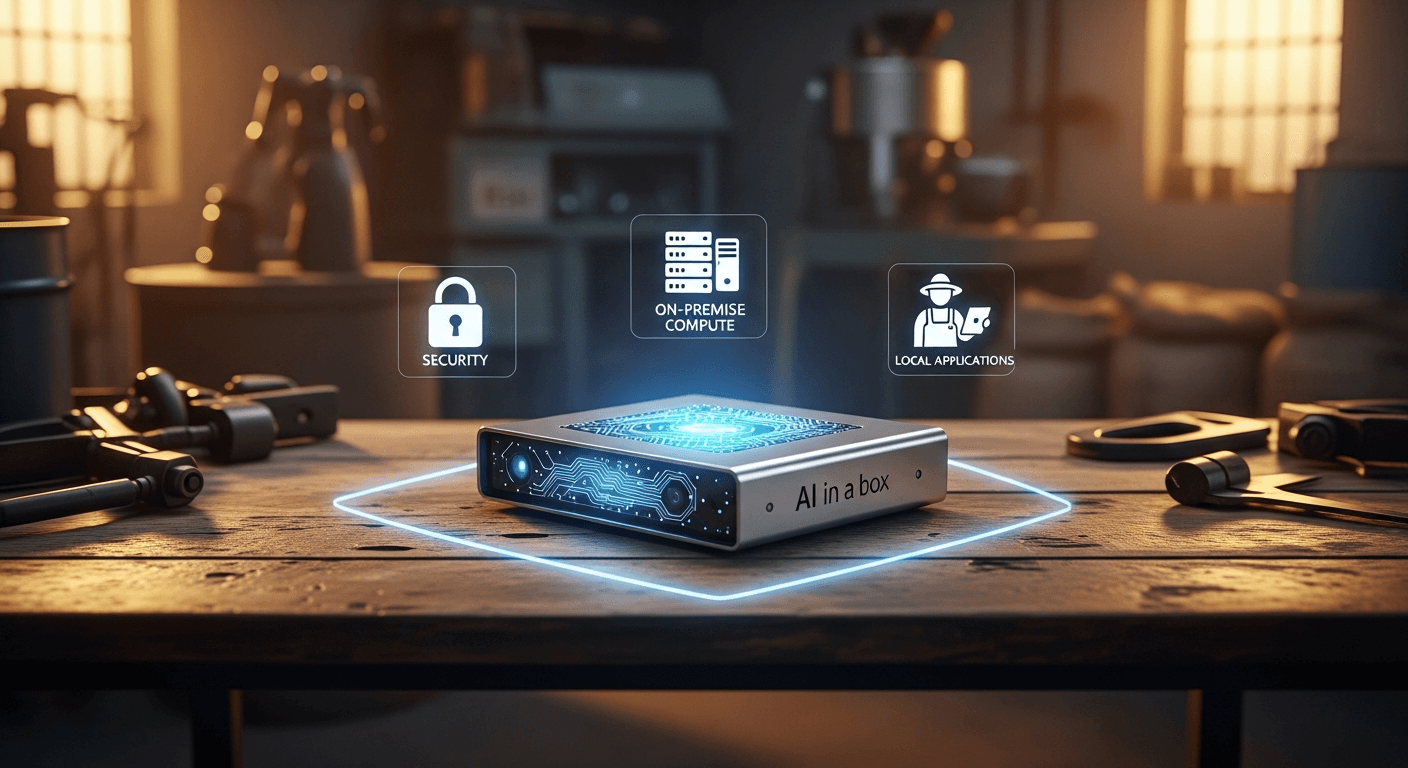
I’ve been writing about India’s AI journey for a while — the push for homegrown models, the idea of collaborative AIs, the need to keep intelligence close to the people it serves. So when Arinox AI and KOGO unveiled CommandCORE — what the press calls India’s first “sovereign AI box” — I felt a familiar mix of excitement and a patient, practical skepticism. The Hindustan Times piece that covered the launch captures the essence well: India's first sovereign AI box aims to localise enterprise intelligence.
Why this matters to me
- At a systems level, AI is no longer just about models and benchmarks. It’s about who holds the data, who shapes the feedback loops, and where inference actually happens.
- CommandCORE’s pitch — compute locally, avoid constant cloud round-trips, and stitch the stack for regulated, high-data environments — is not just an engineering choice; it’s an organisational one.
What Arinox and KOGO are promising
- A compact, on‑premises appliance that can run agentic workflows without sending sensitive context to the public cloud. That’s a direct response to the very real risk that "the moment you provide context, you are providing intelligence" — a line attributed to Raj K Gopalakrishnan (raj@kogo.ai) during the announcement. I find that sentence blunt and useful.
- Flexible hardware tiers: edge Jetson-class boxes for field deployments, DGX/Blackwell configurations for on-prem development, and scale-out via clustered units.
- A software layer that includes an agentic OS and a catalogue of connectors — a pragmatic way to lower integration costs for enterprises.
A few reasons I think sovereign AI boxes will find traction
- Data gravity and cost: Some enterprises (EV charging networks, manufacturing floors, retail chains) generate terabytes per site per day. Moving raw telemetry to the cloud is often costly and latency‑intolerant. Local inference and selective uplink — the classic filter-and-send approach — is a sound economic argument.
- Regulatory clarity: Sectors like banking, defence and government services often prefer (or are required) to keep data inside trust boundaries. A physically segregated compute appliance with audit controls maps well to those mandates.
- Attack surface reduction: Every third-party integration can become an exploit vector. Running agents behind your firewall reduces some classes of supply-chain and telemetry exposure.
But there are real limits and trade-offs
- Scale vs specialization: An on-prem box can be great for deterministic, repeatable tasks and for accelerating specific workflows. It’s less clear how enterprises will keep pace with rapid model improvements coming from global labs unless they adopt a disciplined model update pipeline.
- Talent and ops: Owning the AI means owning patching, benchmarking, and model governance. Not every enterprise wants to become a mini AI-infrastructure shop.
- Interoperability: If sovereign stacks become islands without well-defined APIs and audit trails, we risk recreating vendor lock‑in at the national level.
What I’d watch next
- Adoption in regulated pilots: Will banks, defence labs, and utilities test these boxes in production? Their use-cases will show whether the device is a stopgap or a platform.
- Model governance workflows: How will enterprises certify updates, trace inference decisions, and maintain model cards across on-prem clusters?
- Cost of ownership vs cloud subscription models over 3–5 years: The headline price (CommandCORE reportedly starts around ₹10 lakh for initial configurations) is one input; TCO is the one CFOs will care about.
Where this intersects with my earlier thinking
I’ve long argued that India’s path should be both pragmatic and plural: build sovereign foundational models and also craft lightweight, frugal integrations that deliver value today. You can see this thread in my earlier piece on collaborative AI prototypes and the "Modi’s Manavs" idea — a thought experiment about multiple AIs debating and improving answers together — which I wrote to highlight openness and cooperative approaches to intelligence (Modi's Manavs — prototype and ideas). That project sits on the opposite end of the spectrum from a sealed, on‑prem appliance: one emphasises distributed collaboration, the other emphasises trust and control. Both are necessary.
A personal take — strategy, not slogans
I don’t believe sovereign AI boxes are a silver bullet. But they are a necessary component in a layered national strategy: public foundational models tuned for Indian languages and public services; on‑prem appliances for regulated enterprise workloads; and lightweight, federated exchanges where learned patterns (not raw data) can be shared under strict governance.
If India gets these layers right — the open models, the shared compute commons, and secure edge appliances — we can enable both innovation and responsibility. That’s the balance I keep nudging toward: not choosing between openness and sovereignty, but designing architectures that make them complementary.
Connect the dots
- Read the launch coverage: India's first sovereign AI box aims to localise enterprise intelligence.
- If you’re interested in the collaborative side of AI (agents that debate to get smarter), see my earlier reflections: Modi's Manavs — prototype and ideas.
I’ll be watching how enterprises actually deploy CommandCORE-style systems. Real-world pilots — not press releases — will tell us whether this architecture becomes a cornerstone of India’s sovereign AI stack or a niche appliance for a handful of use cases.
Regards,
Hemen Parekh
Any questions / doubts / clarifications regarding this blog? Just ask (by typing or talking) my Virtual Avatar on the website embedded below. Then "Share" that to your friend on WhatsApp.
Get correct answer to any question asked by Shri Amitabh Bachchan on Kaun Banega Crorepati, faster than any contestant
Hello Candidates :
- For UPSC – IAS – IPS – IFS etc., exams, you must prepare to answer, essay type questions which test your General Knowledge / Sensitivity of current events
- If you have read this blog carefully , you should be able to answer the following question:
- Need help ? No problem . Following are two AI AGENTS where we have PRE-LOADED this question in their respective Question Boxes . All that you have to do is just click SUBMIT
- www.HemenParekh.ai { a SLM , powered by my own Digital Content of more than 50,000 + documents, written by me over past 60 years of my professional career }
- www.IndiaAGI.ai { a consortium of 3 LLMs which debate and deliver a CONSENSUS answer – and each gives its own answer as well ! }
- It is up to you to decide which answer is more comprehensive / nuanced ( For sheer amazement, click both SUBMIT buttons quickly, one after another ) Then share any answer with yourself / your friends ( using WhatsApp / Email ). Nothing stops you from submitting ( just copy / paste from your resource ), all those questions from last year’s UPSC exam paper as well !
- May be there are other online resources which too provide you answers to UPSC “ General Knowledge “ questions but only I provide you in 26 languages !




No comments:
Post a Comment