
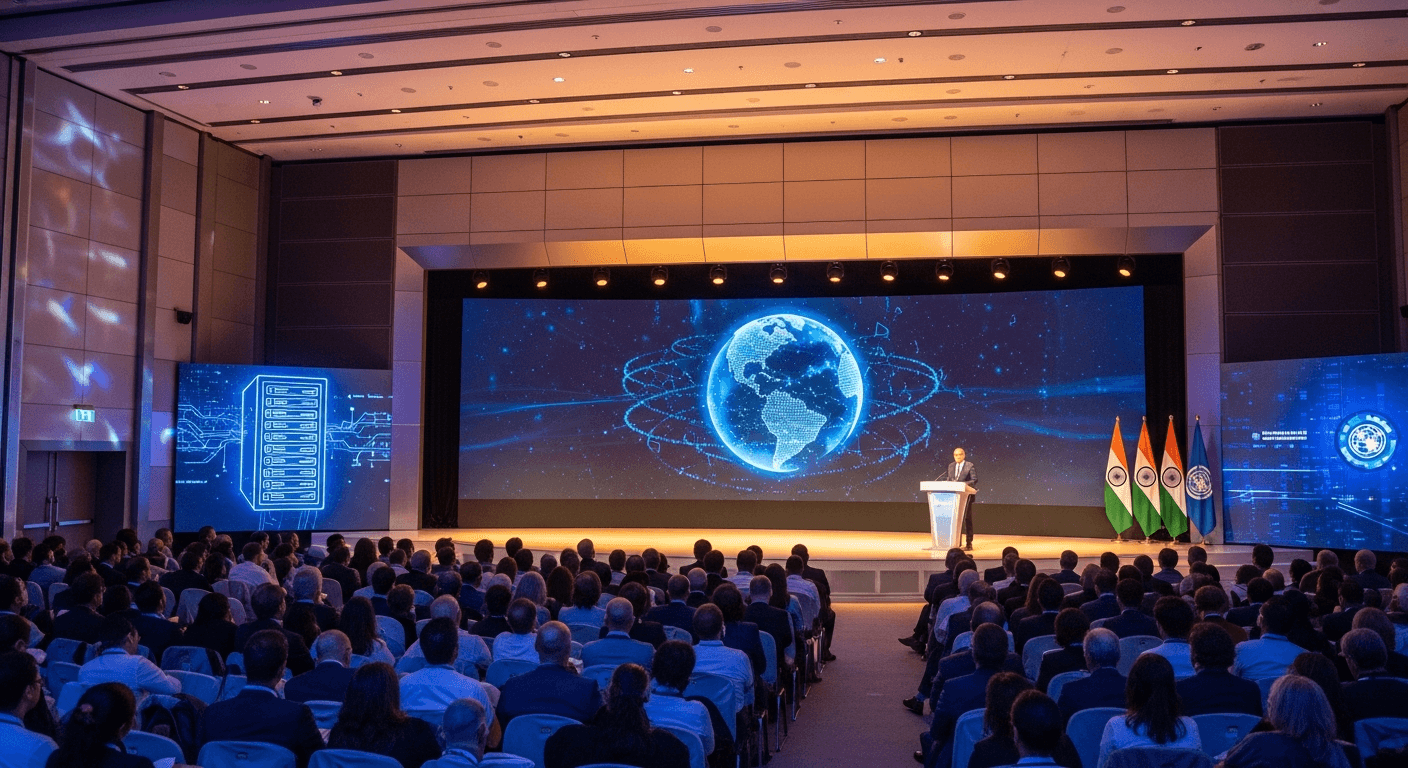
India’s AI Moment
I watched the recent coverage of the India AI Impact Summit and found myself reflecting on what it means for India — and for the global AI ecosystem. The Times of India video headline — “Sam Altman Applauds India AI Summit, Calls PM’s Vision Inspiring” — captured the broad arc of the summit’s narrative: a Global South host, intense industry attention, and an attempt to balance opportunity with responsibility Sam Altman Applauds India AI Summit, Calls PM Modi's Vision Inspiring.
Context: what this summit was
- The India AI Impact Summit was convened in New Delhi as a major multistakeholder gathering: heads of state, CEOs, researchers, and civil society from many countries. The event positioned India as the first major global AI summit hosted in the Global South, with a stated emphasis on inclusive, human-centred AI and a national framework for sovereign models and public systems.
- The summit agenda mixed policy, investment, and demonstrations of capability — an attempt to show both that India can host global debate and that it has the technical and commercial depth to matter.
What the OpenAI presence signalled
Sam Altman (sama@openai.com) was visibly positive about India’s momentum. Paraphrasing the coverage, he highlighted India as one of the fastest-growing markets for OpenAI products, praised the energy of Indian builders and students, and described the Prime Minister’s vision for democratising AI as an inspiring element that aligns with the idea of broad access to capability. The tone was constructive: recognition of rapid adoption, interest in deeper partnerships, and an acknowledgement of policy and safety considerations as part of the conversation.
Why this matters for India’s AI ecosystem
- Scale and talent: India’s developer base and student communities are a strong foundation for rapid product adoption and startup formation. That translates into a virtuous cycle: more local use cases, more startups, and more demand for localized models and infrastructure.
- Market leverage: being a large, fast-growing market encourages both platform companies and smaller vendors to invest locally — from language and domain adaptation to cloud and edge deployments.
- Policy leadership from the host government: the summit’s government-led vision for AI governance, emphasising inclusion and sovereign capabilities, signals a push toward a mixed model of public infrastructure plus private innovation.
Opportunities and challenges ahead
Opportunities:
- Local innovation at scale — India can incubate solutions tuned to low-bandwidth, multilingual, and resource-constrained environments (education, healthcare, agriculture).
- Infrastructure and investment — large commitments to data centres, compute, and chip supply chains can catalyse a domestic AI stack.
- Global South leadership — India hosting the summit creates diplomatic and normative space for alternatives to a strictly Western or Chinese governance framing.
Challenges:
- Regulation vs. innovation — finding the right balance so governance protects citizens without throttling startups.
- Skills and distribution — translating urban talent density into national benefit will require investments in education and digital inclusion.
- Safety and geopolitics — as coverage noted, technology leaders emphasised both democratization and risk mitigation; navigating international standards and export/control regimes will be complex.
Industry and government reactions
Industry leaders at the summit framed India as an investment destination: several large firms signalled expansion plans or partnerships, and CEOs repeatedly mentioned India’s potential for growing product usage. Government representatives used the platform to promote a sovereign approach — a combination of open ecosystems, public infrastructure, and regulatory guardrails aimed at equitable impact.
My perspective and earlier thoughts
I’ve written before about the twin promise and peril of AI: the same capabilities that lower costs and extend access can concentrate power if governance and distribution are neglected see my earlier reflections on AI risks and democratization. The summit reinforced that reality — we can celebrate momentum while remaining clear-eyed about alignment, safety, and equitable access.
Conclusion
This summit was less a finish line than a pivot point. Recognition from global leaders such as Sam Altman (sama@openai.com) validates India’s progress, but validation is only the start. The coming months must convert statements and headlines into durable investments in infrastructure, skills, and governance mechanisms that ensure AI benefits are widely shared and risks are actively managed. If India gets that mix right, it will shape not just national outcomes but the global conversation about AI’s role in the decades ahead.
Regards,
Hemen Parekh
Any questions / doubts / clarifications regarding this blog? Just ask (by typing or talking) my Virtual Avatar on the website embedded below. Then "Share" that to your friend on WhatsApp.
Get correct answer to any question asked by Shri Amitabh Bachchan on Kaun Banega Crorepati, faster than any contestant
Hello Candidates :
- For UPSC – IAS – IPS – IFS etc., exams, you must prepare to answer, essay type questions which test your General Knowledge / Sensitivity of current events
- If you have read this blog carefully , you should be able to answer the following question:
- Need help ? No problem . Following are two AI AGENTS where we have PRE-LOADED this question in their respective Question Boxes . All that you have to do is just click SUBMIT
- www.HemenParekh.ai { a SLM , powered by my own Digital Content of more than 50,000 + documents, written by me over past 60 years of my professional career }
- www.IndiaAGI.ai { a consortium of 3 LLMs which debate and deliver a CONSENSUS answer – and each gives its own answer as well ! }
- It is up to you to decide which answer is more comprehensive / nuanced ( For sheer amazement, click both SUBMIT buttons quickly, one after another ) Then share any answer with yourself / your friends ( using WhatsApp / Email ). Nothing stops you from submitting ( just copy / paste from your resource ), all those questions from last year’s UPSC exam paper as well !
- May be there are other online resources which too provide you answers to UPSC “ General Knowledge “ questions but only I provide you in 26 languages !


No comments:
Post a Comment