
Introduction
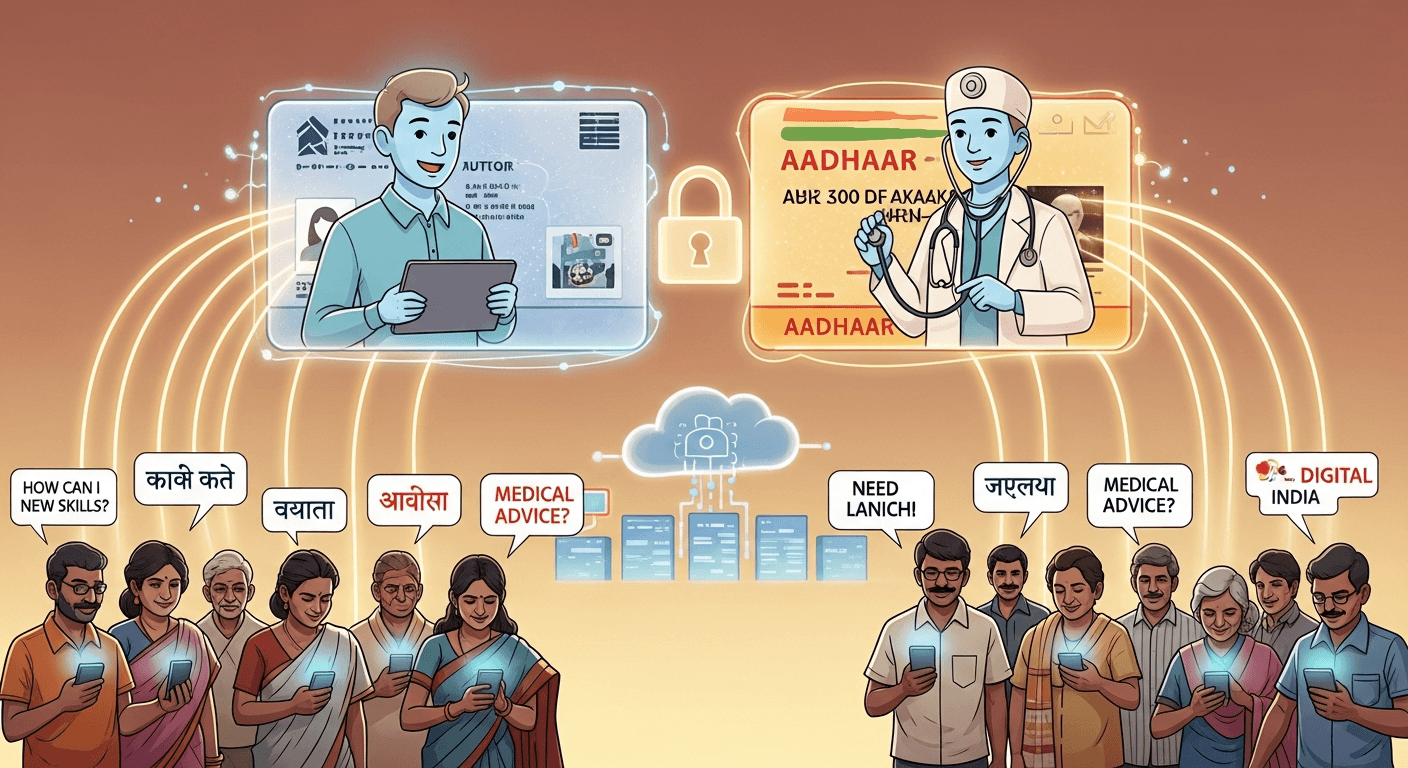
At a recent India AI summit, a prominent venture capitalist outlined a bold vision: within one to two years, AI-powered personal tutors, round‑the‑clock primary‑care doctors, and PhD‑level agronomy advice could be delivered to India’s entire population by integrating these services with the Aadhaar identity stack. I found the argument both electrifying and sobering. Exciting because the core technologies exist; sobering because execution will demand more than models and idealism.
The claim and context
The core claim is straightforward: modular, multilingual AI systems — scaled through a national ID and service layer similar to how Aadhaar enabled UPI — could provide near‑free, high‑quality tutoring, primary care triage and management, and agronomy support to hundreds of millions quickly. Proponents point to existing tutoring platforms and diagnostic models as proof that the building blocks are already here.
I’ve been writing about AI’s potential in education and healthcare for years; my own efforts to make tutoring accessible online are part of that conviction (My-Teacher.in announcement). I’ve also explored AI for healthcare infrastructure and priorities (AI for Healthcare). This current vision is a logical extension — but scale changes everything.
Feasibility: can it be done in 1–2 years?
Technically, many elements are already mature:
- Large language models, knowledge‑tracing systems and adaptive learning pipelines can assess and personalise instruction in minutes.
- Multimodal models (text, voice, images) can handle basic diagnostics and agronomy queries from photos and spoken inputs.
- Cloud and edge compute, plus conversational voice agents, support low‑cost distribution.
But moving from prototypes and pilot populations to 1.3–1.5 billion people in 24 months is an enormous leap. Constraints include localization into hundreds of dialects, rigorous medical validation, integration with government systems, and trustworthy offline/low‑bandwidth access. So feasibility exists in principle; feasibility at national scale in 1–2 years depends on coordinated policy, funding, and operational expertise.
Technology and infrastructure requirements
To make this real we need:
- Multilingual, low‑latency conversational interfaces (voice + text) with local dialect support.
- Robust multimodal models for image‑based diagnostics and crop analysis tuned to regional contexts.
- Scalable, audited data pipelines with secure identity linkage (if Aadhaar is used) that respect consent and allow user control.
- Edge solutions and offline modes for areas with poor connectivity, plus cheaper smartphones/IVR access.
- Clinician and teacher oversight workflows for escalation, ongoing human‑in‑the‑loop training, and continuous monitoring.
Potential benefits
- Massive improvements in access: students without good teachers and patients with no nearby clinics gain immediate first‑line support.
- Cost efficiency: AI can reduce routine workload, enabling scarce human experts to focus on complex cases.
- Personalization at scale: adaptive learning can close gaps far faster than one‑size‑fits‑all classroom methods.
- Agricultural resilience: real‑time, localized agronomy could boost yields and reduce losses for smallholders.
Risks and ethical concerns
- Privacy and surveillance: linking medical and educational interactions to a national ID raises profound privacy risks. Centralised logs of health and learning data are sensitive and could be misused.
- Safety and clinical responsibility: diagnostic errors or missed red flags can cause harm. Clear boundaries for what AI can decide and when human escalation is required are essential.
- Bias and coverage gaps: models trained on skewed datasets can underperform for marginalized groups or rare conditions.
- Overreliance and deskilling: users may defer too readily to AI, and professionals may lose critical hands‑on skills.
- Commercial capture: without nonprofit or public ownership, powerful platforms could monetise vulnerable populations.
Policy and regulatory considerations
If such a programme is pursued, policy must be front‑loaded:
- Strong data governance: purpose‑limited use, minimisation, secure storage, and audit trails are non‑negotiable. Consent architectures must be practical for low‑literacy users.
- Certification and clinical validation: independent clinical trials, staged rollouts, and continuous post‑deployment monitoring.
- Liability frameworks: who is responsible when an AI recommendation causes harm — the vendor, supervising clinician, platform operator, or government?
- Public ownership or nonprofit stewardship: a Section‑8 (nonprofit) build‑operate‑transfer model can reduce commercial conflicts while enabling rapid iteration.
- Pilot→scale approach: regional pilots with tight evaluation metrics before national transfer into any identity stack.
Conclusion
The vision of AI tutors, doctors, and agronomists reaching everyone is beautiful and achievable in parts. The technology is ready for scaled pilots; what’s not yet ready is our regulatory, governance and social infrastructure to do this safely, equitably and respectfully. If we move, let us move with humility: design for the poorest and most marginalised, protect privacy fiercely, and preserve human oversight where lives are at stake.
I remain optimistic. I have seen small, focused pilots transform access to tutoring and healthcare information; the question is whether we can scale those pilots into responsibly governed national services. I will continue to experiment, write and push for pilots that put the needs of the bottom half first — because good technology, thoughtfully deployed, can uplift millions.
Regards,
Hemen Parekh
Any questions / doubts / clarifications regarding this blog? Just ask (by typing or talking) my Virtual Avatar on the website embedded below. Then "Share" that to your friend on WhatsApp.
Get correct answer to any question asked by Shri Amitabh Bachchan on Kaun Banega Crorepati, faster than any contestant
Hello Candidates :
- For UPSC – IAS – IPS – IFS etc., exams, you must prepare to answer, essay type questions which test your General Knowledge / Sensitivity of current events
- If you have read this blog carefully , you should be able to answer the following question:
- Need help ? No problem . Following are two AI AGENTS where we have PRE-LOADED this question in their respective Question Boxes . All that you have to do is just click SUBMIT
- www.HemenParekh.ai { a SLM , powered by my own Digital Content of more than 50,000 + documents, written by me over past 60 years of my professional career }
- www.IndiaAGI.ai { a consortium of 3 LLMs which debate and deliver a CONSENSUS answer – and each gives its own answer as well ! }
- It is up to you to decide which answer is more comprehensive / nuanced ( For sheer amazement, click both SUBMIT buttons quickly, one after another ) Then share any answer with yourself / your friends ( using WhatsApp / Email ). Nothing stops you from submitting ( just copy / paste from your resource ), all those questions from last year’s UPSC exam paper as well !
- May be there are other online resources which too provide you answers to UPSC “ General Knowledge “ questions but only I provide you in 26 languages !


No comments:
Post a Comment