
Delhi declaration urges democratic AI for social good
I write this as someone who has long watched technology shift from niche labs into the daily fabric of societies. The New Delhi Declaration—adopted at the AI Impact Summit in February 2026—struck me as both a practical and moral turning point: it reframes AI not as a scarce strategic advantage but as a shared capability for public benefit. In this post I explain what the Declaration is, the principles it elevates, why it matters for governments, industry and civil society, and the concrete steps I believe we should take next.
What the Delhi Declaration is
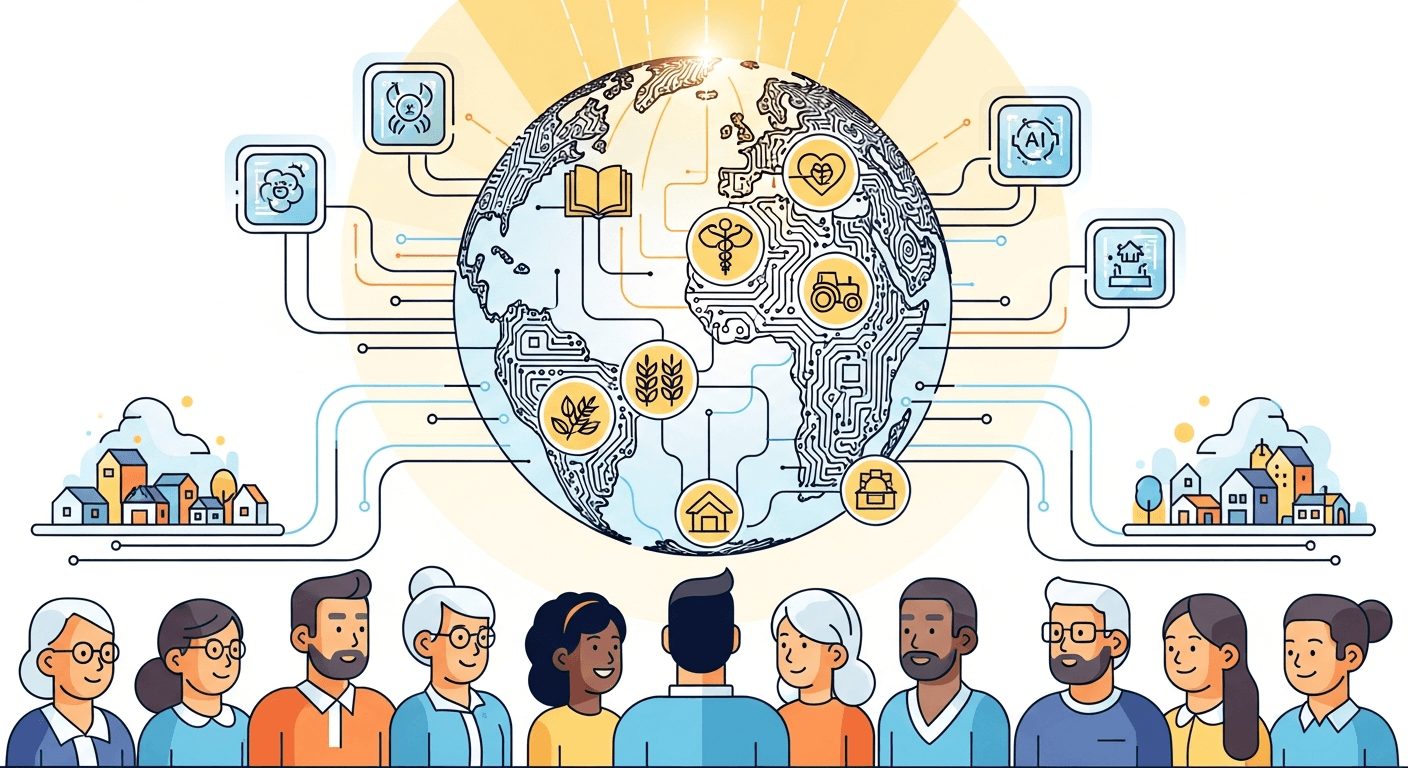
The Declaration is a voluntary, non-binding framework agreed by a large group of countries and international organisations that seeks to steer AI toward equitable economic growth and social good. It is organised around seven "chakras" (pillars) that include democratizing AI resources, promoting AI for economic and social benefits, ensuring secure and trustworthy systems, supporting AI-driven science, expanding access for social empowerment, developing human capital, and building resilient, energy-efficient AI infrastructure (see the official summit materials) [1].
This is not a treaty. Its power lies in shared norms, collaborative platforms proposed alongside it (for example, a Global AI Impact Commons and Trusted AI Commons), and a clear emphasis on diffusion—making compute, data, tools and know-how more widely available (and responsibly used) rather than hoarded [1][2].
Core principles I see reflected
- Democratic governance — broadened access to AI resources, and multistakeholder decision-making rather than single-party control (access as a democratic good) [1].
- Transparency — encouragement of shared best practices, benchmarks, and tool repositories so actors can inspect and learn [3].
- Accountability — lifecycle approaches that tie deployment to responsibility, monitoring and remediation.
- Fairness — a commitment to equitable distribution of benefits so AI does not deepen digital divides.
- Inclusivity — attention to languages, local contexts and capacity-building so solutions meet diverse needs.
These are high-level words, but the Declaration ties them to practical deliverables: playbooks for workforce development, repositories of vetted tools, and targeted platforms to replicate social-good applications [1][3].
Implications for governments, industry and civil society
Governments: The Declaration encourages states to invest in digital infrastructure, AI literacy and workforce reskilling. It also invites participation in shared repositories and voluntary standards—an attractive path for countries seeking pragmatic cooperation without ceding sovereignty [1].
Industry: Firms are invited to engage with open platforms (where appropriate), adopt trustworthy development practices, and collaborate on benchmarks that raise the floor for safety and fairness. The Declaration makes collaborative, reputation-sensitive governance more valuable than purely competitive secrecy [2][3].
Civil society and academia: NGOs, researchers and community organisations gain leverage: shared commons and playbooks lower the barrier to trialing high-impact use cases in health, education and agriculture, and provide common metrics to hold actors accountable.
Taken together, the Declaration nudges the ecosystem toward cooperative diffusion: shared building blocks, local adaptation, and accountable deployment.
Examples of AI for social good (practical and replicable)
- Medical triage and diagnostic assistance in low-resource clinics: models that flag high-risk cases for scarce specialists and accelerate referrals.
- Crop yield prediction and pest-detection tools tuned for local languages and crop varieties, helping smallholder farmers plan and reduce loss.
- Disaster response analytics that fuse satellite, phone and sensor data to prioritize relief efforts in real time.
- Language and literacy tools that scale instruction in dozens of understudied languages, improving access to information and services.
Platforms like the proposed Global AI Impact Commons aim to catalogue and share such proven use cases so governments and NGOs can replicate them more quickly and cheaply [1][2].
Challenges and recommended actions
Challenges:
- Resource imbalance: compute, datasets and talent remain concentrated.
- Governance fragmentation: voluntary frameworks are useful but must be paired with strong local oversight.
- Misuse risk: democratization without safeguards can enable harmful actors.
- Environmental cost: scaling AI can increase energy use unless guided by efficiency principles.
Recommended actions I advocate:
- Invest in regional compute and data infrastructure that is affordable and governed transparently.
- Fund and adopt shared repositories of vetted tools (Trusted AI Commons) paired with local audits.
- Scale workforce development through the Summit’s playbook: AI literacy, reskilling and public-official training.
- Require impact assessments and monitoring for public deployments, with clear remediation channels.
- Prioritize energy-efficient models and governance incentives that reward low-carbon AI.
Conclusion — a call to action
The New Delhi Declaration does not promise a perfect future, but it lays practical building blocks for one where AI is a public capability rather than a private lockbox. I am optimistic because the Declaration explicitly links lofty principles—fairness, inclusivity, accountability—to deliverables we can build: commons, playbooks, and networks for scientific collaboration. If you work in government, industry, civil society or research, my ask is simple: engage with these shared platforms, pilot responsibly, and insist on transparency and local adaptation. Collective stewardship is the only realistic path to ensure AI improves lives at scale.
References
- New Delhi Declaration — AI Impact Summit materials (Ministry of External Affairs) (official summit declaration) [1]
- Coverage and analysis of the Declaration and its "chakras" in national press [2]
- Reporting on the Global AI Impact Commons and Trusted AI Commons deliverables [3]
Regards,
Hemen Parekh
Any questions / doubts / clarifications regarding this blog? Just ask (by typing or talking) my Virtual Avatar on the website embedded below. Then "Share" that to your friend on WhatsApp.
Get correct answer to any question asked by Shri Amitabh Bachchan on Kaun Banega Crorepati, faster than any contestant
Hello Candidates :
- For UPSC – IAS – IPS – IFS etc., exams, you must prepare to answer, essay type questions which test your General Knowledge / Sensitivity of current events
- If you have read this blog carefully , you should be able to answer the following question:
- Need help ? No problem . Following are two AI AGENTS where we have PRE-LOADED this question in their respective Question Boxes . All that you have to do is just click SUBMIT
- www.HemenParekh.ai { a SLM , powered by my own Digital Content of more than 50,000 + documents, written by me over past 60 years of my professional career }
- www.IndiaAGI.ai { a consortium of 3 LLMs which debate and deliver a CONSENSUS answer – and each gives its own answer as well ! }
- It is up to you to decide which answer is more comprehensive / nuanced ( For sheer amazement, click both SUBMIT buttons quickly, one after another ) Then share any answer with yourself / your friends ( using WhatsApp / Email ). Nothing stops you from submitting ( just copy / paste from your resource ), all those questions from last year’s UPSC exam paper as well !
- May be there are other online resources which too provide you answers to UPSC “ General Knowledge “ questions but only I provide you in 26 languages !



No comments:
Post a Comment