
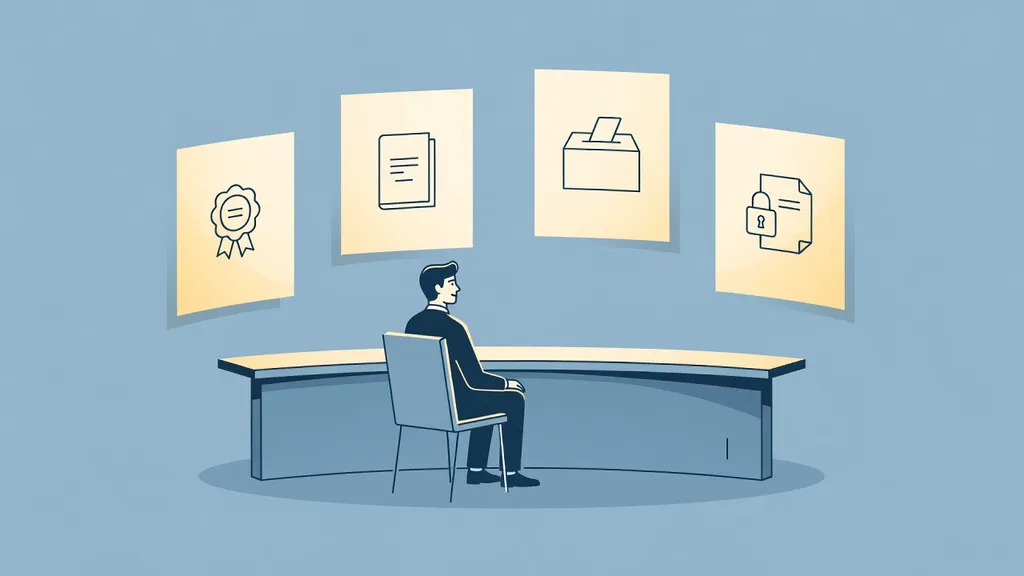
Mint's campus story of 28 November 2026 is not about the pay. It is about the question paper: Nvidia's reinstated chief executive, H-1B curbs, the US midterms, third-party AI tools under the DPDP Rules. Four questions needing four documents no Indian college teaches together. Set against 18% attrition and a projected 9.1% increment for 2027, I repeat one ask — a single, assessed, portable AI-readiness credential, so a tier-II student in Bhubaneswar can be seen at all.
A final-year MBA student at a tier-2 Bhubaneswar business school, sitting before a financial services and enterprise AI firm, was asked whether the Democrats' midterm win would slow innovation through stricter AI regulation. That is not a campus question. That is a policy-desk question with a salary attached to the answer.
Mint's Rudrani Chattopadhyay reported this morning (28 November 2026, 06:31 IST) that the 2027 batch is fielding four questions of this kind:
Should Nvidia have reinstated Jensen Huang despite the controversy over his personal conduct? Would you move to the US despite H-1B visa curbs? How should companies respond to the Democrats' victory in the US midterm elections and its implications for AI regulation? Can third-party AI tools be trusted with sensitive company data under India's new data protection rules?
I read that list as a syllabus, not a stunt. Four questions, four documents: a company's code of conduct (Mint notes Huang resigned in early November over personal misconduct and was reinstated on 23 November, before the interview took place), a visa regime, a foreign election result, and the DPDP Rules notified in November 2025, which require firms to disclose personal-data use, obtain consent and safeguard against breaches. No Indian engineering college teaches those four together. And look where the candidates sat — tier-II schools in Kolkata, Bengaluru and Bhubaneswar.
Narayanan Ramaswamy of KPMG India gave Mint the reason in one sentence: "With AI taking over more routine tasks, decision-making skills are now important even at junior levels." Juniors, he added, can no longer wait for a senior's step-by-step instructions. In the same report, and new to me, are these figures from Aon:
| Aon, via Mint, 28 November 2026 | Figure |
|---|---|
| Attrition across India Inc, 2026 | 18%, against 16.2% in 2025 |
| Average salary increase, 2027 (projected) | 9.1%, against an actual 9% in 2026 |
The ₹90 lakh–₹1 crore specialist band against ₹60–70 lakh appears in the same story, and I used it two days ago in AI takes the campus rung before Day Zero (26 November 2026). I will not spend it again. The band is the least interesting sentence in the report. Eighteen per cent attrition is the interesting one: a firm losing one employee in five cannot go on choosing by college name. The Economic Times' job-market tracker on 27 November 2026 carried SAP's plan to cut about 10,000 posts, roughly 9% of staff, and JPMorgan's illustrative scenario of 24 million knowledge-worker jobs at risk worldwide over five years.
So the ask I keep making sharpens. In The AI job scare is really a fresher problem (7 November 2026) I narrowed my National Employment Grid to three things, the third being that score carried as a portable credential, so a hiring manager reads readiness and not a college's name. Mint's question paper now tells us what that credential should examine. I would suggest:
- One national AI-readiness assessment, sat once, scored to a percentile valid for three years, with a compulsory case section drawn from exactly four documents — a code of conduct, a visa regime, a foreign election, a data law.
- A published rubric, and every question paper released after the test, so preparation stops being a fee paid to a coaching centre that somehow knows the pattern.
- The score carried as a verifiable certificate, checkable in minutes, so a student in Bhubaneswar is read as a rank before he is read as a pincode.
I may be wrong that one credential can hold four arguments at once. But a question only an interviewer in a tier-1 room gets to ask is a filter wearing the costume of a test. Score it, publish the mark, and let the whole queue see who thought well.
With regards,
Hemen Parekh
www.Iam-Immortal.ai / www.IndiaAGI.ai / www.YourContentCreator.in
28 Nov 2026
No comments:
Post a Comment