
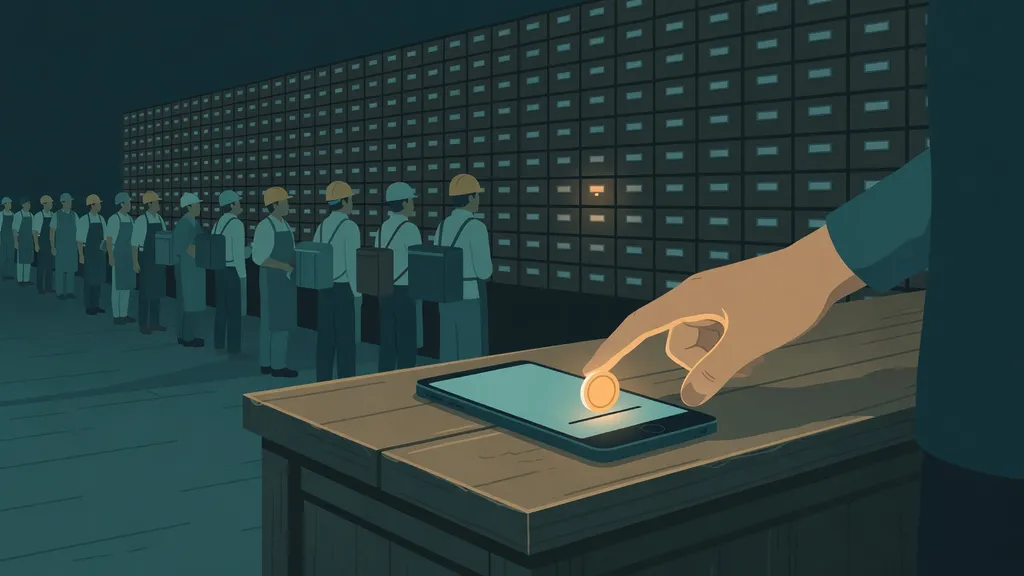
Two EPFO decisions land on the same morning and only make sense read together. The court-ordered higher pension will cost an extra ₹1.109 lakh crore, and four years on only 1,51,874 pension payment orders exist. The Central Board of Trustees will also weigh a systematic withdrawal plan — and, hidden inside it, UAN-linked micro-contributions from tips and gifts. That quiet clause, I believe, is the universal social security scheme I first sketched in 2017, funded not by the exchequer but by the ₹20 tip. I suggest a round-up default to make it real.
Two EPFO papers reached me on the same morning, and I do not think the timing was an accident. One is a bill. The other is a doorway.
The bill first. Four years after the Supreme Court's judgment on pension based on higher wages, The Hindu reported on 19 November 2026 that the EPFO has told its Central Board of Trustees it
“may have to spend an additional ₹1.109 lakh crore to implement the order and pay higher pensions to about 4.45 lakh applicants.”
The queue behind that number, as the same report sets it out:
- applications for higher pension considered: 15.24 lakh
- demand letters issued by 13 November: 4,45,471
- pension payment orders issued: 1,51,874
I do not begrudge a rupee; these members contributed on higher wages in good faith, and a court has spoken. But notice the shape of it: retrospective, litigated, slow, and open only to people already inside the organised fold. Only about a third of those who received a demand letter hold a pension order.
Now the doorway. On Thursday the same Board, chaired by Labour Minister Mansukh Mandaviya, will weigh a Systematic Withdrawal Plan reported by The Times of India and The Indian Express on 19 November 2026. Instead of withdrawing the entire corpus within three years of retirement, after which the account turns inoperative and stops earning interest, a member may leave it in the EPF and draw monthly, quarterly or annually — or take the interest alone, or stop whenever he likes. A nominee can continue on the same terms. The Indian Express puts the first-phase pool at 6.32 lakh members above 55 holding over ₹5 lakh each, and records the officials' point that the plan creates no recurring liability on the government, the EPFO or the pension fund.
Buried in that same agenda is the clause that made me sit up. Voluntary contributions will need no employer matching, and third-party micro-payments — “tips, gifts, gratuities, and similar payments”, in the words of the officials quoted — will be allowed straight into an EPF account through UAN-linked digital payment mechanisms. The workers named are gig, platform, construction, domestic, street-vendor and home-based.
In July 2017, in “How to Universalize Social Security?”, I proposed crediting a slice of every digital payment to the buyer's PPF or EPF account, and closed with a line I still hold to: “In this way, Social Security will become ‘Self Financing’!” I did not expect the ₹20 tip to be the door it came in through. In April 2026, in “EPFO & ESIC for Unorganised”, micro-contribution pathways were still an option under discussion. The circular has arrived before the discussion ended.
If the tip is to carry a universal pension, three small things will decide it:
- A round-up switch, on by default, in every UPI app: the change to the nearest ₹10 goes to the worker's UAN unless he turns it off.
- A second line on every counter QR — the customer's tip reaches the worker, and the platform credits an equal micro-amount to that same UAN.
- A balance he can actually see in the EPFO app, with nominee continuation and no monthly minimum.
Telangana has already shown the politics of the small slice. On 14 November 2026 it launched a gig workers' scheme with ₹5 lakh accident cover, ₹10 lakh health cover and 1% of every transaction routed to a welfare fund, as The Hindu reported. The EPFO is arriving at the same principle from the other direction.
The ₹1.109 lakh crore is the price of the last settlement. The ₹20 tip is the seed of the next one. I would suggest Mr Mandaviya's Board approve both on the same afternoon, and say plainly which of the two can scale.
With regards,
Hemen Parekh
www.Iam-Immortal.ai / www.IndiaAGI.ai / www.YourContentCreator.in
19 November 2026
No comments:
Post a Comment